


Launched (by surprise) in July 2025, the Sony RX1R III marks the revival of a line of full frame compact camera that many believed had been dead for nearly a decade.
This camera, built around a 61 MP full-frame sensor, stands out thanks to its impressive compactness and banks on a high-performance autofocus system to hold its own against premium competition.
But in the field, do the performances live up to the promise? Do the compromises Sony had to make have a real impact? Is this camera well-equipped enough to earn a spot in the bag of demanding photographers? The answer in our full review of the Sony RX1R III.
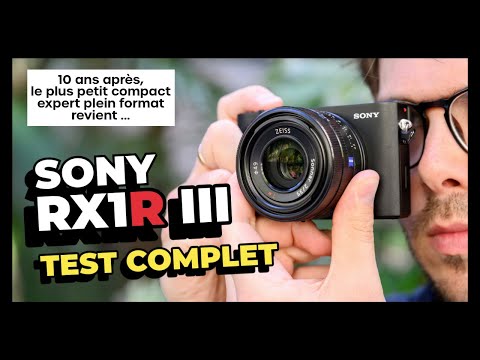
Watch our video review of the Sony RX1R III (in French):
Sommaire
- Sony RX1R III, the endless wait
- Ergonomics: the king of compactness
- Performance and image quality of the RX1R III
- Lens quality of the Sony RX1R III
- Autofocus and tracking of the Sony RX1R III
- Burst rate and buffer
- Rolling shutter
- Sony RX1R III: stabilization neglected
- Video: the RX1R III, a backup camera
- Limited battery life… and limiting
- Connectivity and storage
- Sony RX1R III: the most appealing and the most frustrating compact camera
Sony RX1R III, the endless wait
At the end of summer 2012, Sony unveiled the RX1, the first camera to pack a full-frame sensor into a body barely larger than a “mere” small-sensor compact. It preceded Leica and its Q (Type 116) by 3 years. Then came the RX1R II in 2015, featuring a built-in viewfinder. And… nothing more. For nearly a decade, this lineup seemed abandoned. But in July 2025, Sony came back, almost by surprise, with the RX1R III.
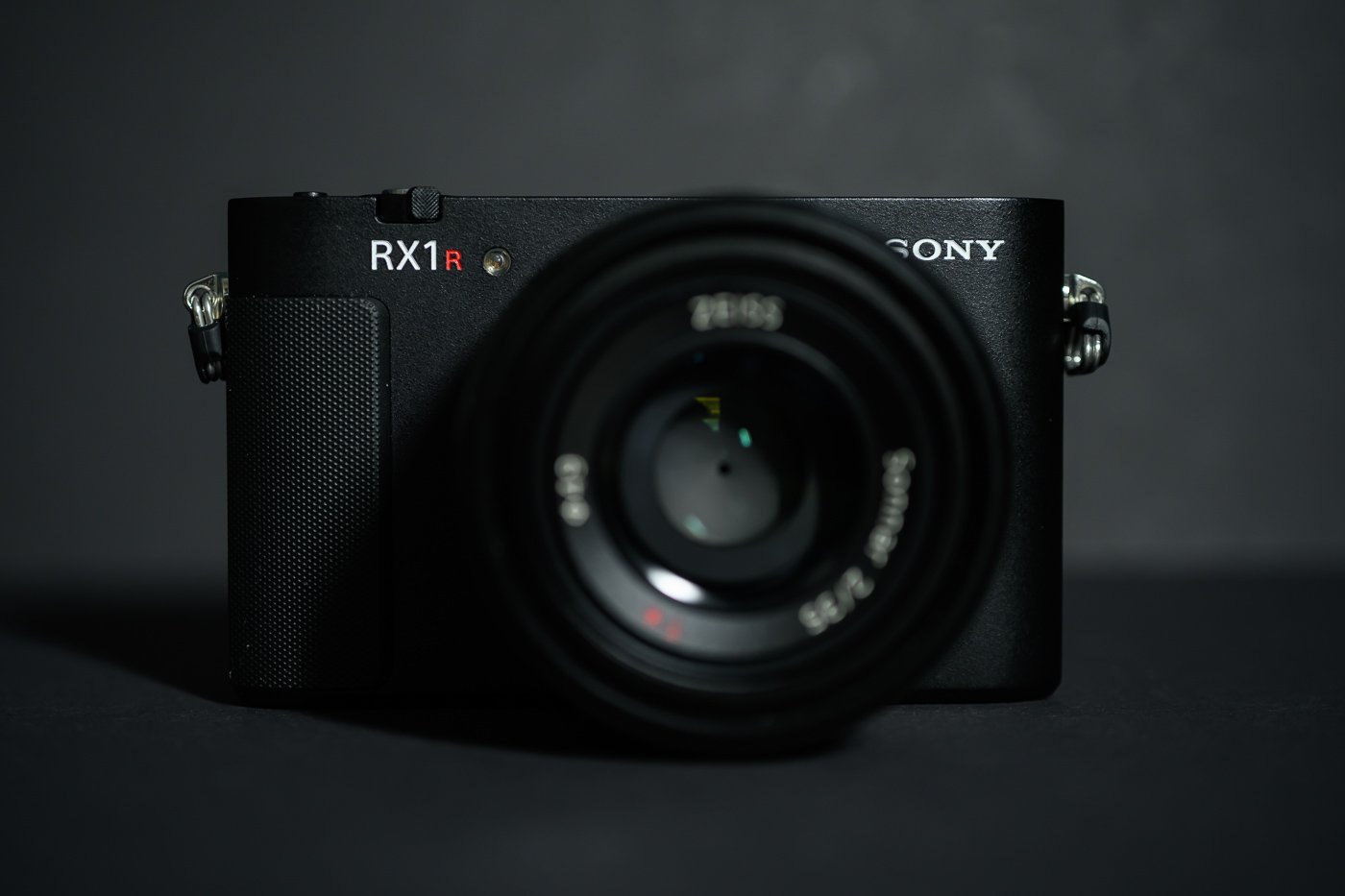
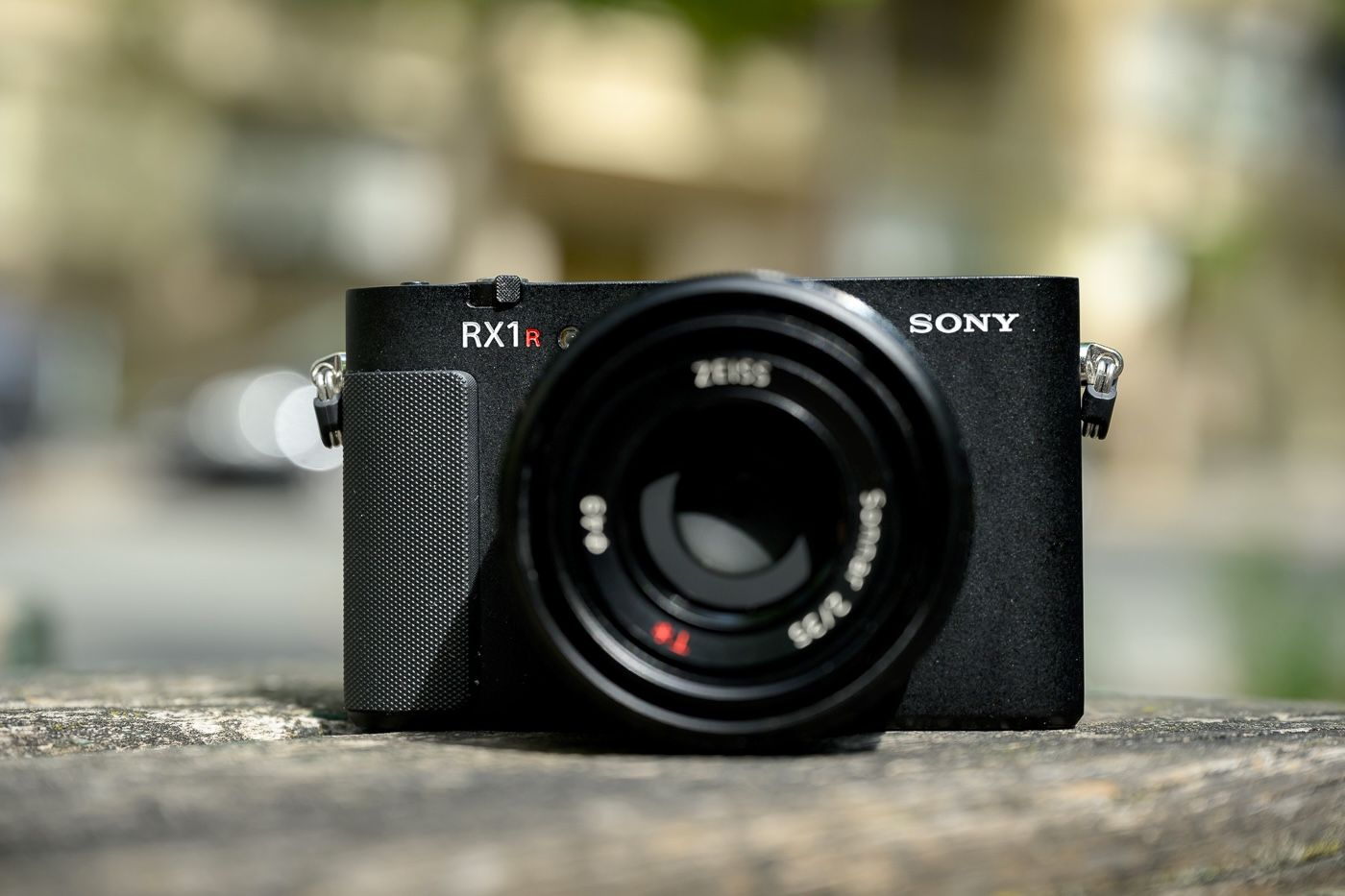
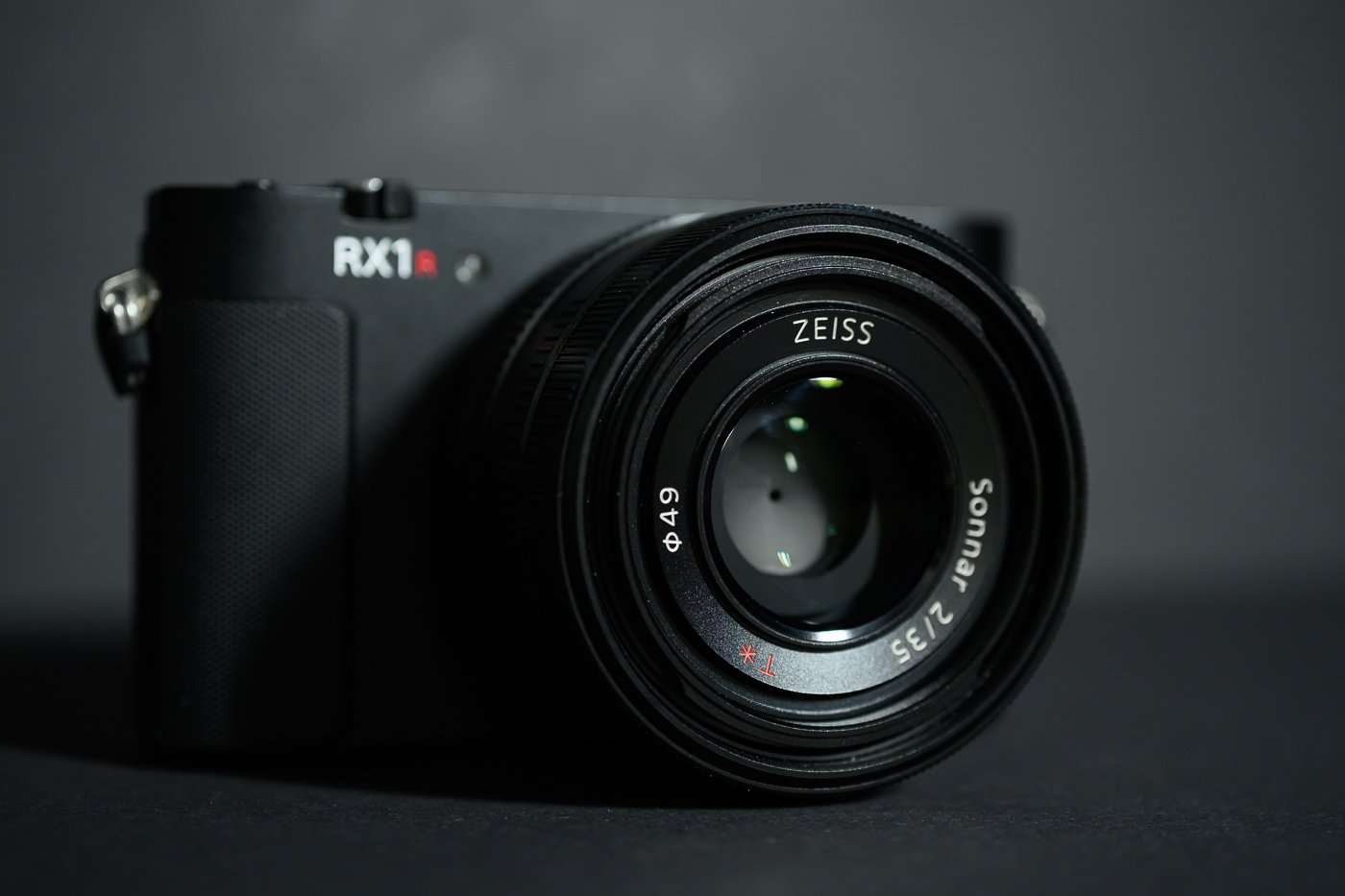
To put it simply, the RX1R III carries over most of the elements that already made the RX1 so appealing. We already mentioned the very compact form factor; we can also point to the minimalist controls, the fixed screen, and of course the Zeiss Sonnar T* 35mm f/2 fixed lens.
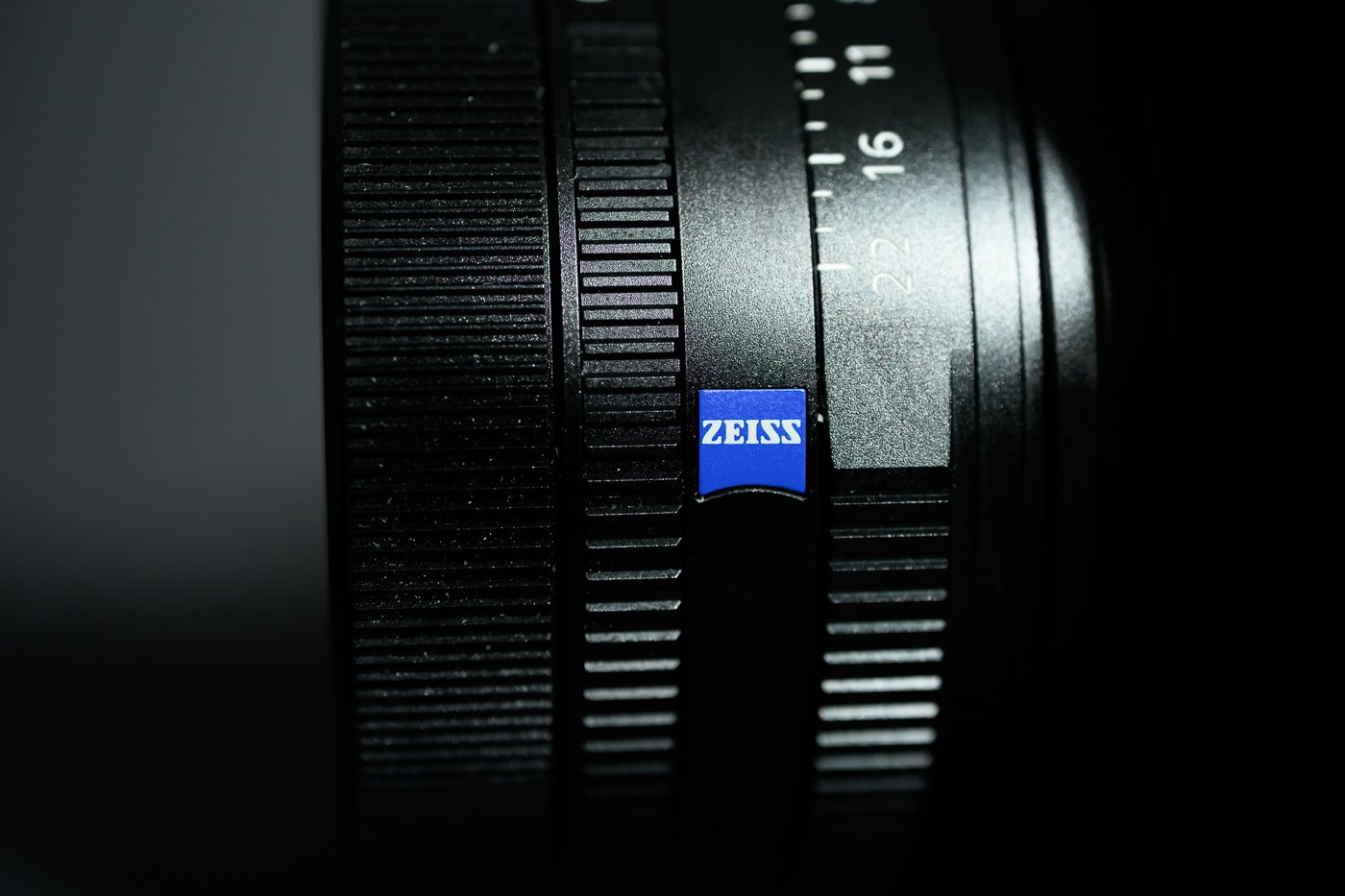
Yes, much like Leica and its Summilux 28mm f/1.7 ASPH fitted to its Leica Q cameras for the past 10 years, Sony stays faithful to its lens with Germanic heritage. This raises a double question: is this lens – and its optical formula of 8 elements in 7 groups – capable of handling the 61 MP of the Exmor R BSI sensor?
Likewise, what about the autofocus speed? Until now (and even accounting for the age of these bodies), the RX1 series was never known for fast autofocus. On this front, Sony highlights its AF algorithms, boosted by a dual Bionz XR CPU and an AI chip – all directly carried over from the brand’s latest mirrorless cameras.
On the other hand, the complete absence of stabilization (sensor or optical) is a valid criticism. This shortcoming, combined with a high-resolution full-frame sensor, can prove risky – especially in low light. Something we already lamented on the recent Fujifilm GFX100RF, by the way.
Still, it’s hard not to find a certain appeal to this Sony RX1R III. Its compactness will allow discerning (and well-heeled) street photography enthusiasts to slip it into a coat pocket with no problem at all. Professionals on assignment may also be tempted by a discreet camera that delivers outstanding image quality.

Obviously, wildlife, sports, or even video specialists will be less impressed, but they were never really the target audience of premium compact cameras.
Here are the detailed specifications of the Sony RX1R III compared to the RX1R II:
| Sony RX1R III | Sony RX1R II | |
|---|---|---|
| Capteur | 24x36 Exmor R BSI 61 Mpx | 24x36 Exmor R 42,4 Mpx |
| Filtre passe-bas | non | non |
| Processeur | 2x Bionz XR + puce IA | Bionz X |
| Viseur électronique | OLED de 2,36 Mpts, 0,7x | OLED de 2,36 Mpts, 0,74x |
| Ecran LCD | 3 pouces, 2,36 Mpts, fixe | 3 pouces, 1,23 Mpts, inclinable |
| Autofocus | AF hybride à détection de phase + contraste | AF hybride à détection de phase et contraste |
| Nombre de points AF | 693 points AF | 399 points AF |
| Couverture AF | 78 % | 45 % |
| Plage AF | -4 à 20 EV | N.C. |
| Sensibilité | 100 à 32 000 ISO (extensible de 50 à 102 400 ISO en photo) | 100-25 600 ISO (extensible de 50 à 102 400 ISO) |
| Obturateur | central et électronique | central et électronique |
| Rafale (obturateur mécanique) | 5 i/s | 2,5 i/s |
| Mode haute résolution | non | non |
| Obturation | 30 s – 1/8000 s | 30 s - 1/4 000 s |
| Stabilisation, gain | non | non |
| Vidéo | 4K UHD 30 fps, Full HD jusqu’à 120 fps | Full HD 60 fps |
| Profils colorimétriques vidéo | 12 Film looks, S-Log 3, S-Cinetone | 12 Film looks |
| Stockage | 1x slot SD UHS-II | 1x slot SD UHS-I / memory stick |
| Connectivité sans-fil | Wifi 2,4 et 5 Ghz, Bluetooth 5.0 Low Energy | Wifi 2,4 Ghz, NFC |
| Connectivité filaire | USB-C, micro HDMI, prise micro | microUSB, micro HDMI, prise micro 3,5 mm |
| Batterie | NP-FW50 (270 / 300 vues) | NP-BX1 (200 / 220 vues) |
| Rechargement par port USB | Recharge et alimentation directe USB-C | Recharge microUSB |
| Tropicalisation | N.A. | N.A. |
| Dimensions (L x H x P) | 113,3 x 67,9 x 87,5 mm | 113,3 x 65,4 x 72,0 mm |
| Poids (batterie + SD inclus) | 498 g | 480 g |
| Prix au lancement | 4899 € (juillet 2025) | 3599 € (octobre 2015) |
| Objectif | Zeiss Sonnar T* 35 mm f/2 | Zeiss Sonnar T* 35 mm f/2 |
Ergonomics: the king of compactness
The Sony RX1R III truly lives up to its “compact” designation! Even more so than the Leica Q3 or the Fujifilm X100VI, the RX1R III is genuinely… small.
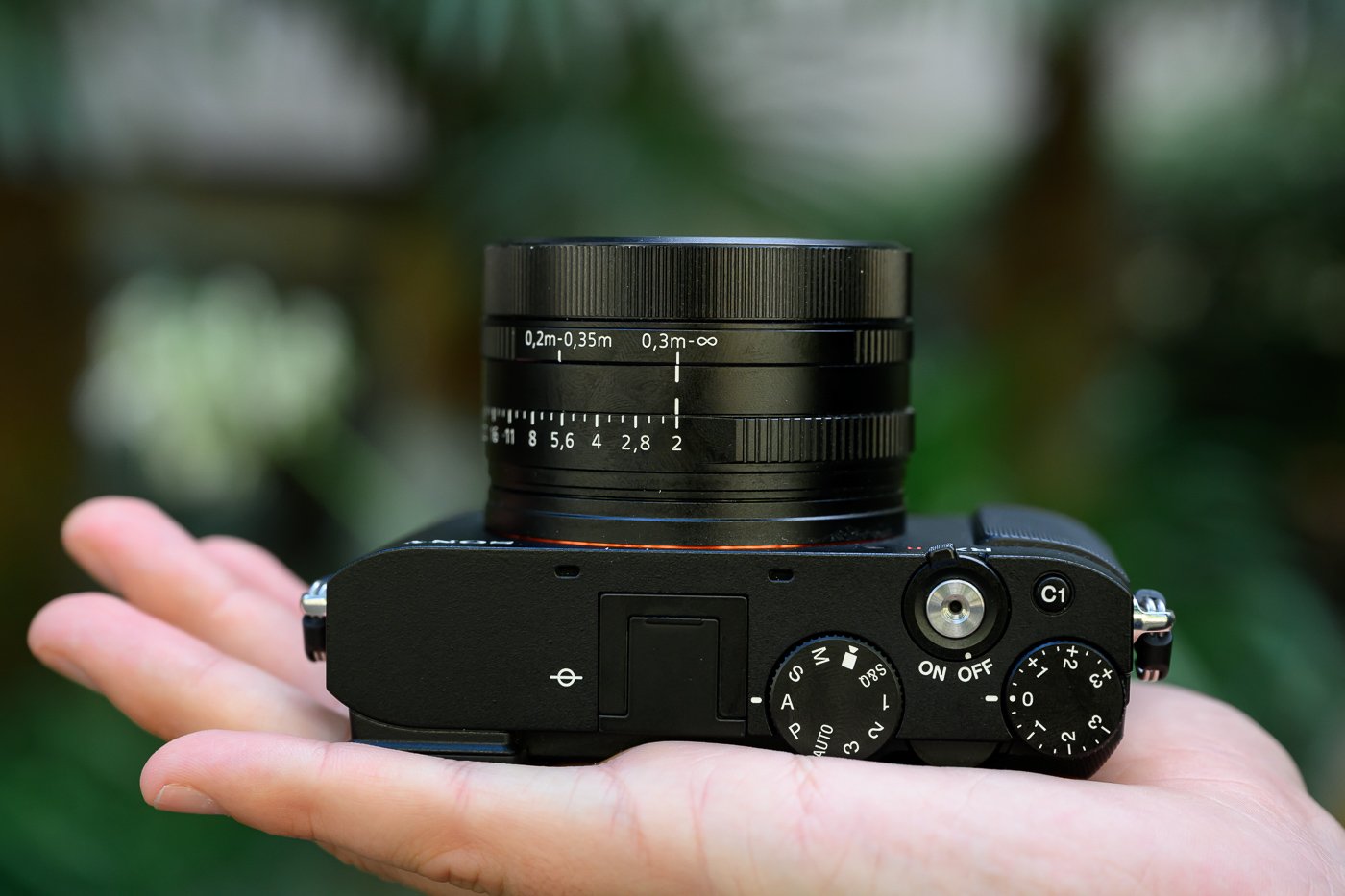
Indeed, at 11 cm wide, 6.8 cm tall, and 8.7 cm deep, weighing in at just 498 g, it plays in almost the same league as the Ricoh GR III. For comparison, the Leica Q3 weighs nearly 300 g more!
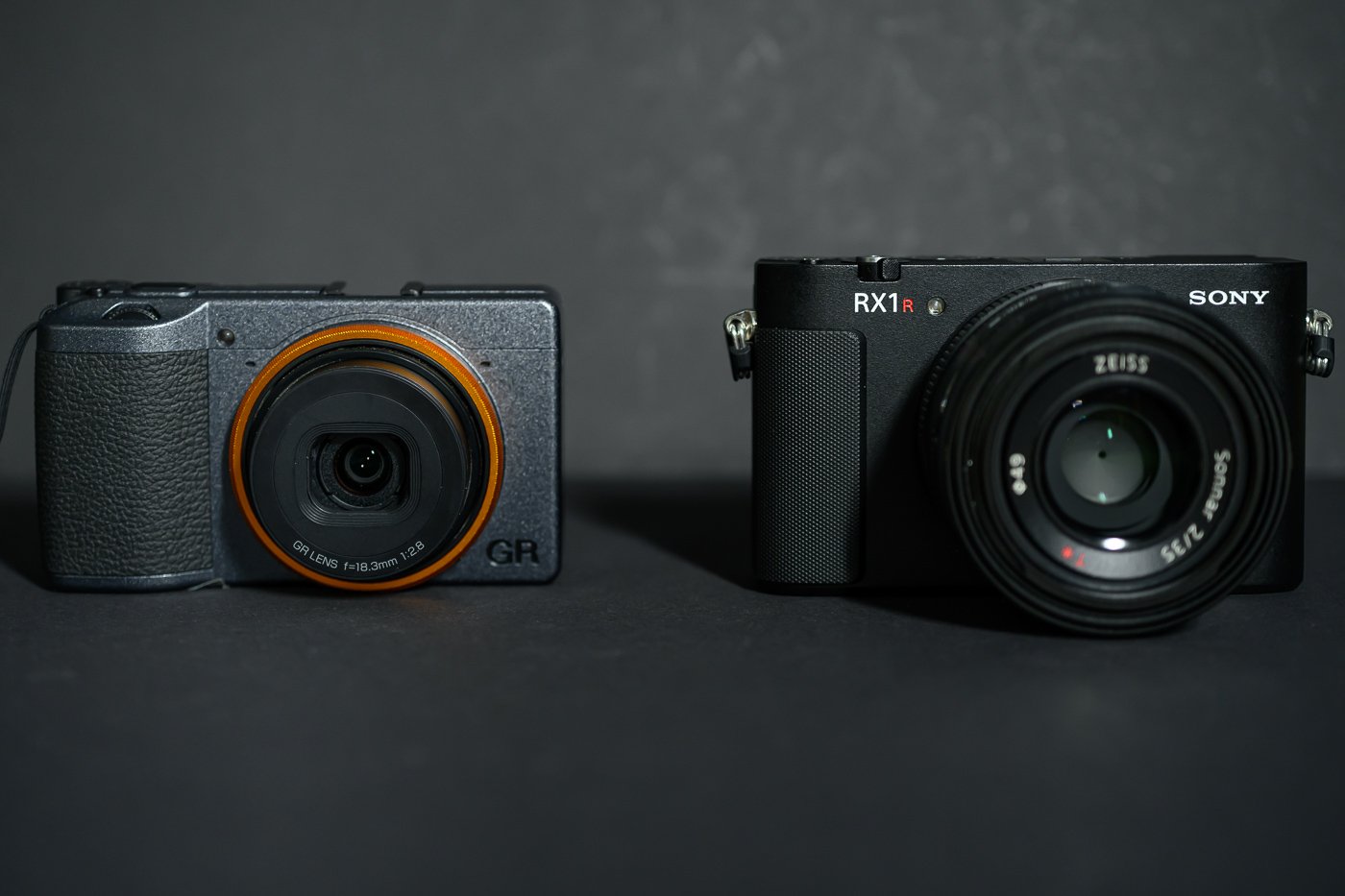
Barely larger than its predecessor, it can still fit into a jacket pocket. On the street, it’s very easy to go unnoticed. Very few passersby would imagine that inside this small body lies a “gigantic” full-frame sensor.
Those with larger hands might have appreciated an extra centimetre or two in height for a more secure grip. On this note, it’s a shame Sony didn’t think to design a small grip extension like the one included with the A7C II / A7C R… which would have been more useful than the various accessories the brand offers at a ridiculously high price.
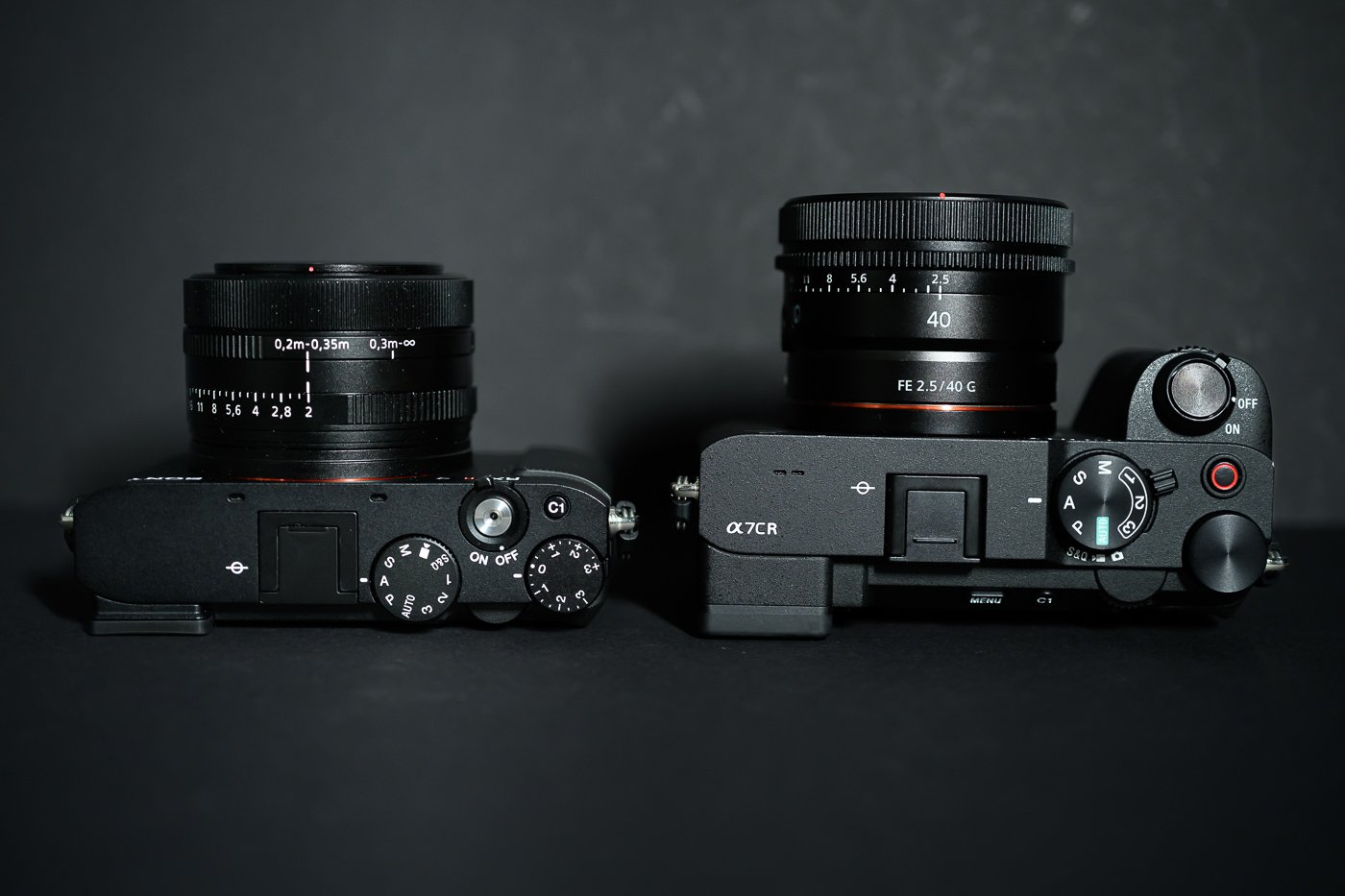
Made in Japan (a first for Sony in 10 years), the camera boasts a high level of build quality. It sits in line with the brand’s mirrorless cameras. Similarly, and somewhat like Ricoh here as well, Sony bets more on compactness than on aesthetics to stand out, whereas Leica or Fujifilm capitalize also (or even primarily) on vintage design and a high level of finish.
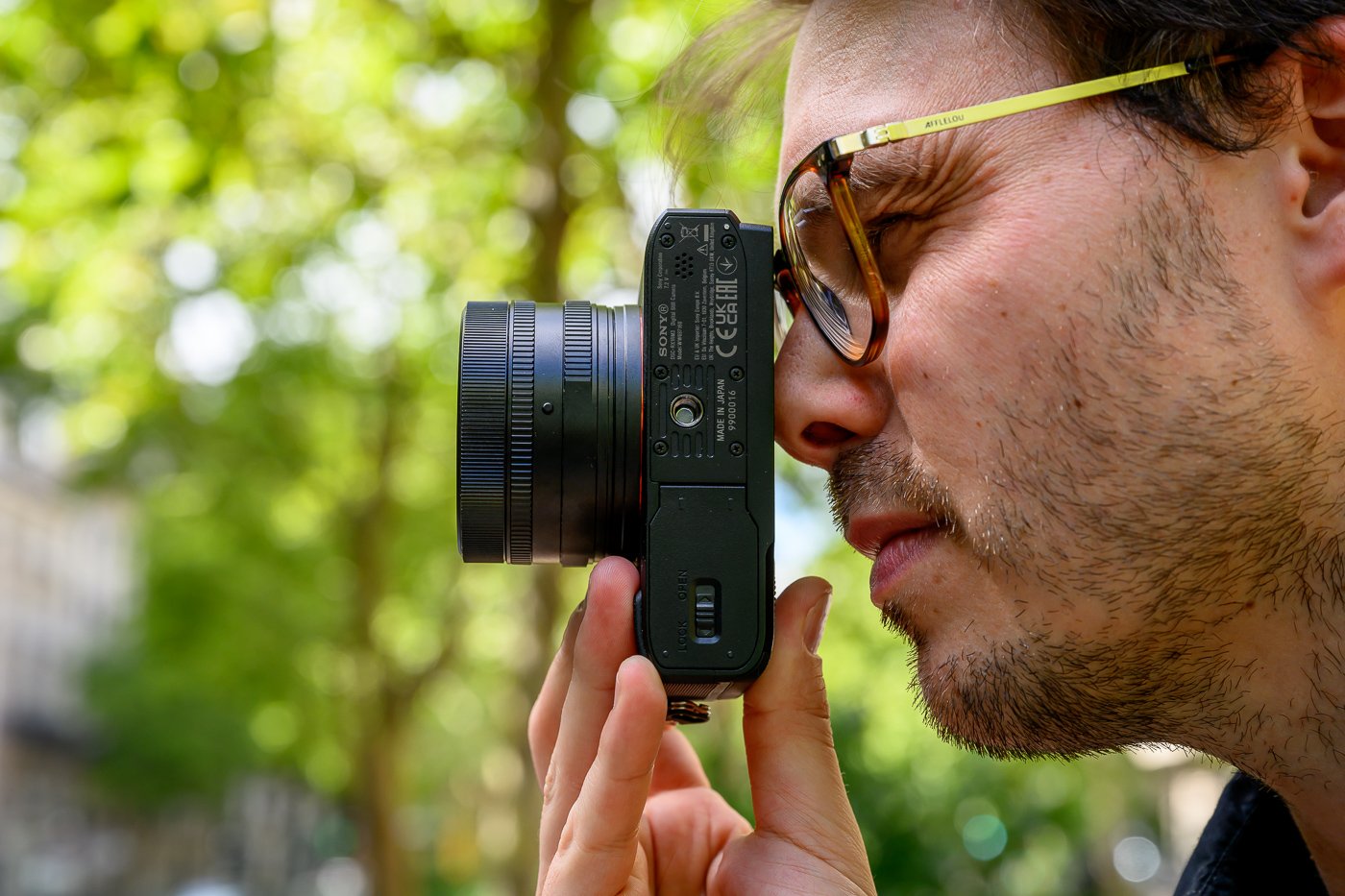
The front of the body is very stripped-down, as Sony chose to remove the focus mode selector previously found on its RX1 cameras.
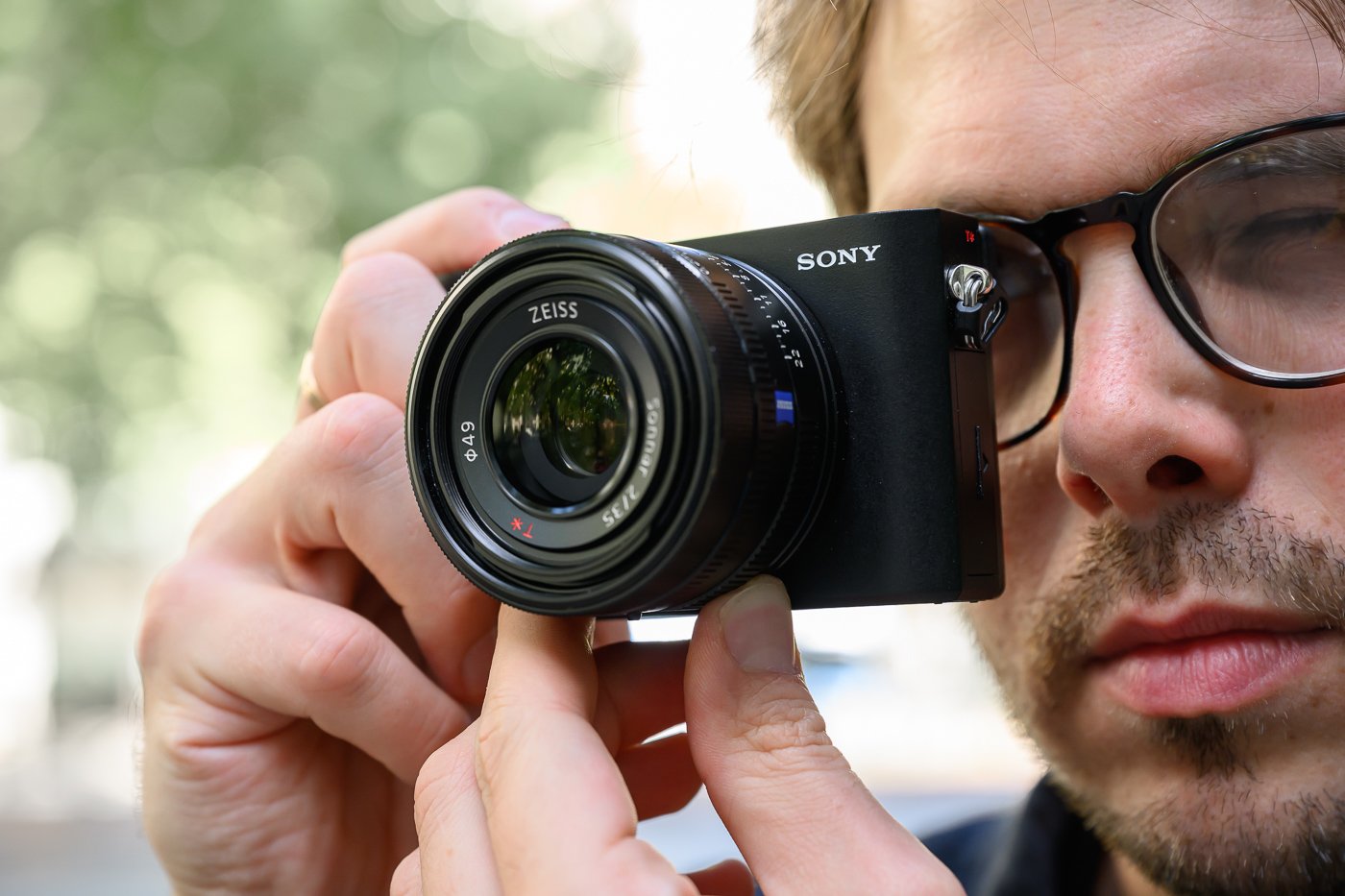
To compensate for the lack of a proper grip, Sony placed a small textured pad that ensures a solid hold on the camera. Even though the lens appears almost oversized relative to the rest of the body, the handling isn’t unbalanced. We note here the only flaw in terms of build quality. Sony didn’t opt for faux leather, but rather for a plain, very cheap-feeling rubber carried over from the previous generation.

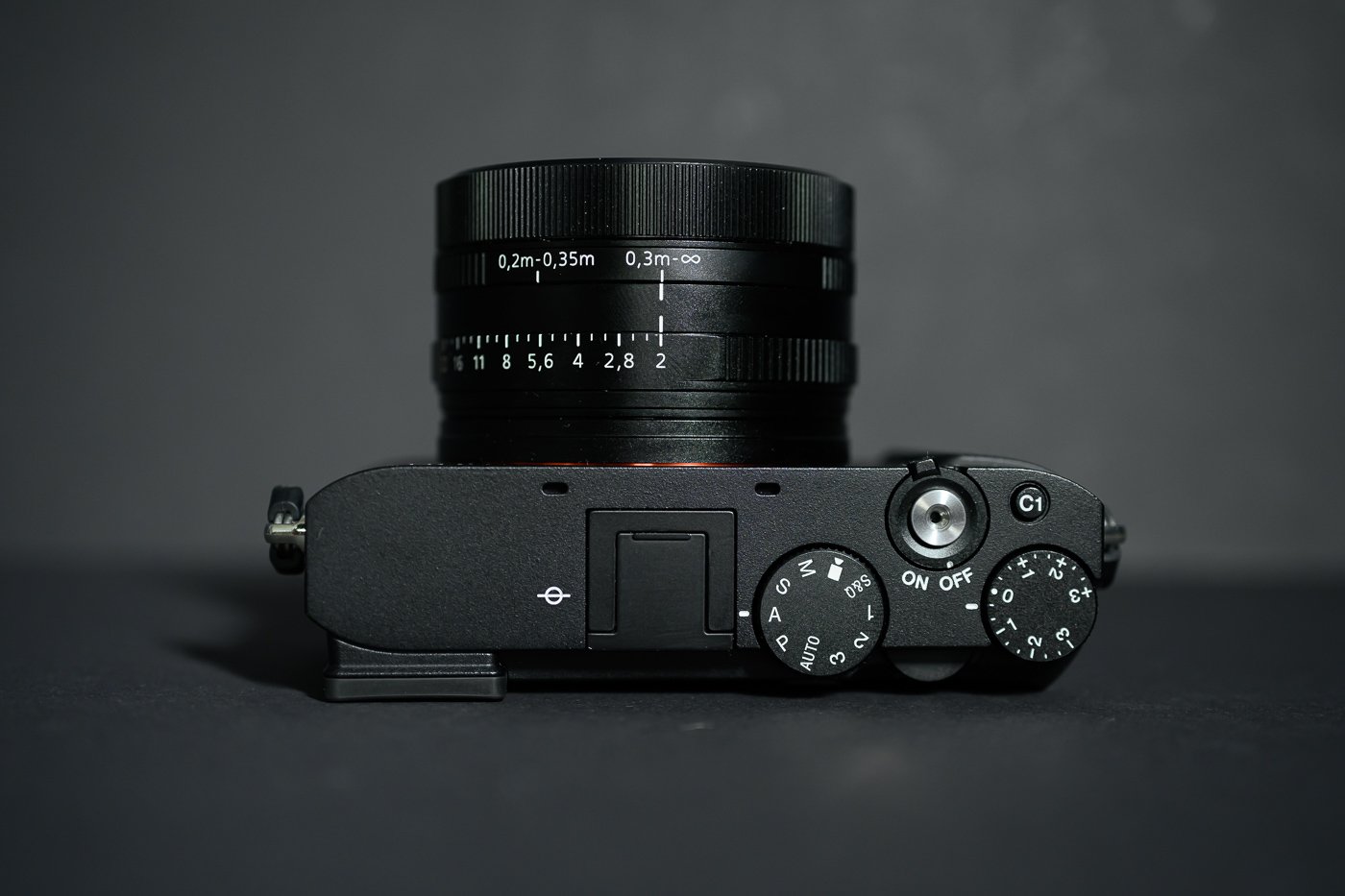
The top plate is equally minimalist. We find the shutter button flanked by the power lever. Noteworthy here is the small threaded socket for mounting a soft release button or a custom button. There’s also a customizable C1 button, an exposure compensation dial, and the PASM mode dial.
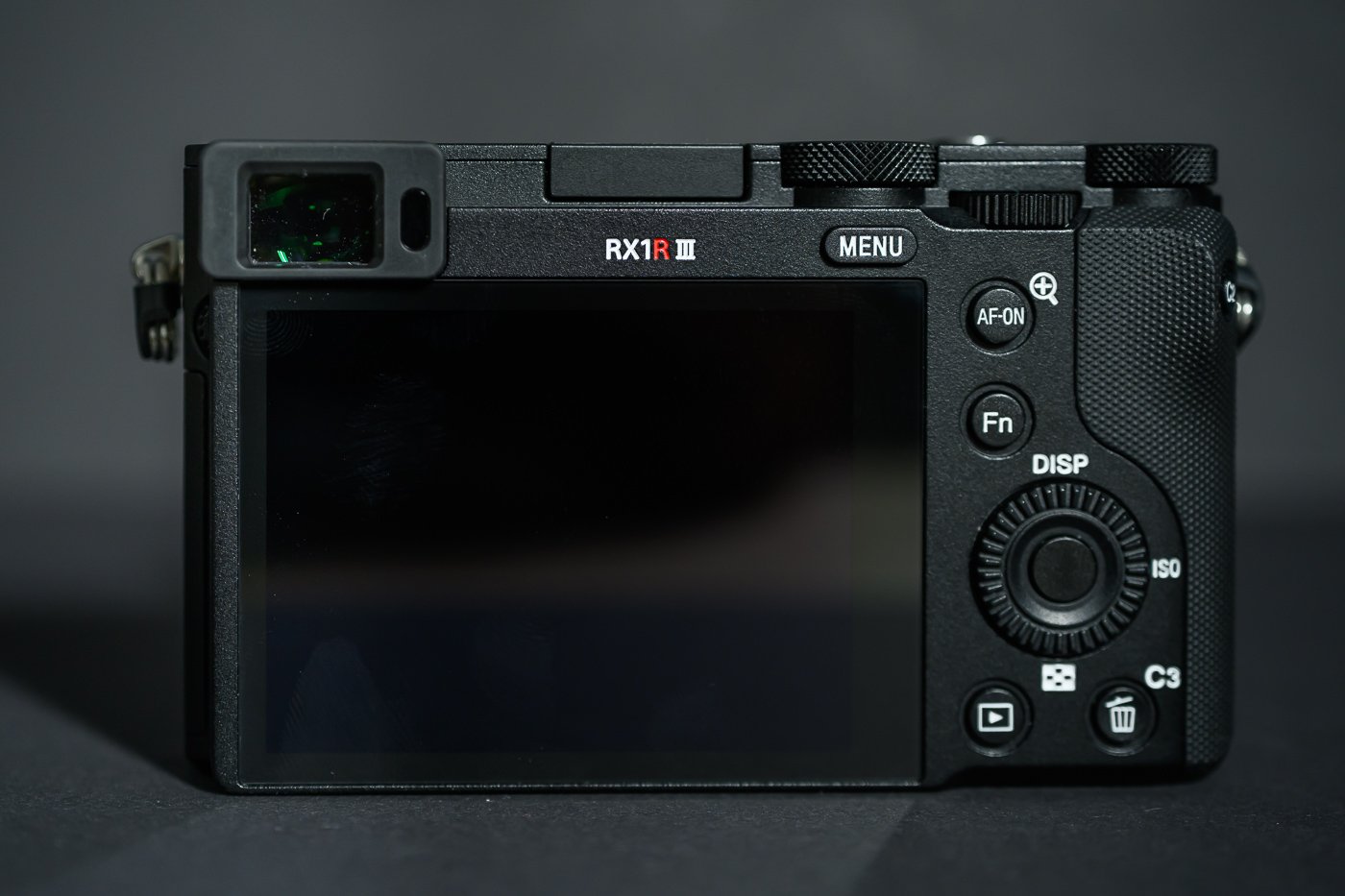
On the back, controls are kept to a bare minimum. A control wheel, a few customizable buttons, and the standard buttons (playback, menu, delete, etc.). We regret the absence of a joystick: moving AF points will have to be done through the 3-inch touchscreen. The latter sees its resolution increase to 2.36 Mdots (1090×730 px, 3:2), making it one of the monitors with the sharpest image on the market, rivalling a camera like the Hasselblad X2D 100C!
HOWEVER, the tilting screen of the RX1R II has become… fixed. Undoubtedly to minimize the overall footprint, Sony returns to a choice already made on the first RX1 models. Yet, the Mark II wasn’t exactly bulky, and its tilting screen was perfectly functional.
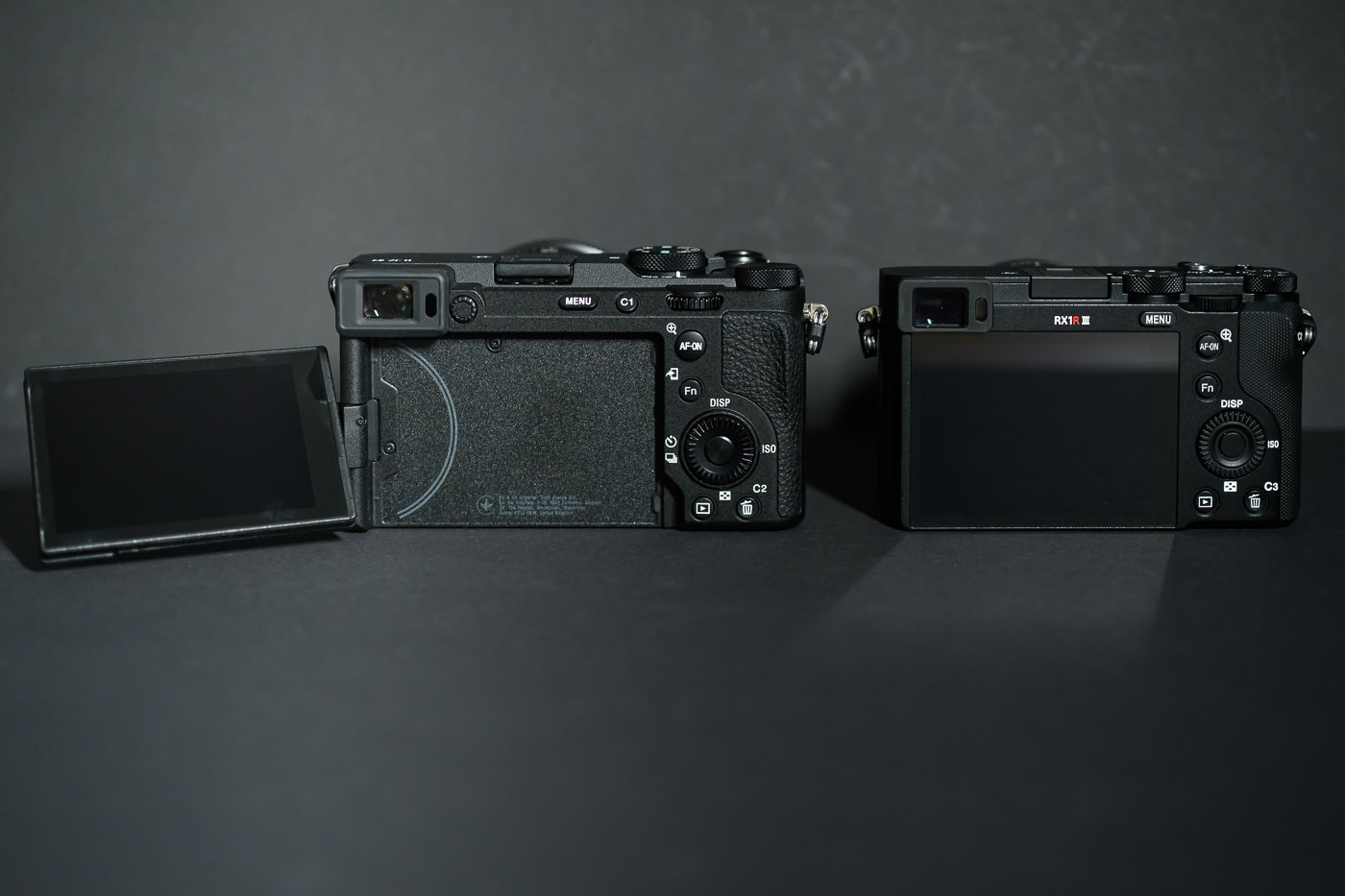
The return to a non-tilting screen is quite baffling – especially since it significantly limits discreet street photography where you might want to shoot from the hip. Some will argue that Leica only introduced a tilting screen with the Q3, or that the Leica M cameras have never had (and likely never will have) an articulating screen.
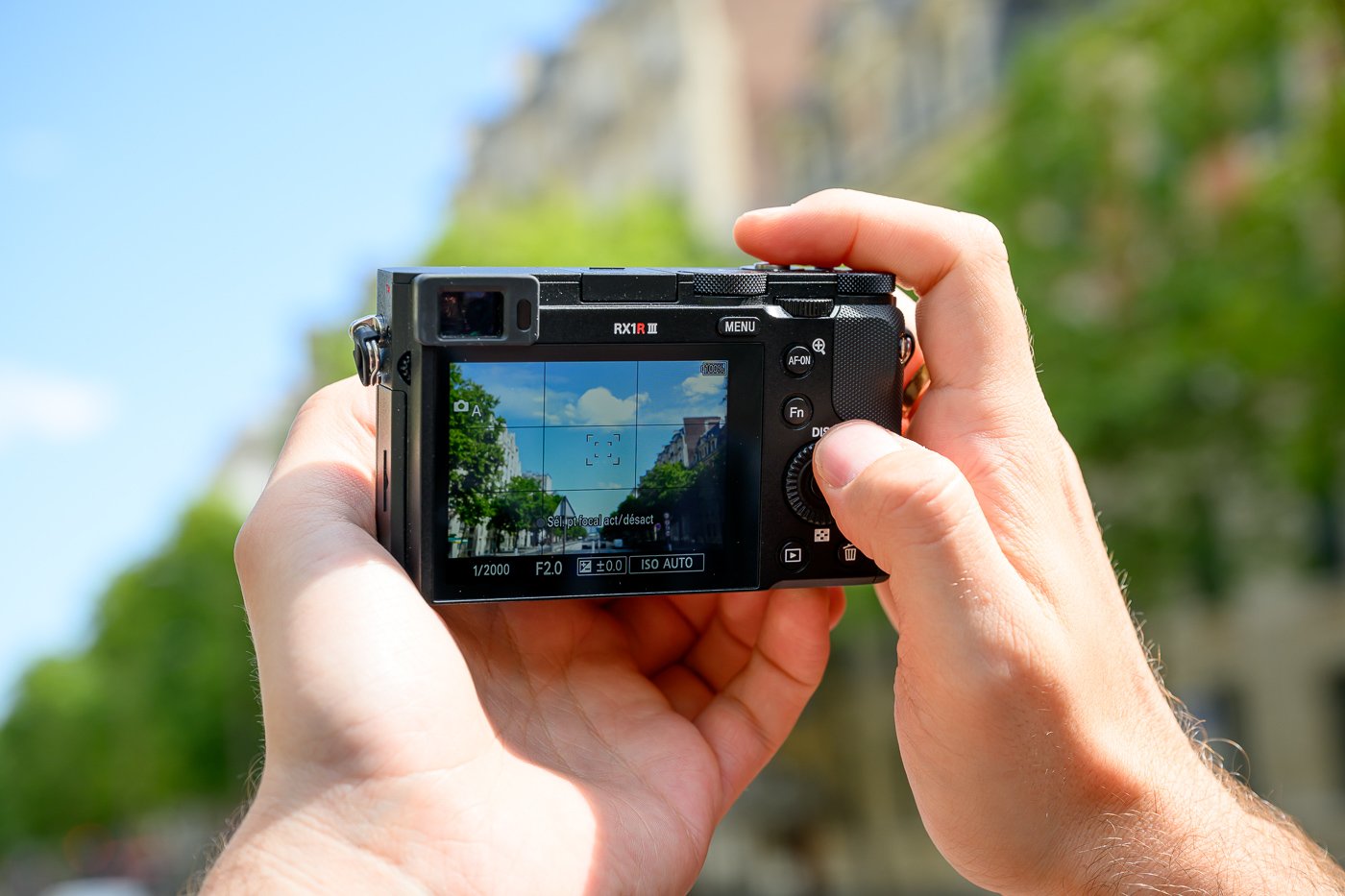
To those, we’d reply that it’s rather absurd for Sony to backtrack on this front. And that the Leica M cameras, despite their history and prestige, aren’t always models of ergonomics and accessibility…
As such, it must be acknowledged that the lack of a tilting screen significantly limits shooting possibilities. You sometimes have to be quite limber in the knees or contort your neck to compose your shot.
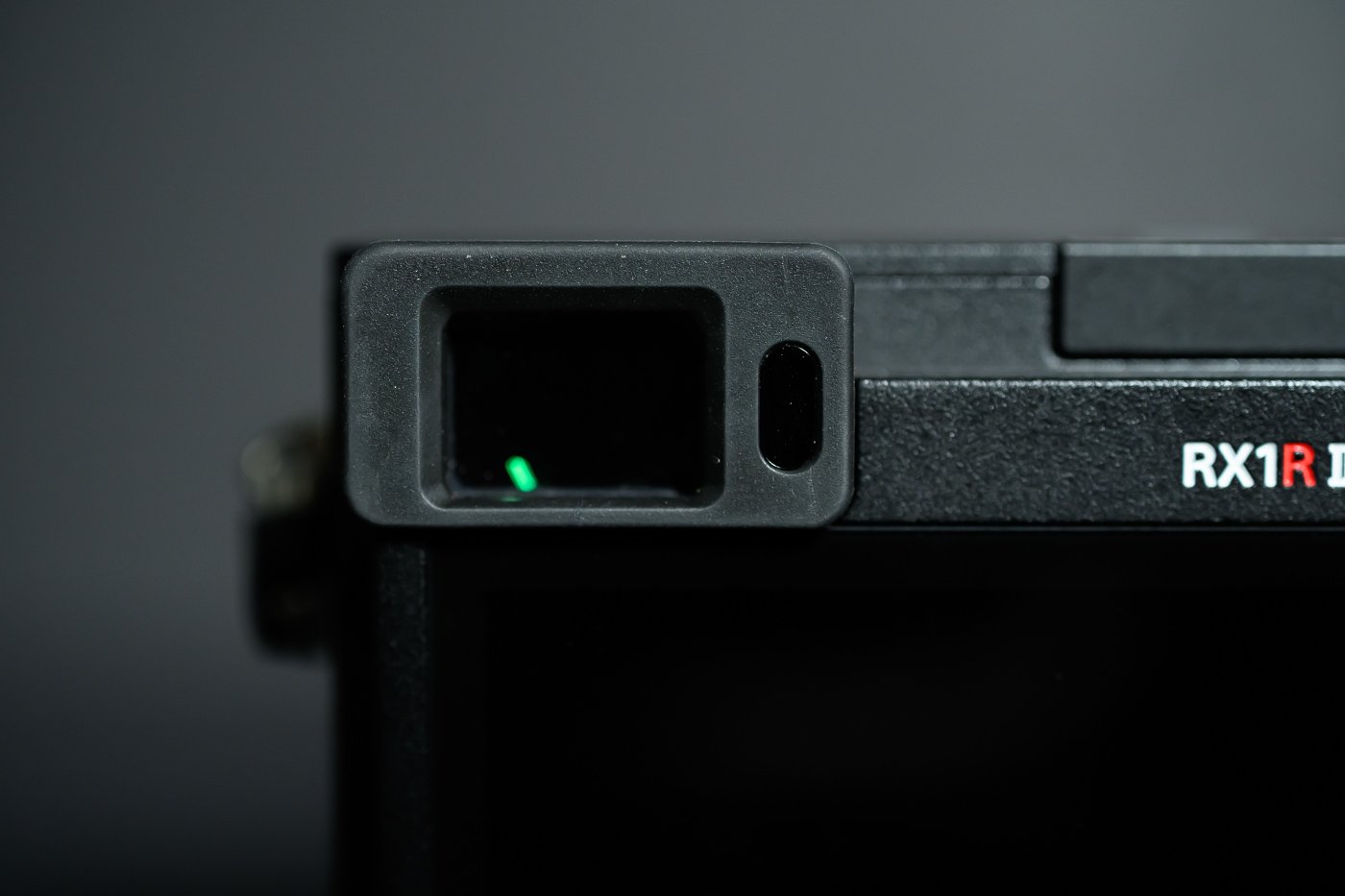
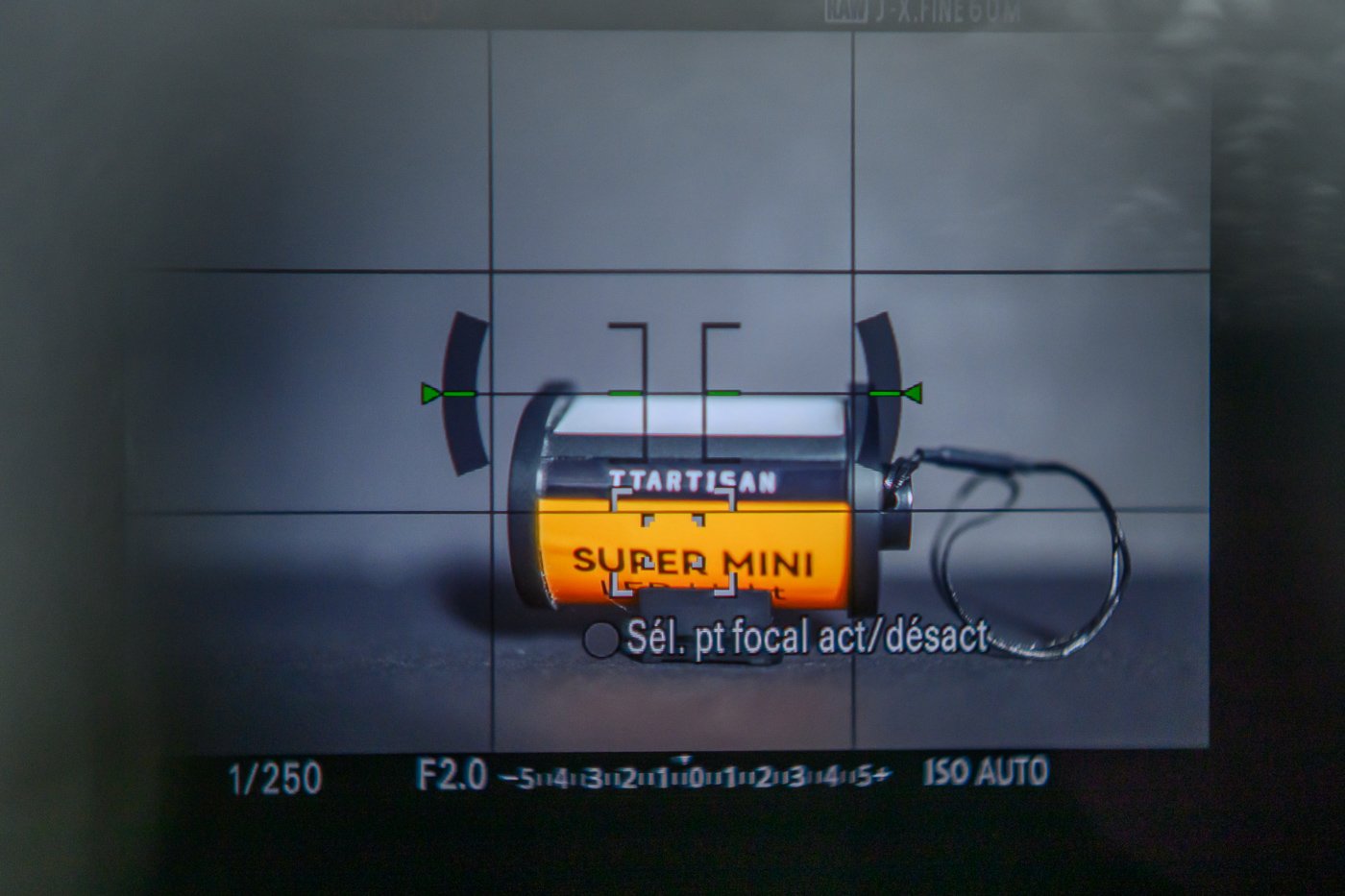
Beyond this frustrating screen – which concentrates much of the criticism aimed at this body – the RX1R III also features a 2.36 Mdot electronic viewfinder (1024×768 px, OLED, 0.7x). It’s carried over from the Sony A7C R / A7C II and is neither the largest nor the brightest on the market. Sony includes a soft eyecup in the box. While it makes the viewing experience somewhat more comfortable, it also protrudes more noticeably from the camera, breaking the overall compactness of the body.
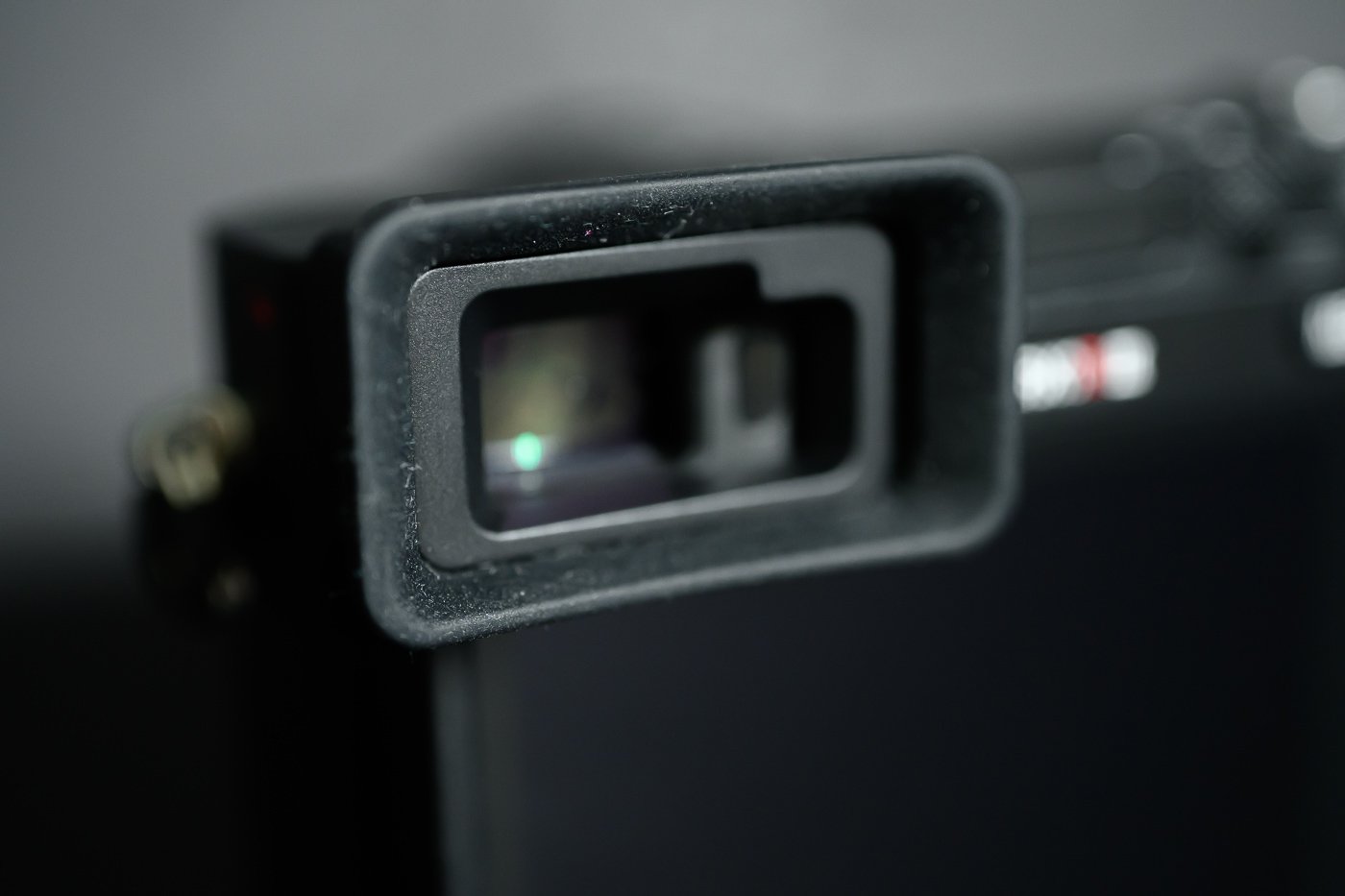
It suffers here from the comparison with the Leica Q3‘s viewfinder, which is 2.44x higher in resolution and far more precise. Given that Sony makes some of the best viewfinders on the market and prices its compact camera higher than the A7R V at launch, it’s rather puzzling to carry over such an inferior viewfinder.
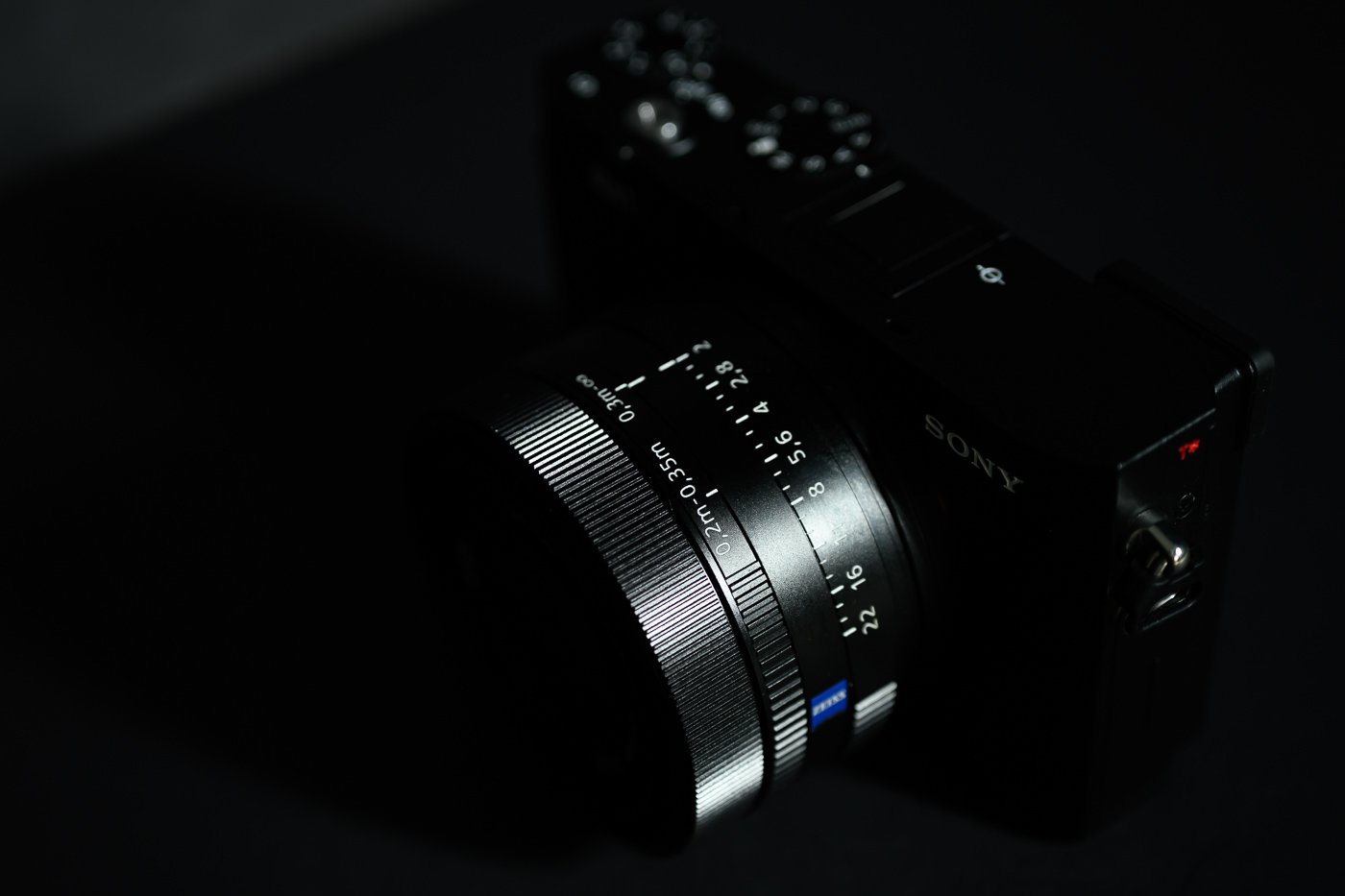
As with previous generations, the 35mm f/2 lens protrudes quite noticeably from the body. It is almost twice as deep as the camera body itself, which means you can feel the whole thing tilting slightly forward. Fortunately, the RX1R III remains quite light.
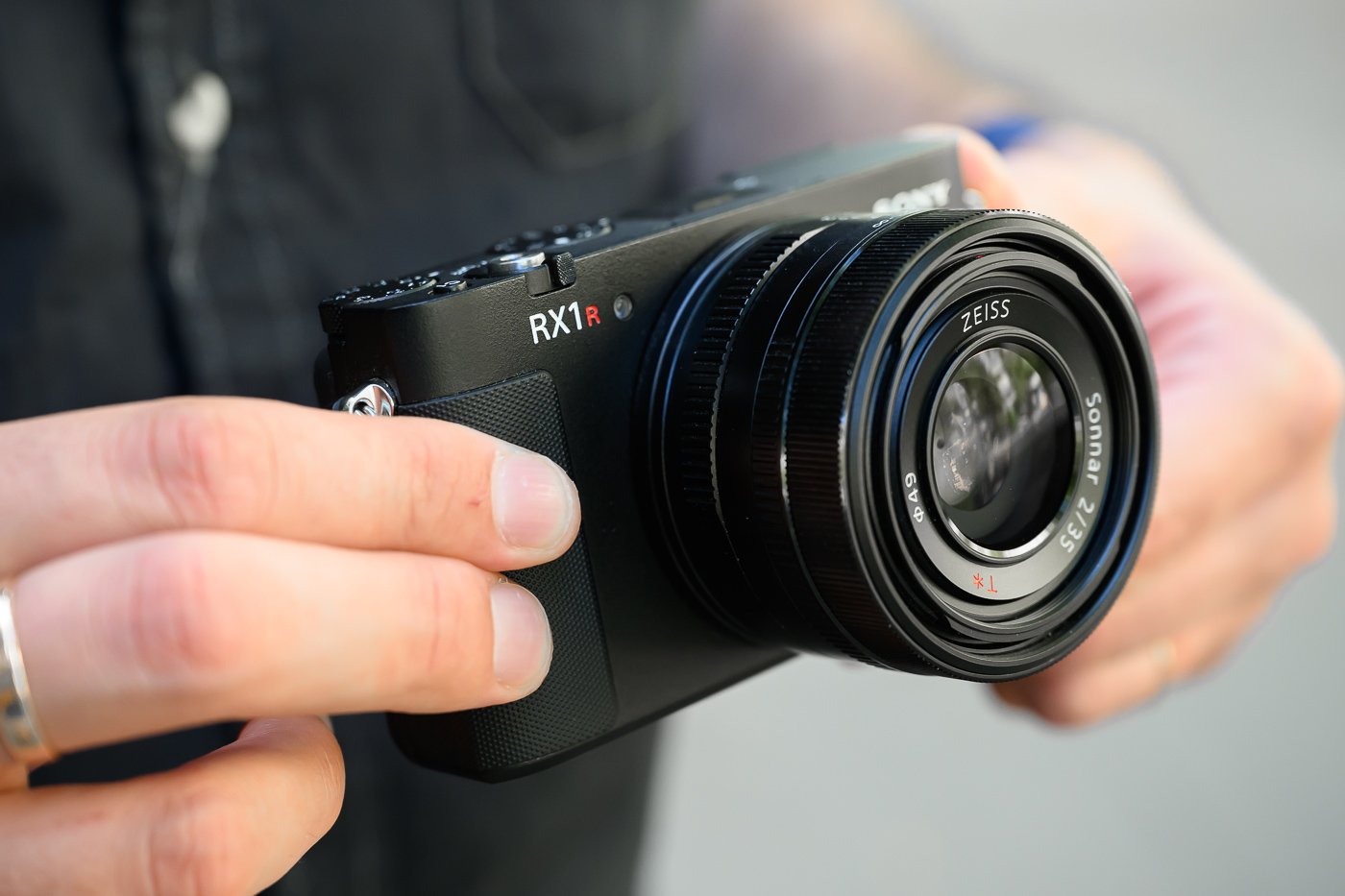
The lens, though quite compact, still features 3 rings:
- Focus
- Aperture (f/2 – f/22)
- Focus distance limiter: ∞ – 30 cm; 35 – 20 cm (“macro” mode)
We have nothing particularly noteworthy to say about these rings – they all work as expected. At most, we can point out that the aperture ring lacks an “Auto” position, making it impossible to control the aperture from the rear command dial.
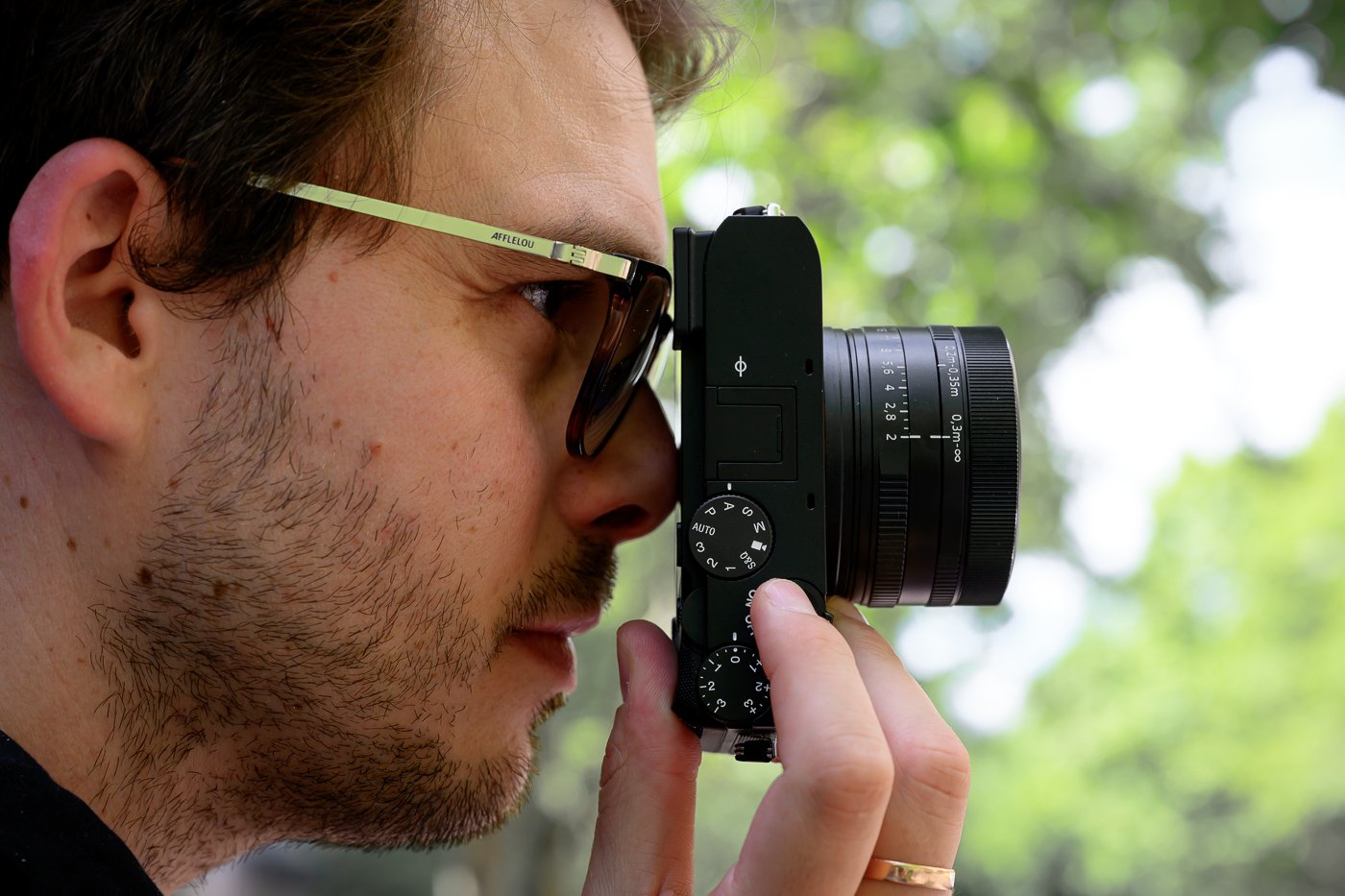
Finally, one last glaring omission must be mentioned: the lack of weather sealing. You read that right – despite its very premium positioning, the Sony RX1R III offers no protection against the elements or dust infiltration. Outrageous!
Performance and image quality of the RX1R III
The Sony RX1R III packs a 61 MP full-frame Exmor R BSI sensor and relies on its Zeiss Sonnar T* 35mm f/2 lens. The sensor has been used in the manufacturer’s high-resolution bodies since 2019, while the lens dates back to… 2012.
This full-frame sensor is, to date, the highest-resolution on the market, and we know it’s capable of delivering exceptional images.
Feel free to click on the photos in this review to display them in higher quality.

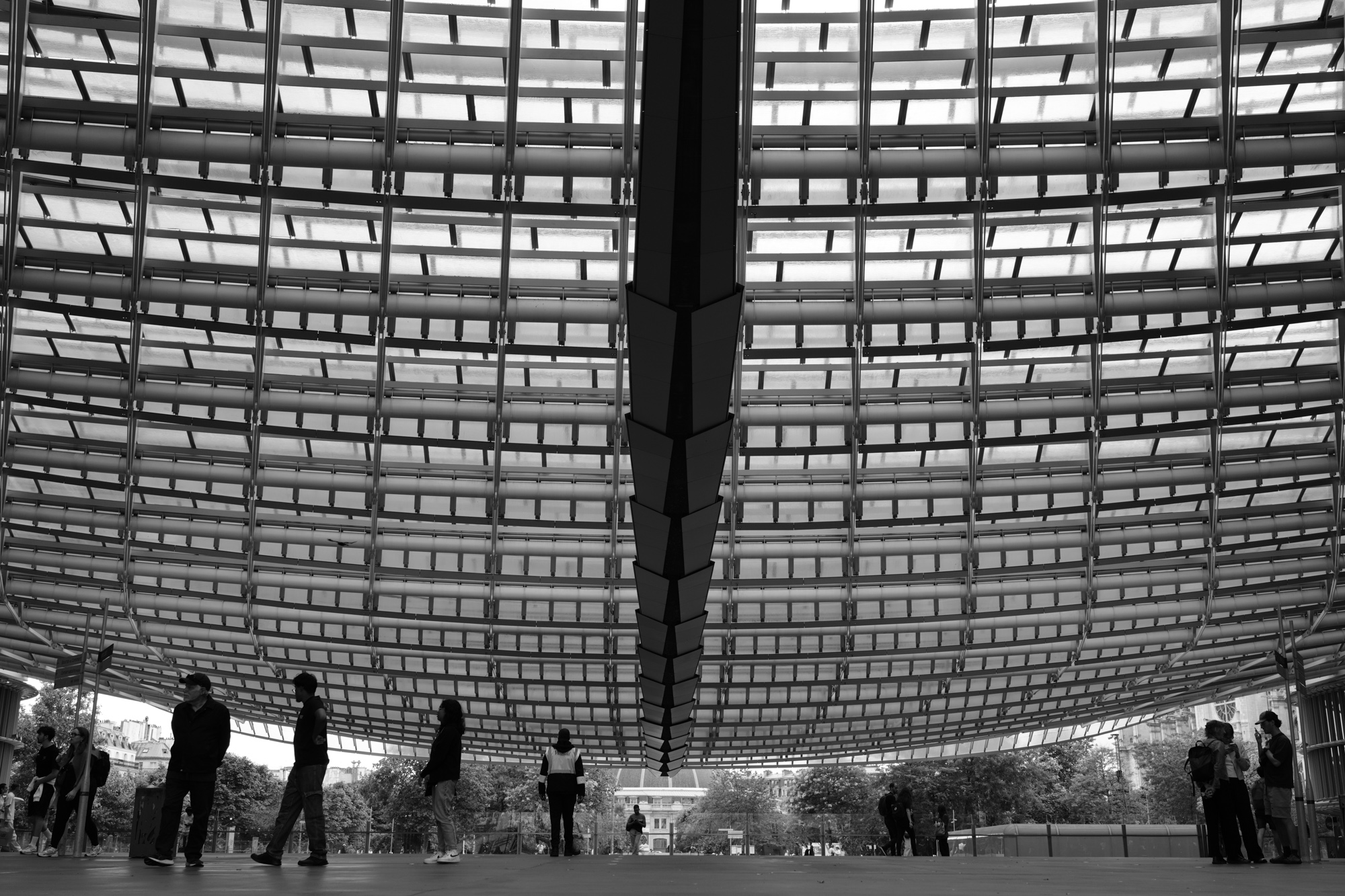

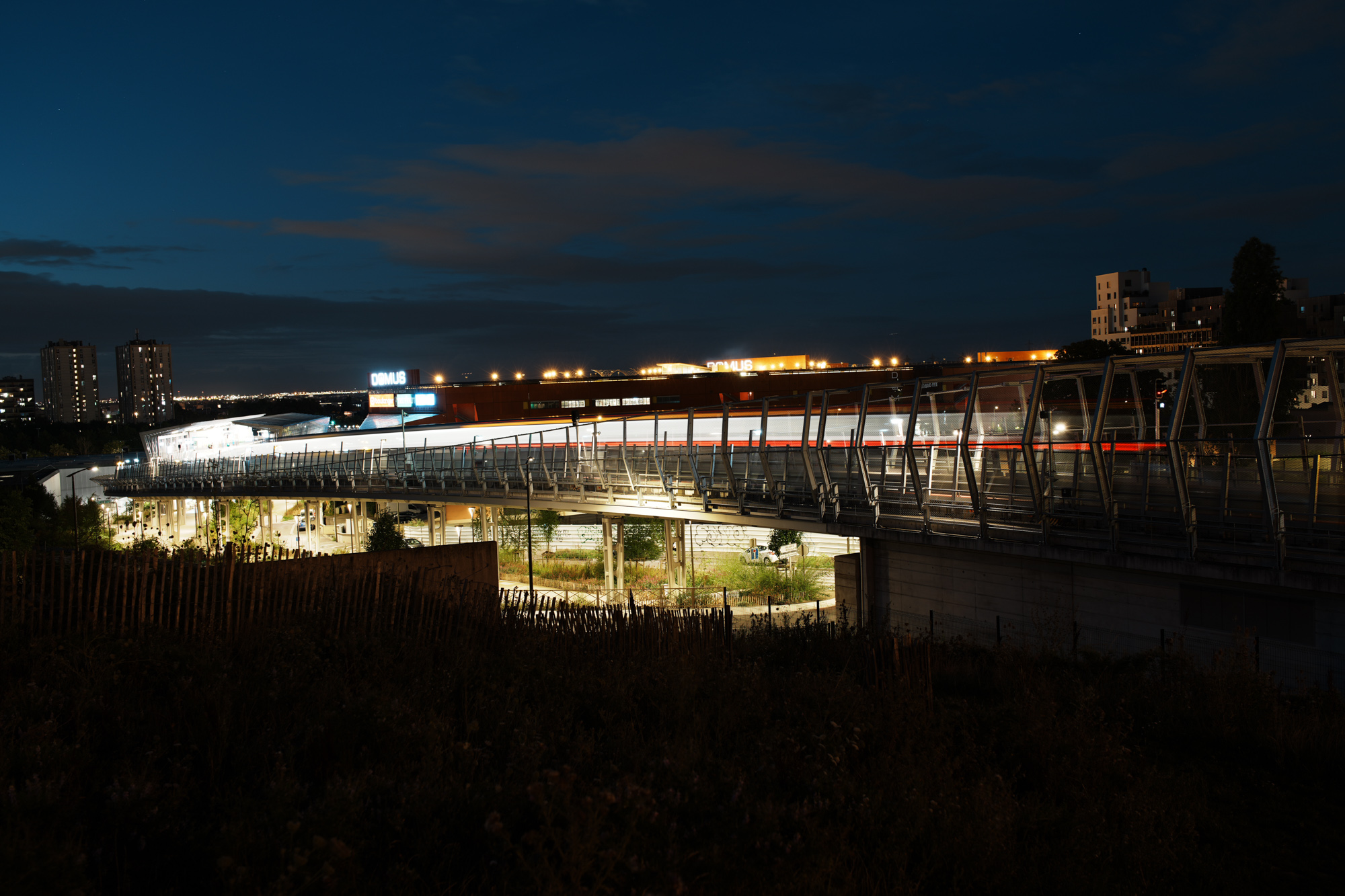
Each image measures 9504 x 6336 px. An uncompressed RAW file weighs 125 MB. Lossless compression brings these files down to 70 MB, while JPEGs come in at 35 MB. In addition to JPEG, the body also offers capture in HEIF (4:2:0 or 4:2:2 10-bit).
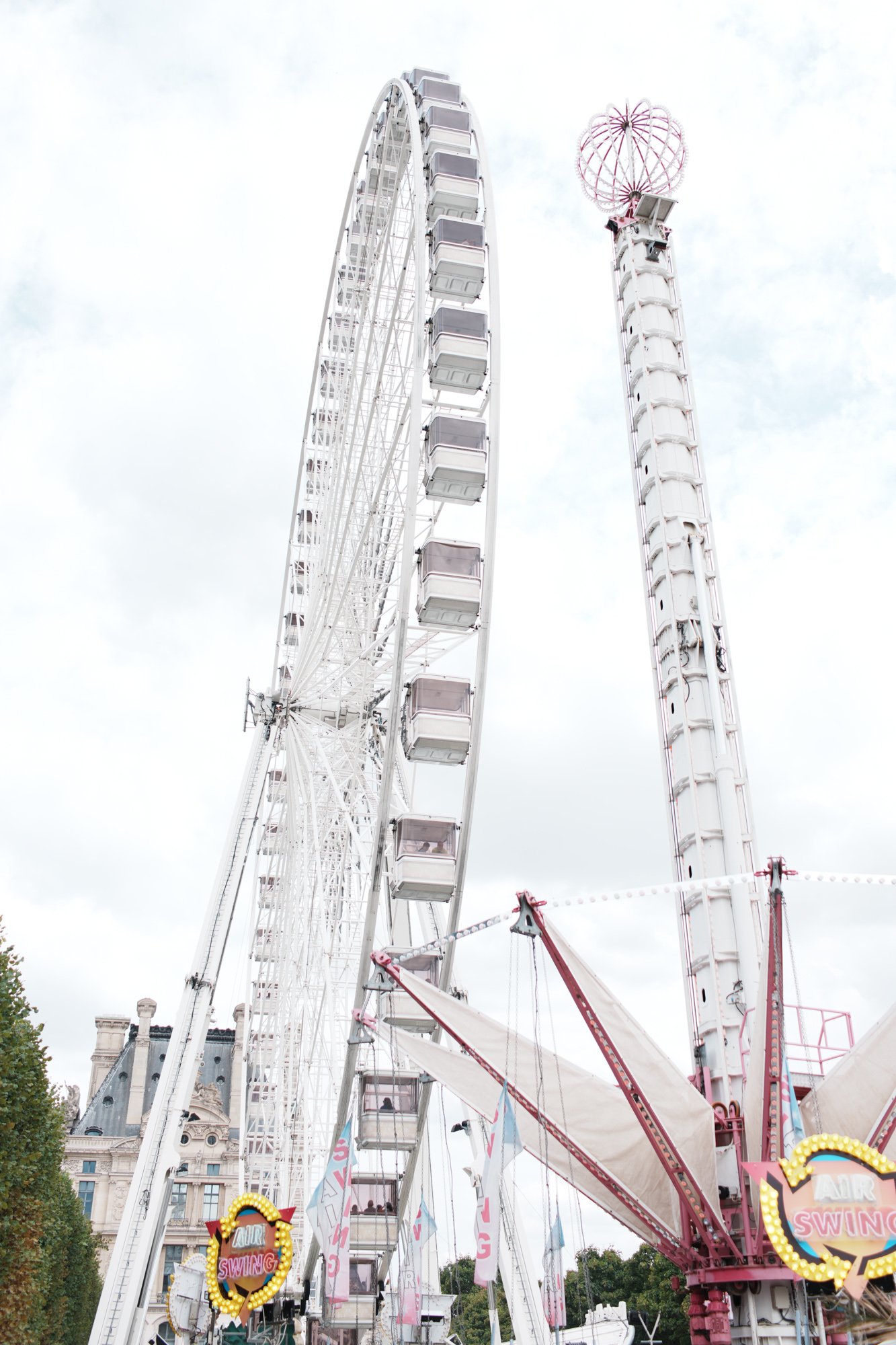
You can reduce file resolution to 26 MP (M) or 15 MP (S), without cropping. The body also offers 2 “virtual” focal lengths, providing digital crops equivalent to 50mm (29 MP) and 70mm (15 MP). A fairly common feature on premium compact cameras that adds a bit of versatility to the fixed lens. Like Leica with its Q3, we would have appreciated if Sony had pushed this to 90 or 95mm…
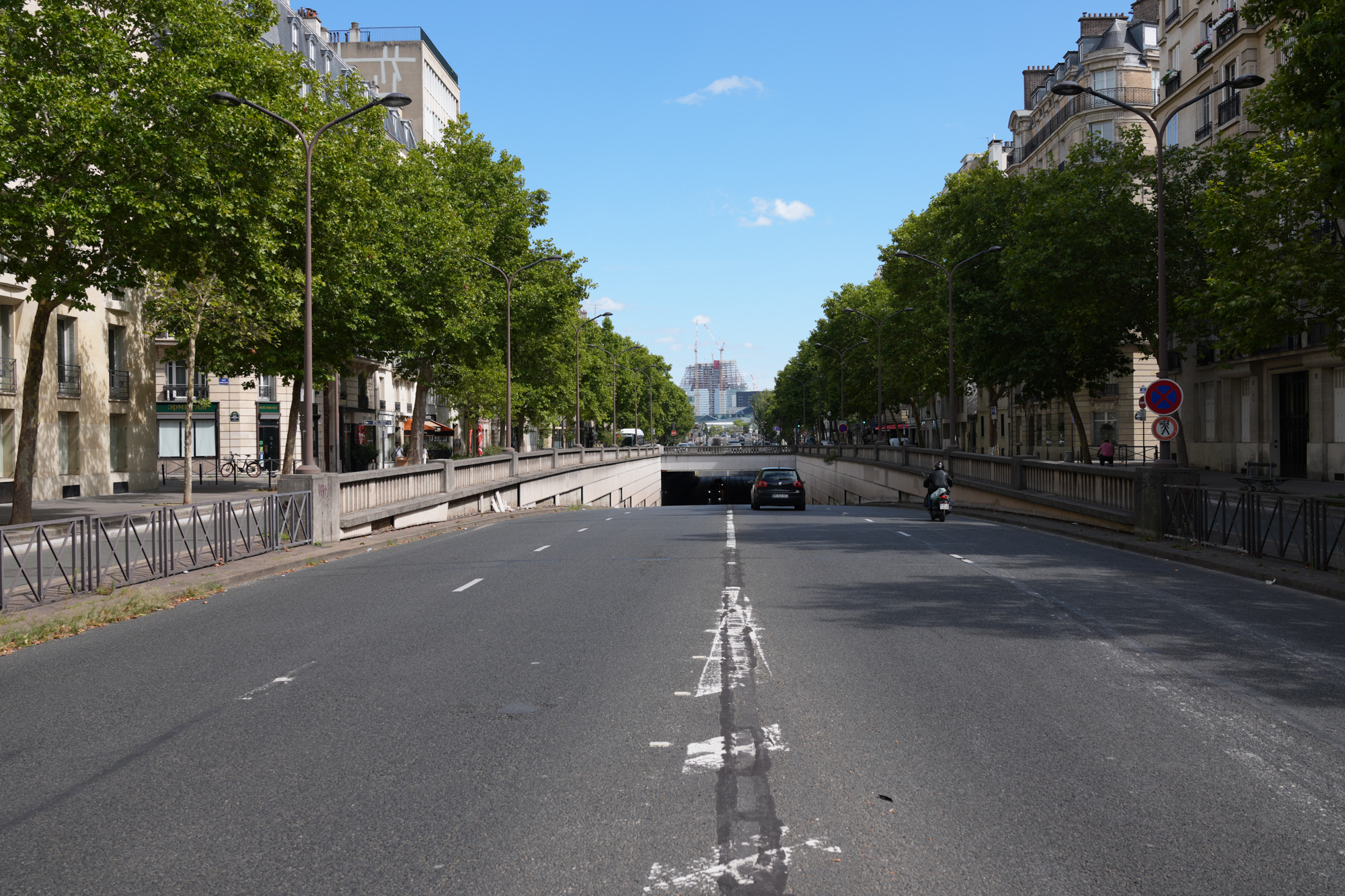
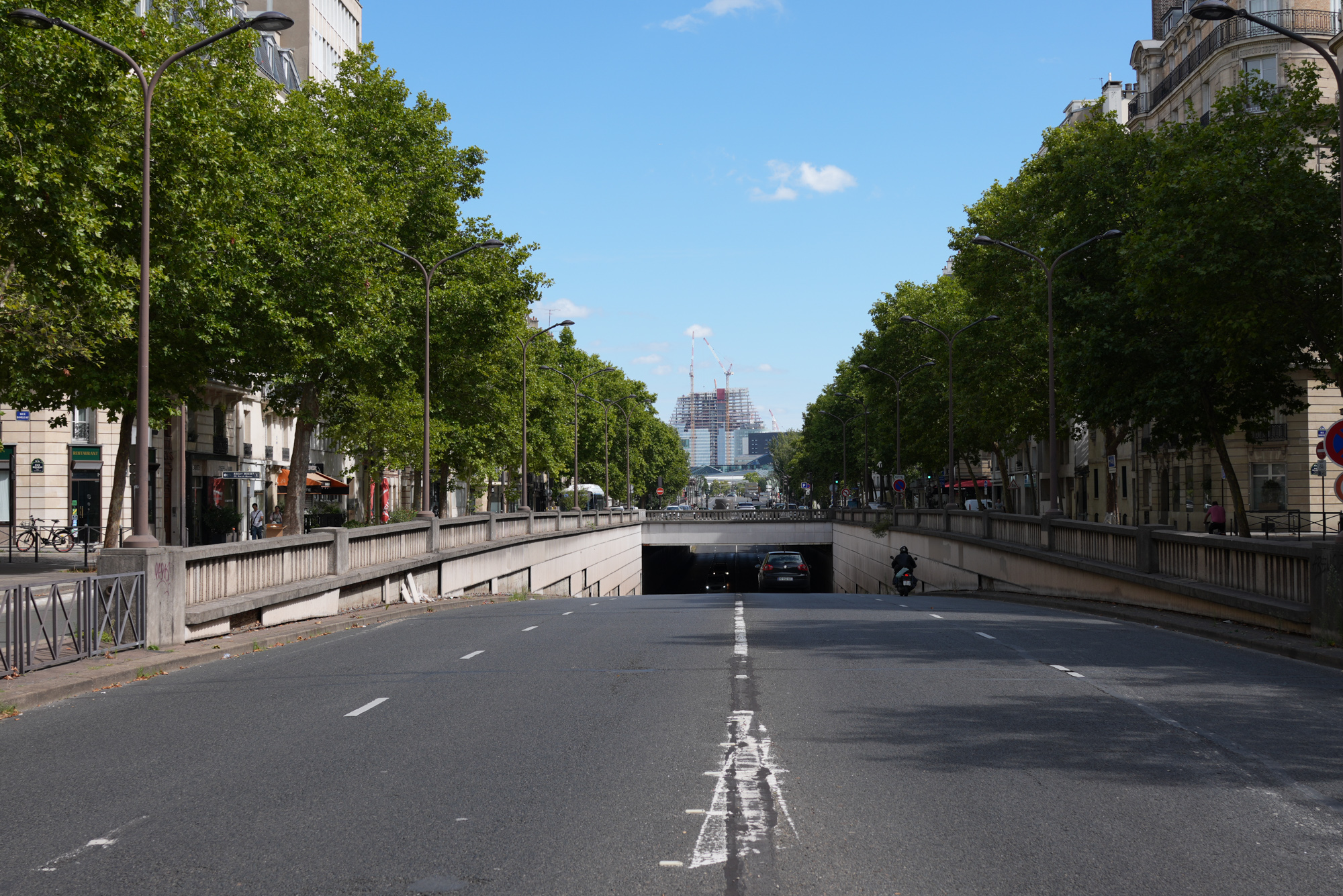
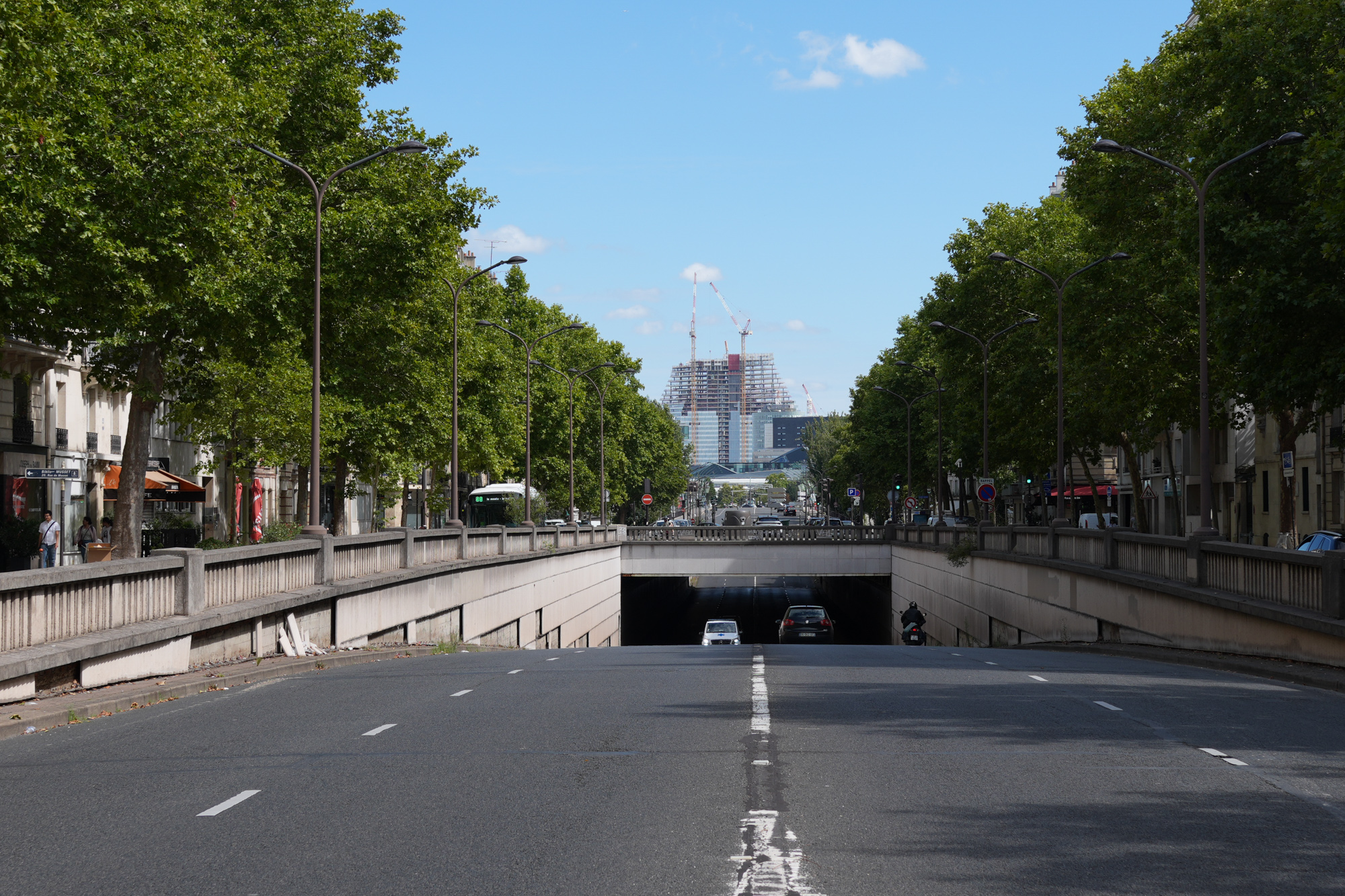
ISO performance and dynamic range
The native sensitivity range spans from ISO 100 to 32,000, expandable from ISO 50 to 102,400.






High-ISO noise management is very solid and unsurprising: up to ISO 1600, digital noise remains virtually imperceptible. A first notable threshold is reached at ISO 3200.
Grain remains relatively contained up to ISO 12,800, before a second step is crossed. At ISO 25,600, images are still usable, but beyond that – starting from the default extended sensitivity of ISO 32,000 – noise becomes significantly more pronounced.






The highest sensitivities should be avoided in most cases. As usual, they’re only useful in very specific situations and aren’t intended for everyday use. Additionally, colours display a vivid and pleasing rendition. Portrait photographers will appreciate the faithful skin tones.
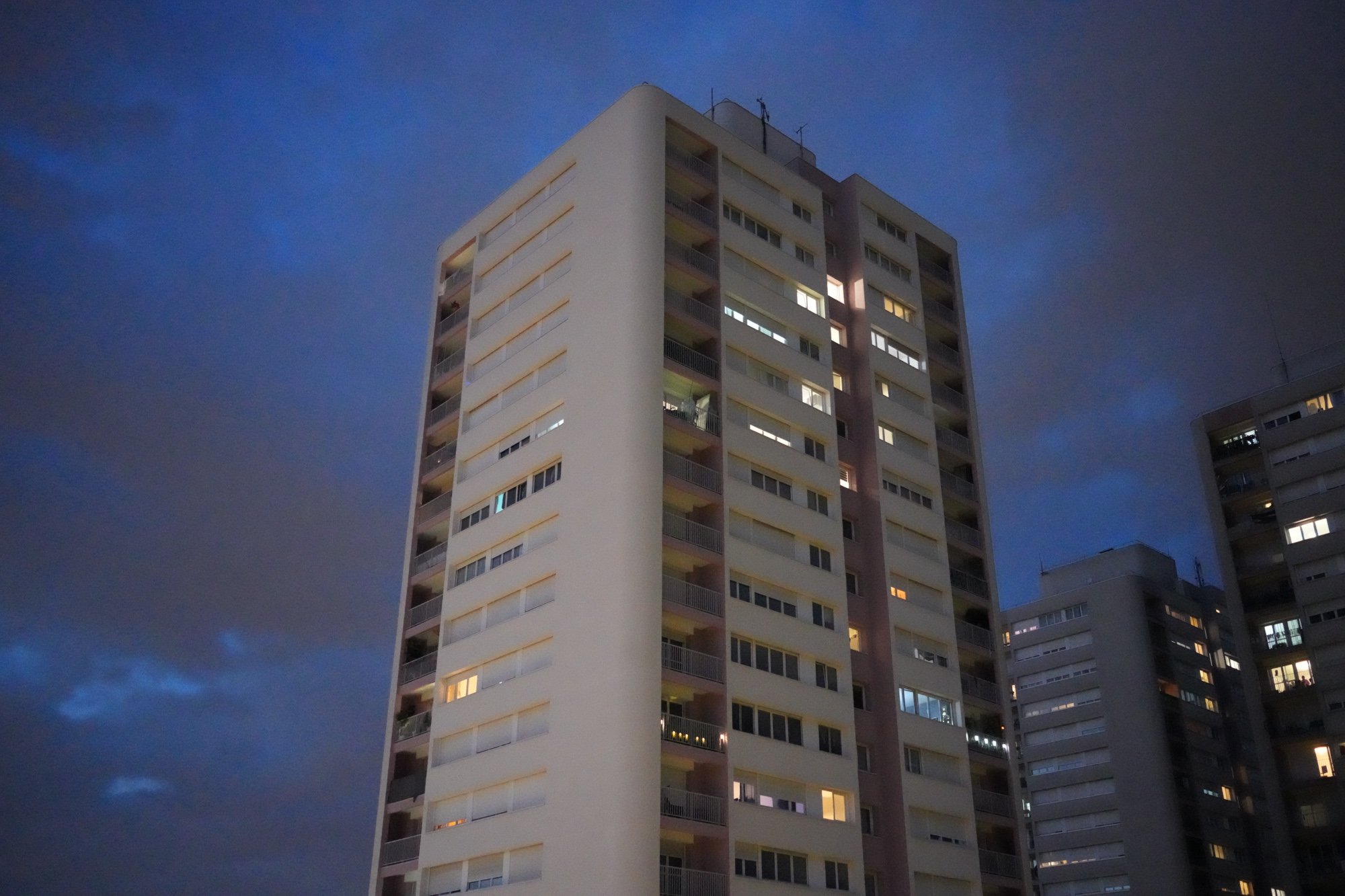
Shadow areas are easily recoverable, and digital noise only appears at high sensitivities. As for highlights, often tricky to control, they are well contained here, with comfortable correction headroom – provided, of course, you don’t push the sliders too far.


Picture profiles
More than with any other camera before, Sony puts its “Creative Looks” front and centre. They are the equivalent of Fujifilm’s film simulations or Leica’s film looks. There are now 12 of them, including 10 that were already available on most of the brand’s cameras.
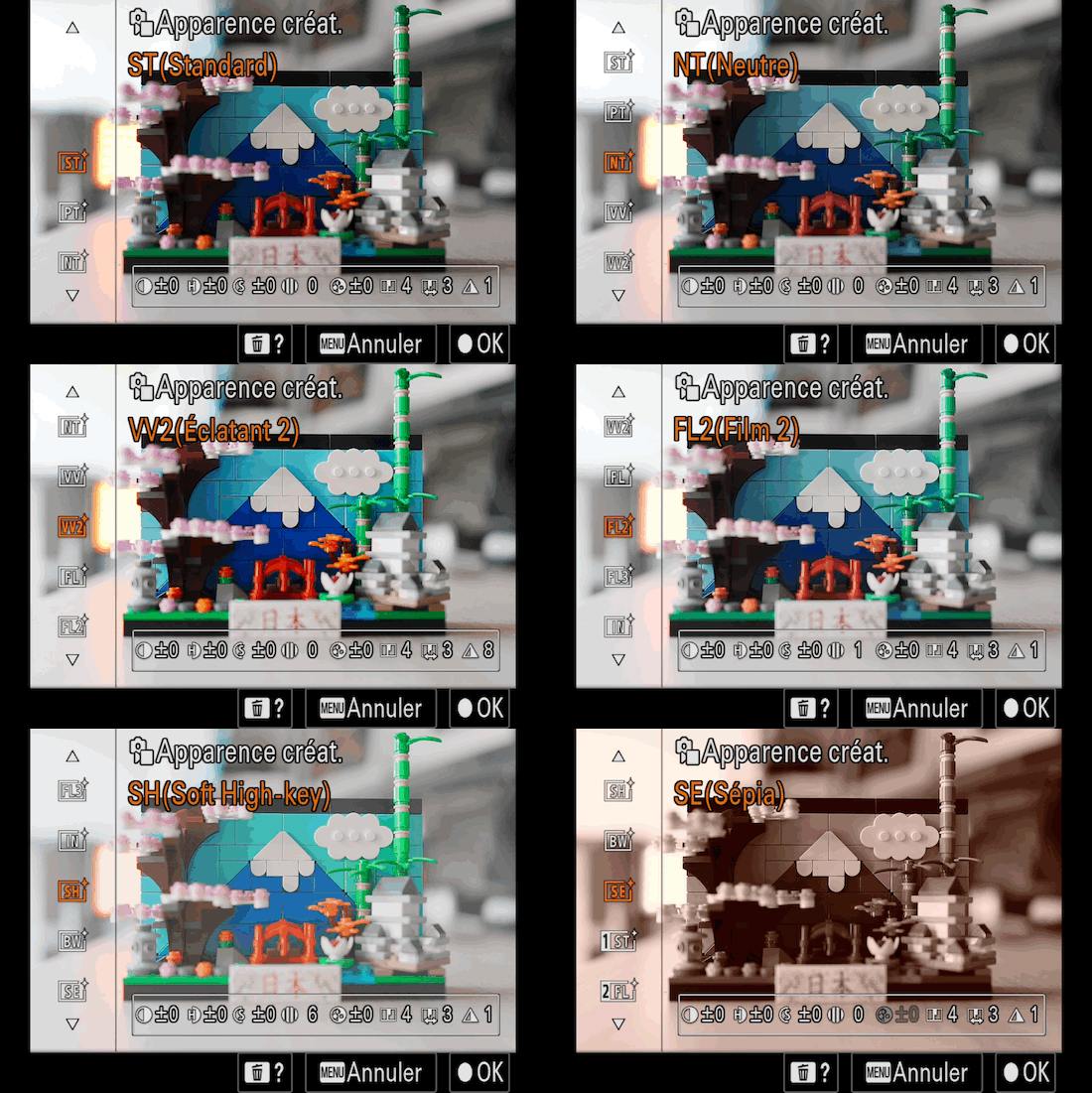
Even though the number of “looks” isn’t as high as Fuji’s, we’ve long appreciated the rendition of the FL, IN, and SH profiles, among others. Sony has also added two new variations, FL2 and FL3, with teal and orange tones, which we played with extensively.


Of course, those who swear by the rawest RAW files possible won’t even glance at these profiles. However, we’re less dogmatic and are giving increasingly more credit to in-camera JPEGs while spending less and less time editing our shots.

Sony is trying to play Fujifilm’s game and does it rather well, even if most of the “filters” offered don’t yet convey a truly distinctive character.
Lens quality of the Sony RX1R III
The RX1R III inherits the Zeiss Sonnar T* 35mm f/2 – a lens nearly 13 years old, with a 8 elements in 7 groups optical formula. The diaphragm features 9 blades, while the minimum focusing distance ranges from 20 cm to 30 cm (in macro mode).
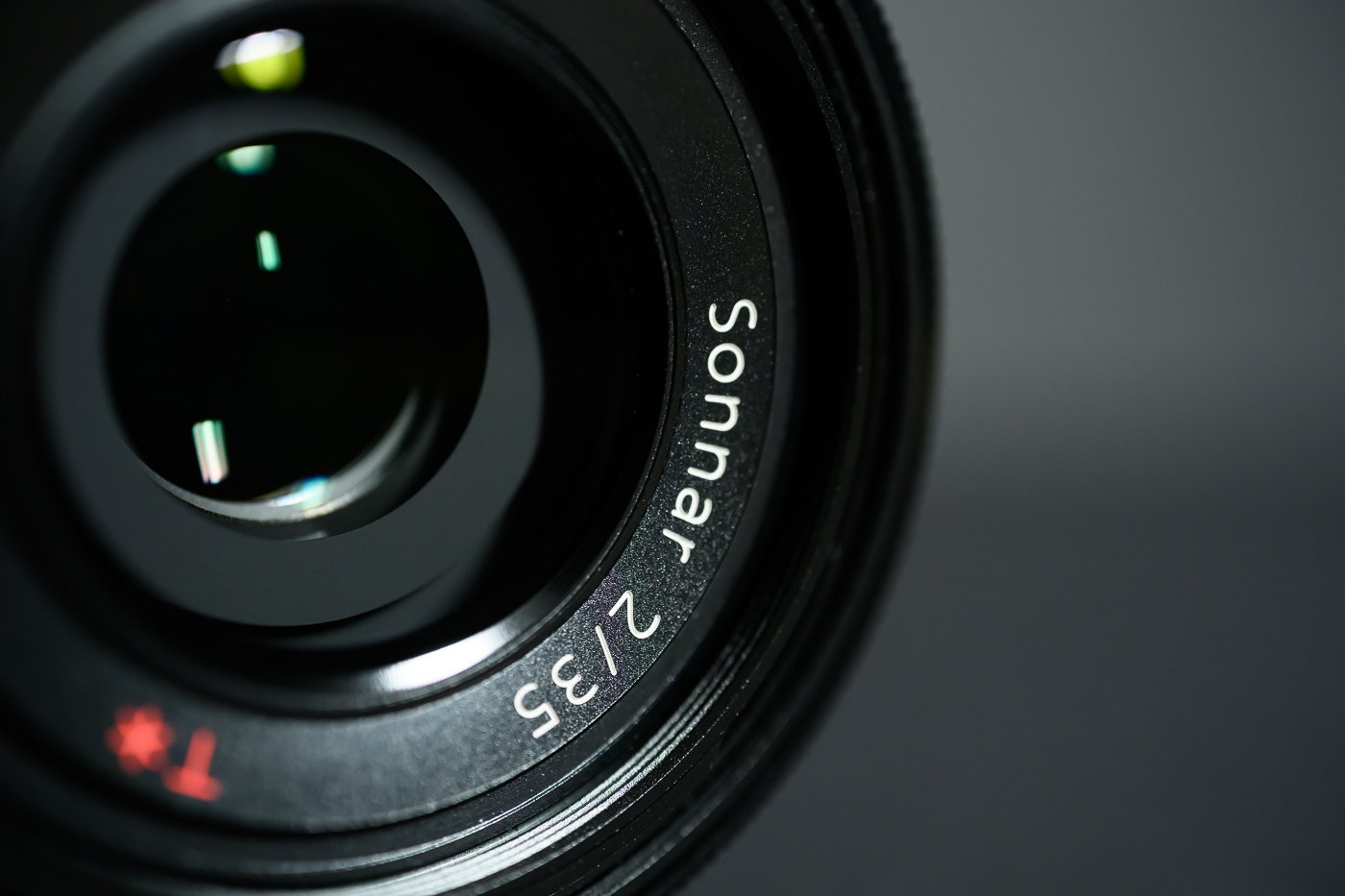
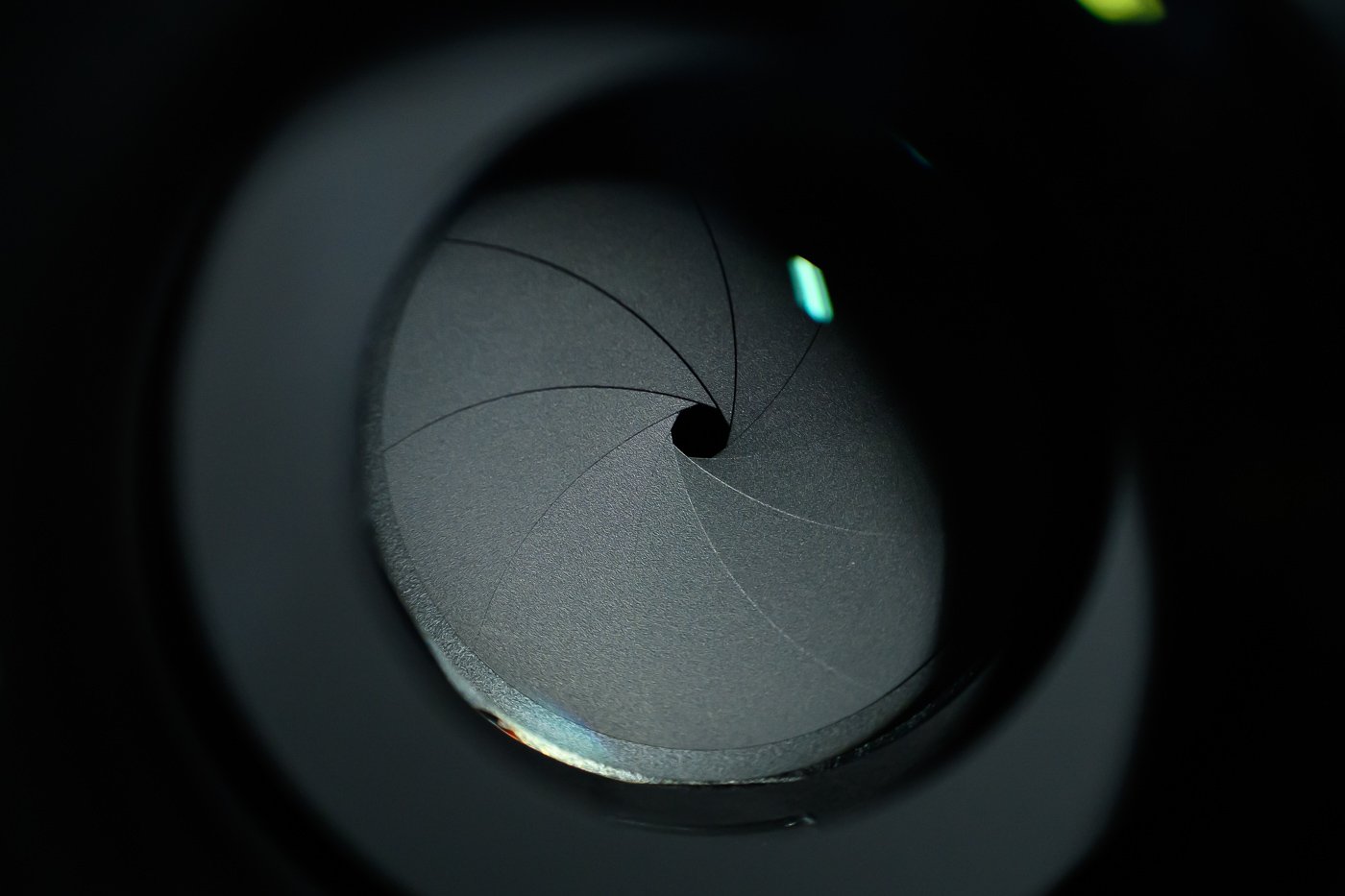
The reproduction ratio can accordingly alternate between 0.14x and 0.26x.
Sharpness
By not modernizing its compact’s optics, Sony was taking a small risk, as this lens was never known for clinical sharpness wide open. And what was true with 24 or 42 MP sensors becomes even more apparent with 61 MP.
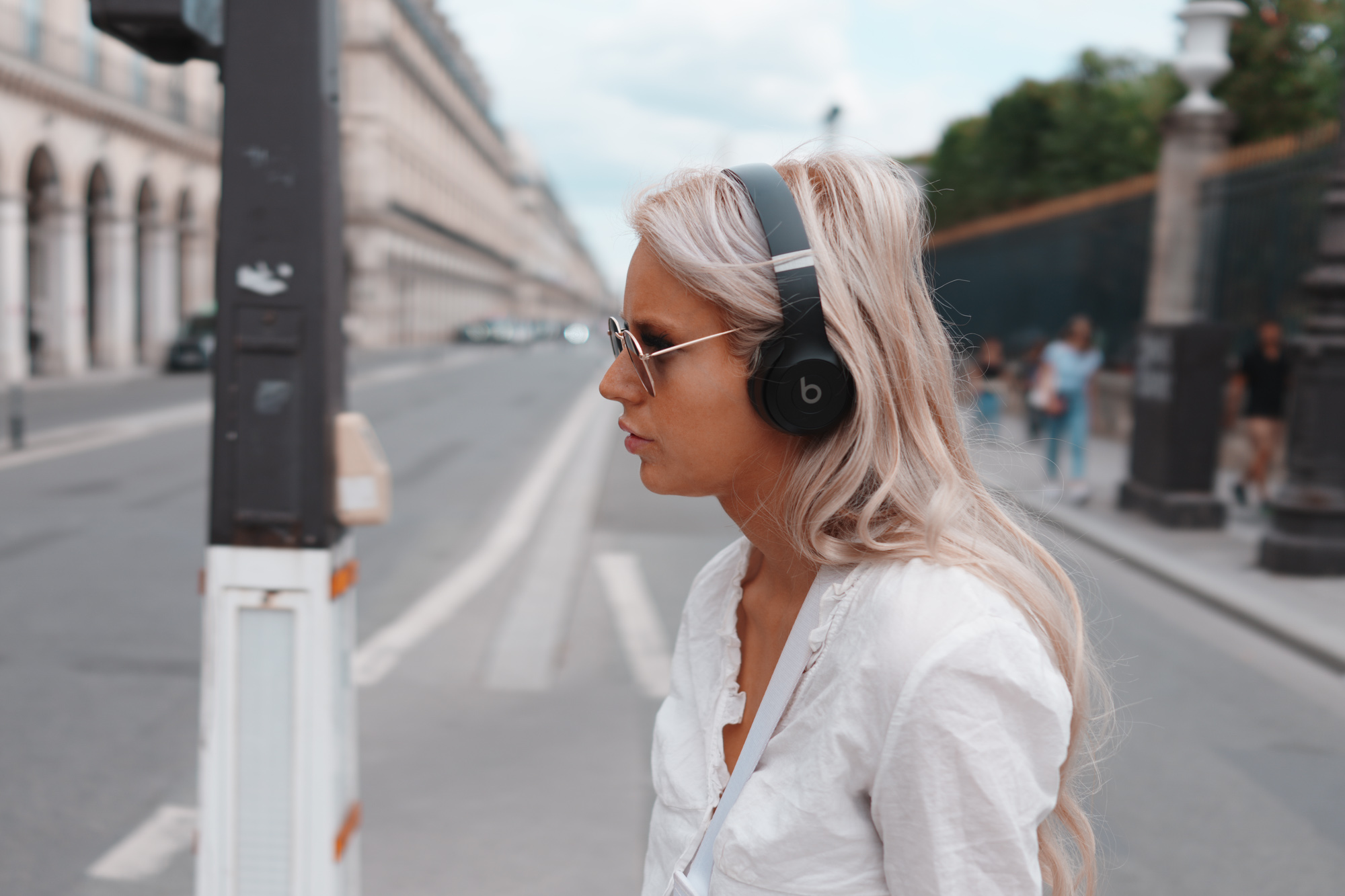

At f/2, we’re quite far from the surgical sharpness of Sony’s most recent lenses. The level of sharpness is not very high, but at least there’s fairly good uniformity across the frame.

Sharpness logically improves as you stop down, and while f/4 offers very decent resolving power, you need to reach f/5.6 to get the best this lens has to offer. This behaviour was acceptable 13 years ago… but falls well short of what modern lenses deliver. The gap with the Summilux 28mm f/1.7 fitted to Leica Q cameras for a decade is clearly measurable.

Wide-open sharpness isn’t bad, though. The more optimistic will even describe it as a soft, film-like rendering – which actually suits a reportage camera quite well.
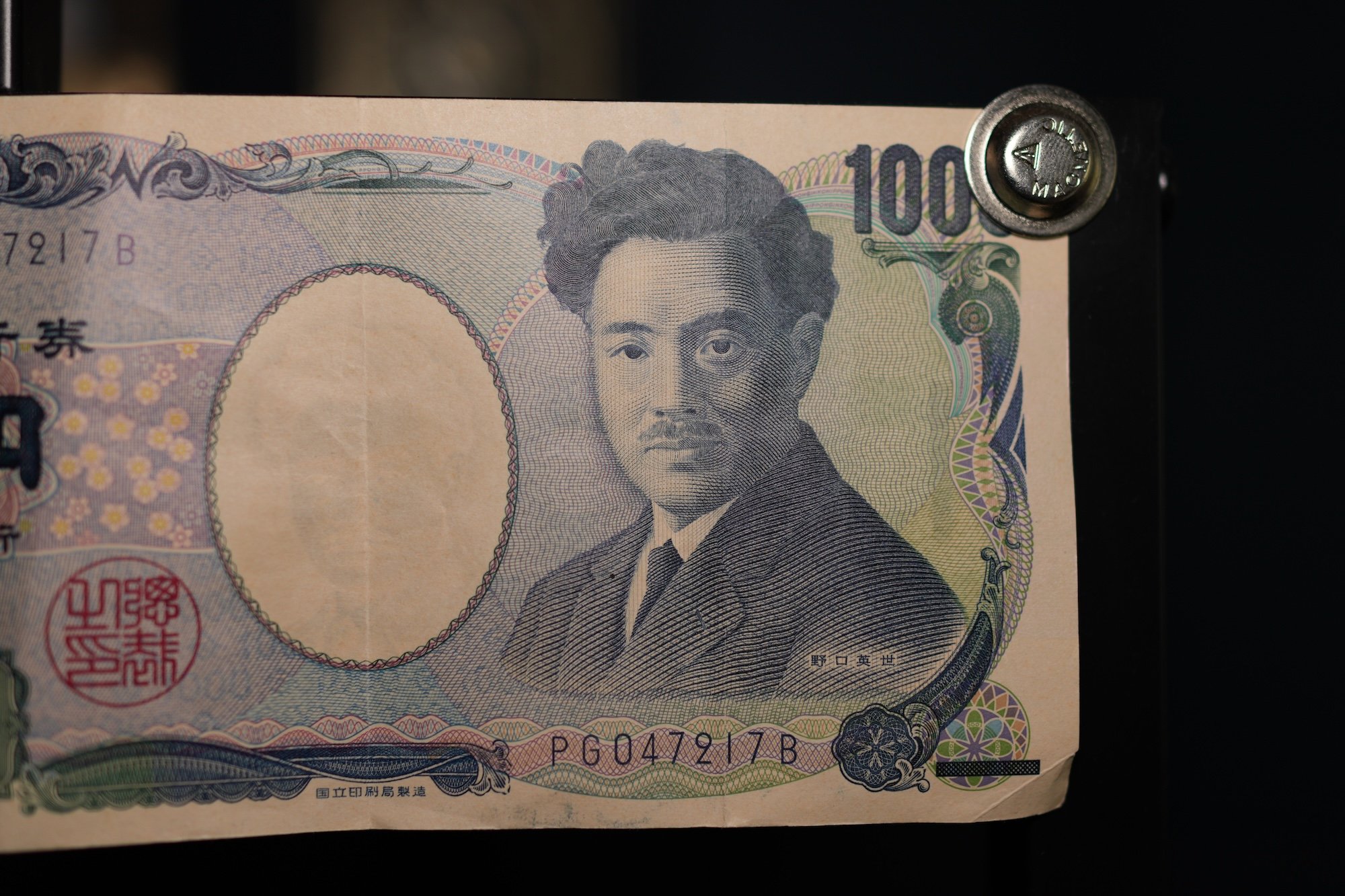


Moreover, in “macro” mode, it’s possible to capture truly detailed and satisfying shots that beg to be cropped into. Admittedly, 35mm isn’t the most obvious focal length for insect photography, but between the sensor’s cropping potential and the autofocus efficiency, you can produce rather stunning images – shots that would be far harder to achieve with the competition.

Likewise, while 35mm isn’t the go-to focal length for portraits either, it offers a rendering that many appreciate, and with the f/2 aperture, you can achieve decent subject separation.

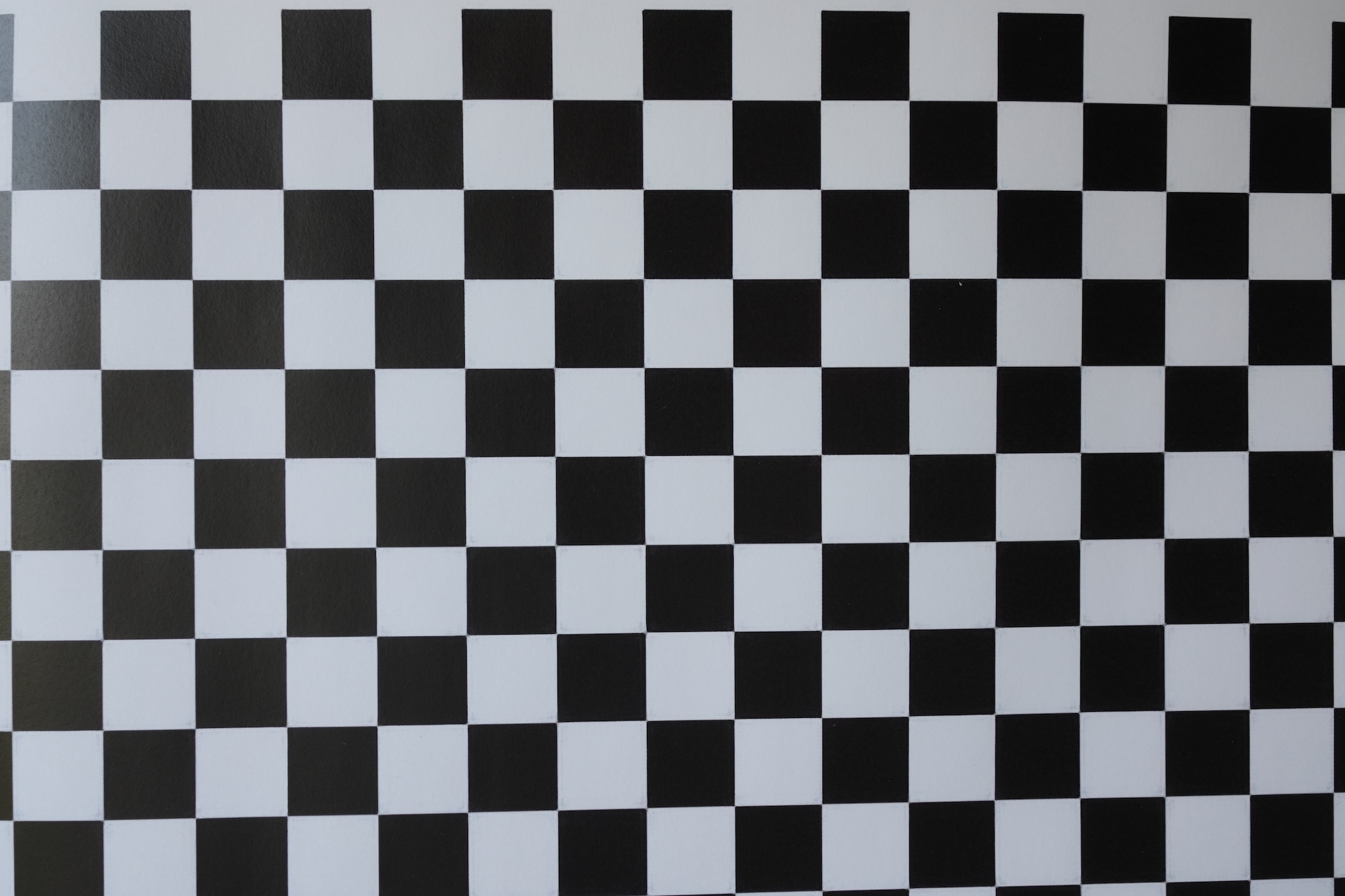
Distortion
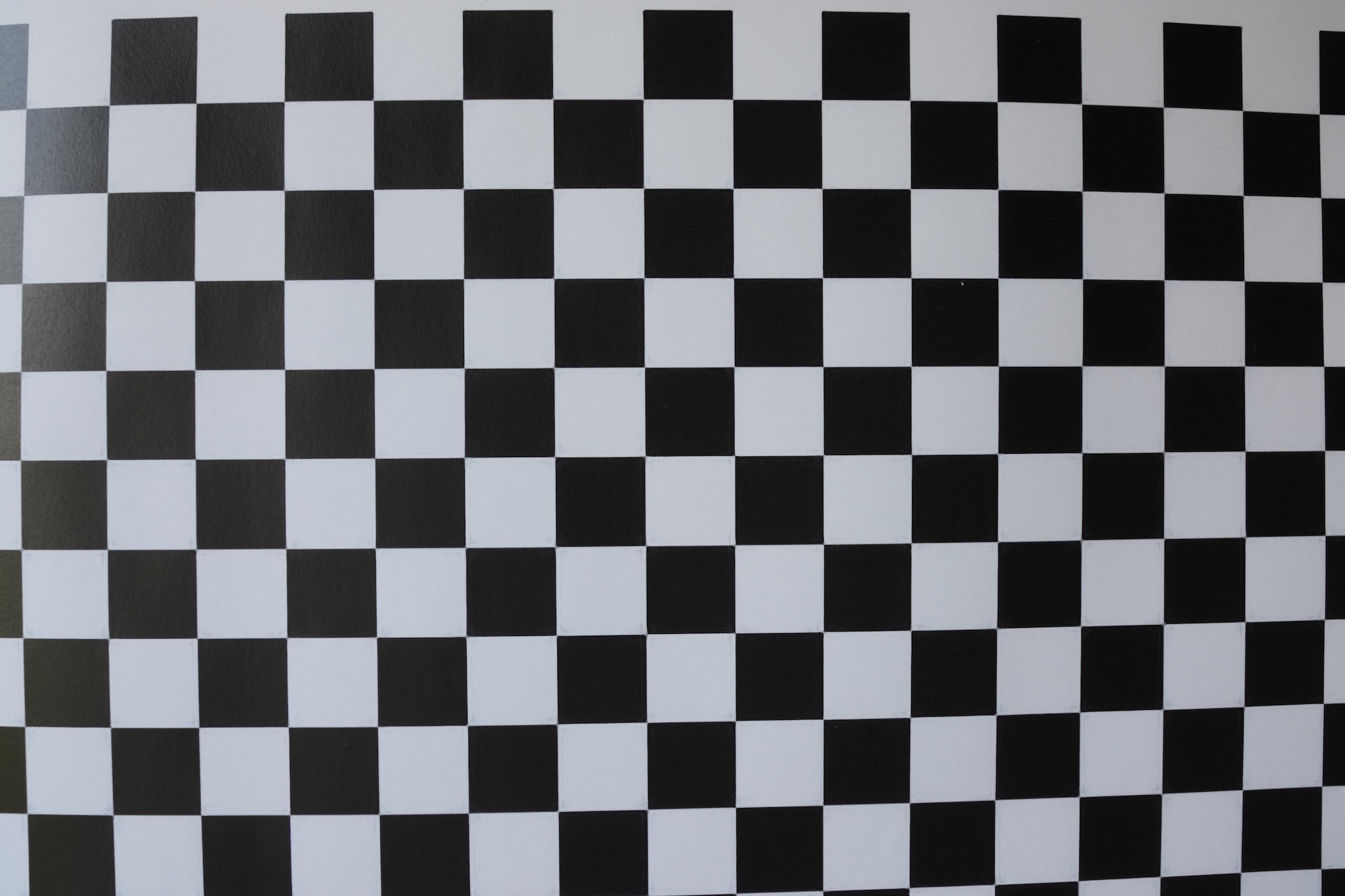
The lens shows noticeable barrel distortion that can be easily corrected in-camera. The result isn’t perfect, but the correction is fairly effective.
Chromatic aberrations
If chromatic aberrations are your nemesis, this camera may not be for you. As a sign of its age, the Zeiss 35mm f/2 is highly prone to chromatic aberrations. Wide open, as soon as you approach the blurry edges of the frame, green/purple fringing appears.

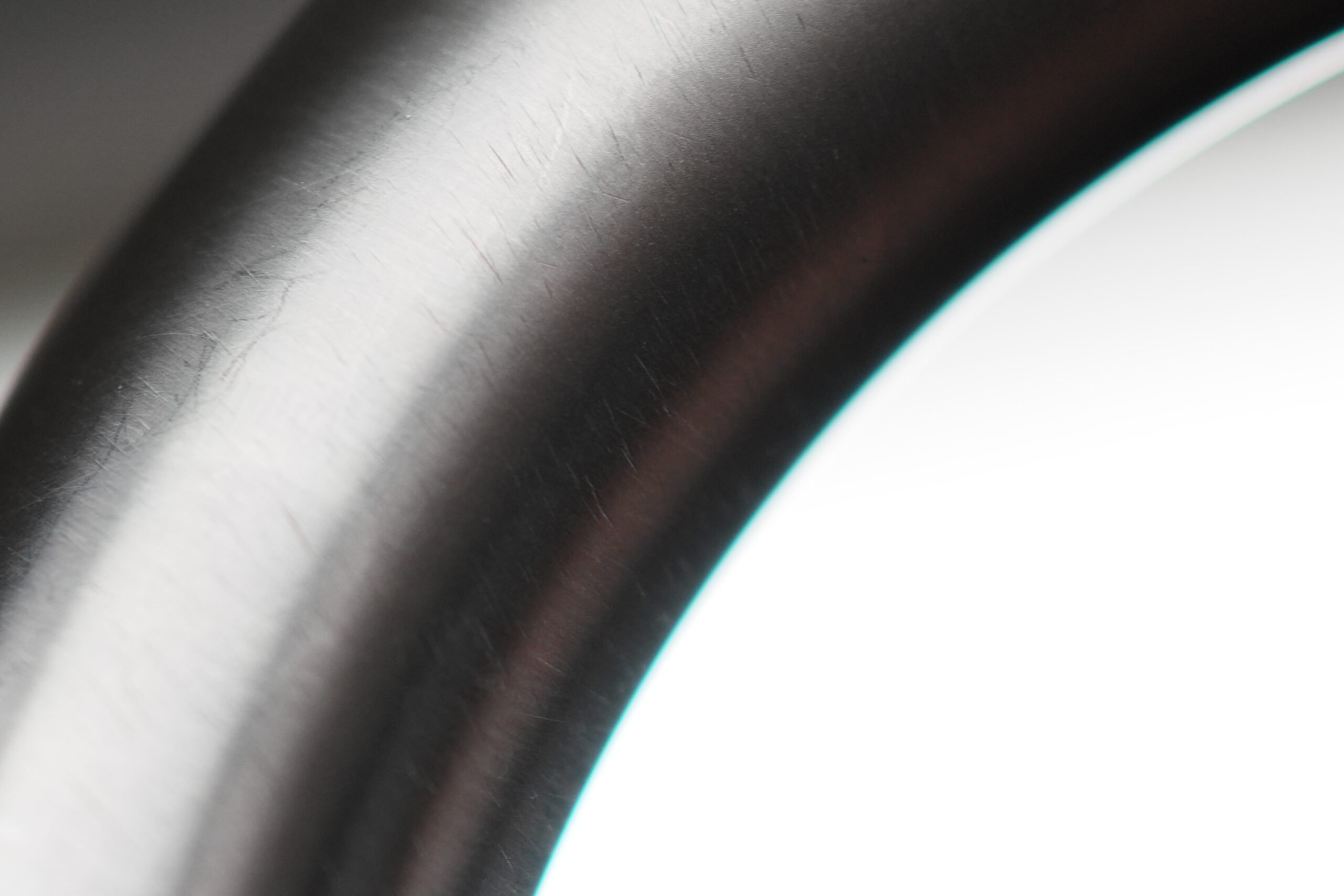
With even the slightest backlight, said fringing will be very pronounced. The phenomenon diminishes slightly at f/2.8, but persists at f/4, and while the colour shifts disappear at f/5.6, you need to reach f/8 for a satisfactory contrast level.

Vignetting
Vignetting is clearly visible at f/2 and tends to improve at f/2.8, reaching a plateau from f/4 onwards.


Even wide open, it remains fairly contained compared to modern fast lenses, and the correction profile compensates for it well.


Bokeh
The Sony RX1R III and its Zeiss lens deliver a beautiful background blur with smooth, diffused bokeh. The transition between planes is delicate, effectively highlighting the subject.

The bokeh balls are fairly round in the centre of the image. That said, if you zoom in to 200%, you’ll notice they’re more like polygons than circles.

In any case, they quickly lose their roundness and take on a more oval shape. We remain, however, quite far from the cat’s-eye effect, thankfully.

It isn’t the best bokeh on the market, but the rendering is truly pleasing. The modelling and subject separation are far superior to those of a Fujifilm GFX 100RF, for instance.

Autofocus and tracking of the Sony RX1R III
The body inherits the AF system from the Sony A7R V / A7C R. It therefore uses a hybrid autofocus system based on 693 AF points. These cover 86% of the sensor height and 93% of its width, for an overall coverage of 78%.
The autofocus is backed by artificial intelligence based on Deep Learning, enabling highly advanced subject tracking regardless of the subject type. This kind of system has become standard at Sony, integrated into all mirrorless cameras launched since late 2022.
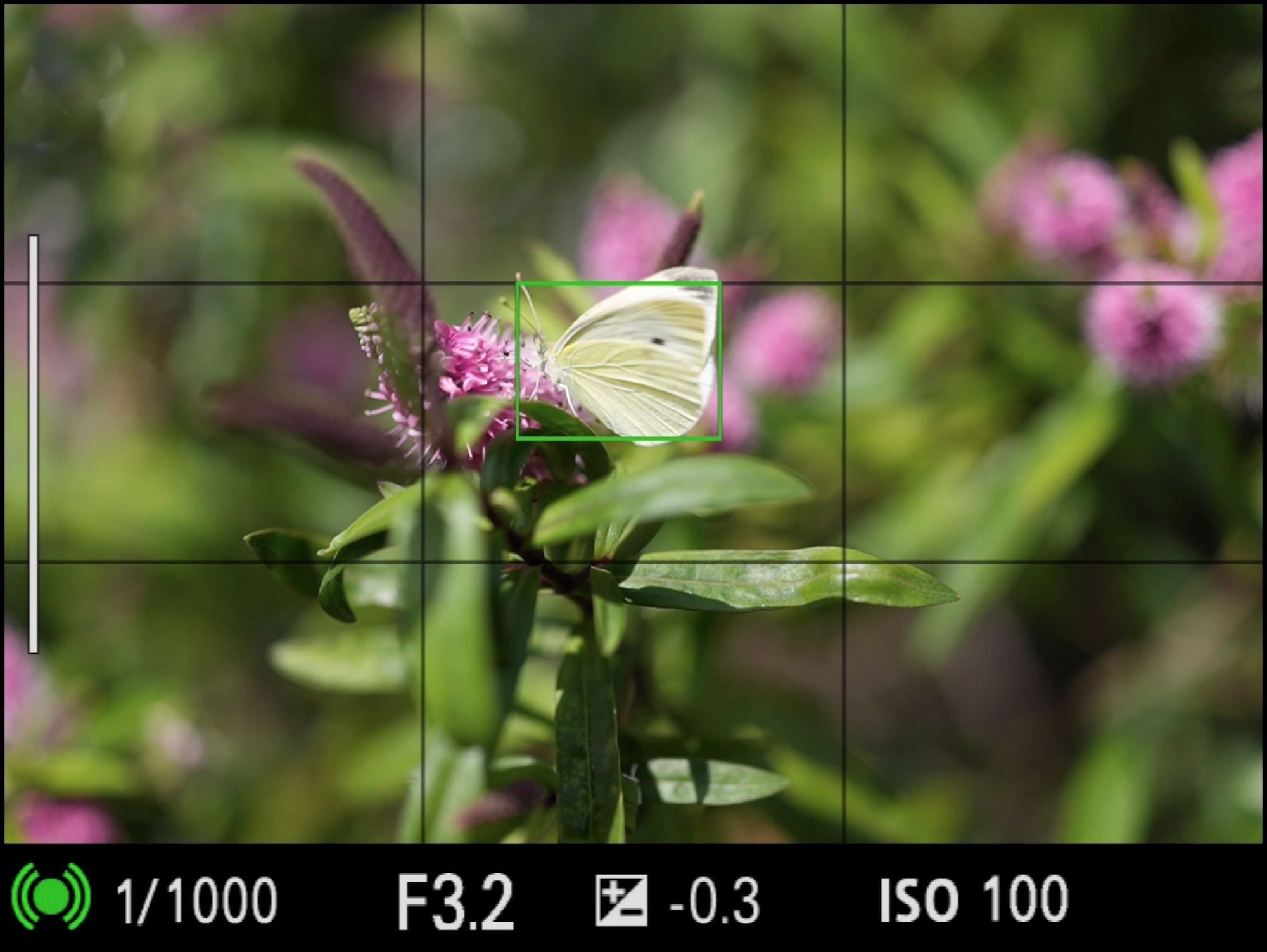
Beyond eye, face, and human body detection, the camera offers several additional recognition modes. The RX1R III can track different types of animals, including birds (with eye, face, and body detection), as well as insects.


With the macro mode and a bit of patience, you can capture truly striking shots that wouldn’t even be conceivable with the AF of a Q3 or a GFX 100RF. The camera also supports recognition of vehicles such as trains, planes, cars, and helicopters, but excludes two-wheelers.


It fulfils its mission without difficulty, despite the aging AF motors of the lens. This tends to prove the good foresight of Zeiss and Sony’s engineers regarding the future of autofocus, going back to 2012.
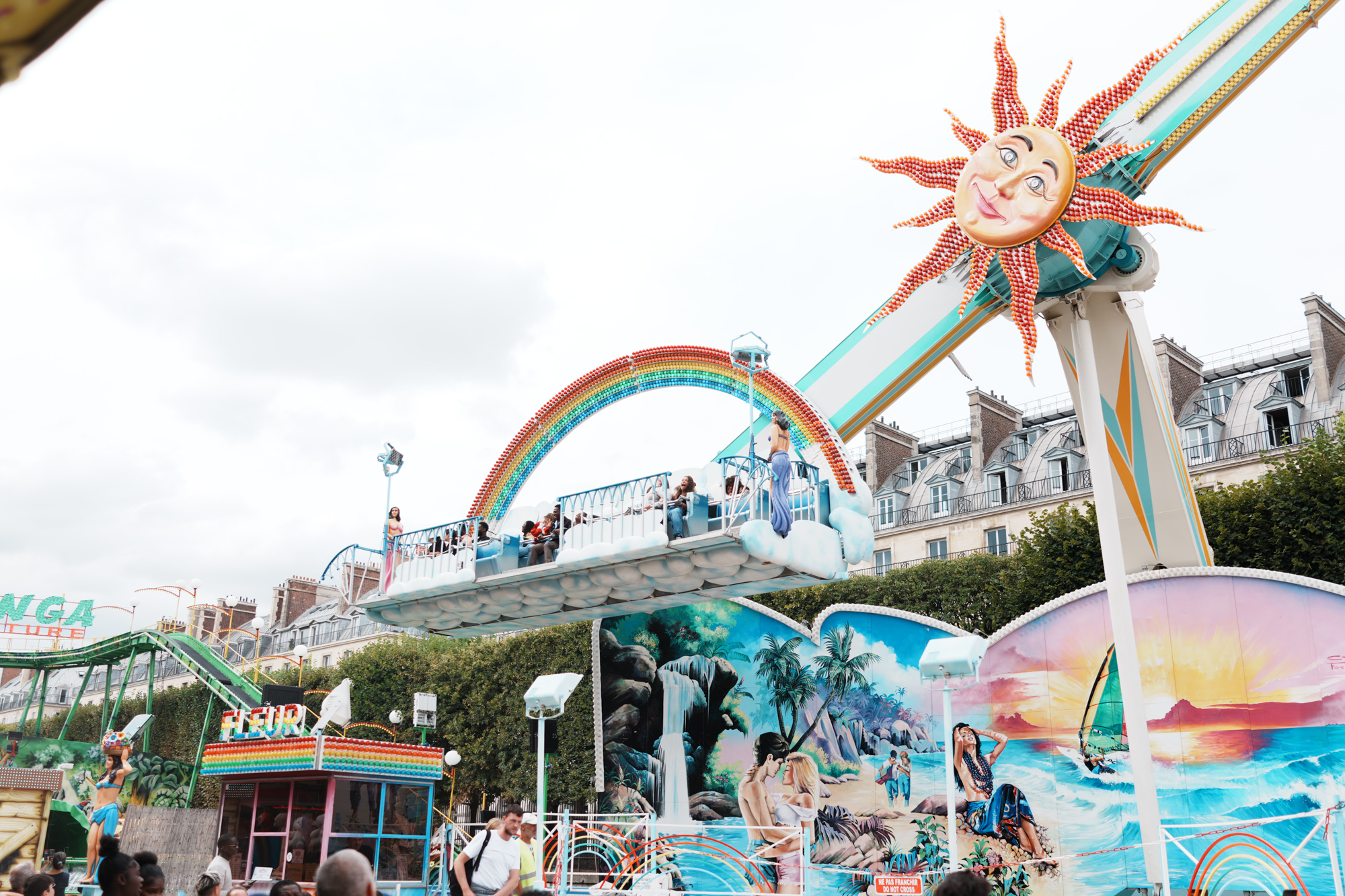

The only slightly disappointing point (especially for videographers) concerns the AF motor noise. Far from being totally silent like on a Fuji X100VI, you can hear it moving. Nothing too bothersome for stills, but it could prove more problematic for video if you don’t have an external audio recording setup.
Burst rate and buffer
A far cry from the performance of a Sony A9 III, the RX1R III is clearly the manufacturer’s least suitable body for burst shooting. Indeed – regardless of the shutter type – the camera manages just 5 fps (with AF-C)! But that’s still twice as fast as the RX1R II. And it also outperforms its rival the Leica Q3, which achieves only 4 fps in AF-C.

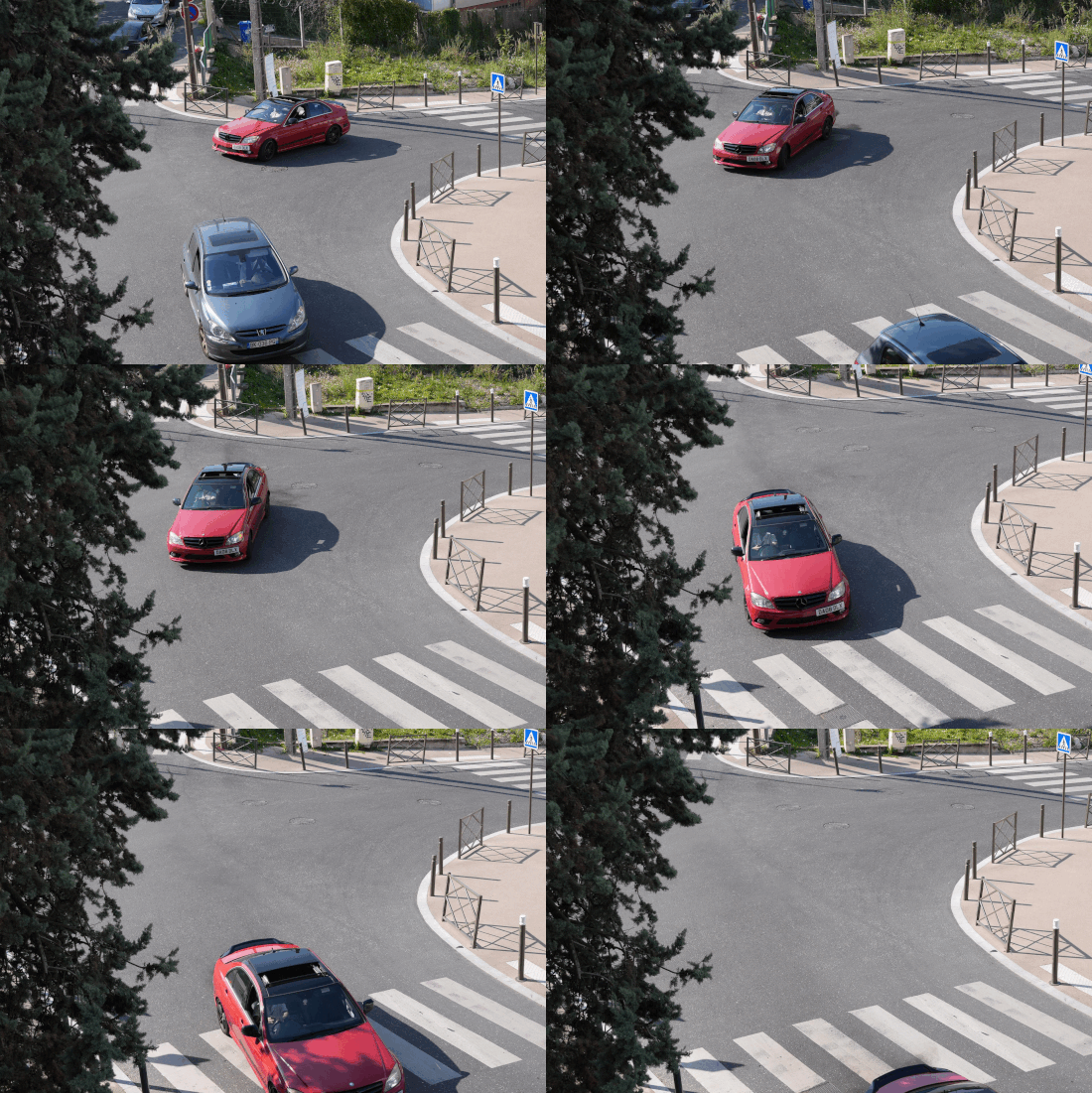
Of course, at this frame rate and with a sophisticated AF system, tracking works flawlessly. However, you’ll have to deal with a very limited buffer. Indeed, the buffer can only handle 15 consecutive uncompressed RAW files before filling up. By selecting compressed RAWs, you can record up to 52 shots, or over 10 seconds of burst.
In any case, the RX1R III isn’t built for sports or wildlife photography. At a stretch, for weddings or reportage… but only if the procession isn’t moving at a brisk pace.
Rolling shutter
Like the A7R V and A7C R before it, the RX1R III proves highly susceptible to rolling-shutter distortion with the electronic shutter, not to mention banding under artificial lighting.

One uncontrolled movement and your subject will turn into jelly. In the vast majority of situations, you’ll prefer using the leaf shutter. It is particularly smooth and discreet, perfect for capturing quiet moments. It also allows flash sync up to 1/2000 s.
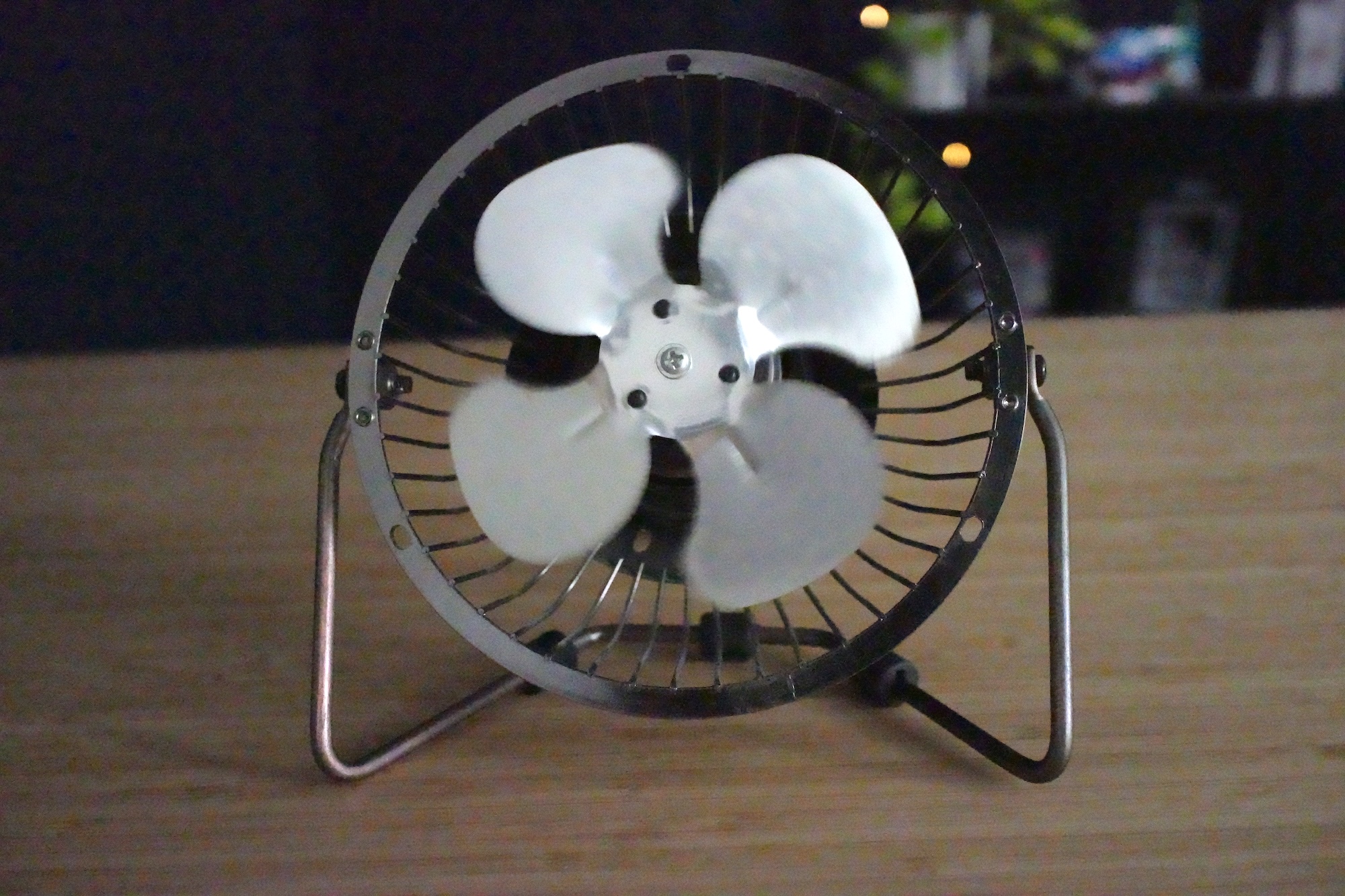

However, the leaf shutter tops out at 1/4000 s. Without a built-in ND filter, if you need an even shorter shutter speed, you’ll have to settle for the electronic shutter (max. 1/8000 s) and the rolling shutter effect mentioned above.

You won’t hesitate long before investing in a small 49mm screw-on ND filter for your lens.

Sony RX1R III: stabilization neglected
Unfortunately, the Sony RX1R III integrates no form of stabilization whatsoever. That’s a real shame – especially since competitors do better. We’re thinking of Leica, which offers optical stabilization on its Q3 and Q3 43, or Ricoh with its GR III. In both cases, stabilization works on 3 axes for a limited but very real benefit.
Fujifilm even managed to miniaturize a stabilization unit for its X100VI, with 5-axis stabilization as a result. But for its GFX 100RF, the company didn’t repeat the feat. The RX1R III suffers from the same original sin.

Sony chose not to modify its lens. Integrating sensor-shift stabilization would likely have added bulk to the body. And since the very compact size of the RX1R III is one of its key assets (if not the main one), Sony wasn’t willing to compromise on this.

One could always argue that sensor-based stabilization is still fairly recent in the history of photography. But it remains extremely practical, even essential – especially with high-resolution sensors that are very sensitive to the slightest vibrations, as is the case here.
Fortunately, thanks to a relatively wide-angle and fast compact lens, the risk of camera shake is lower than if Sony had opted for an 85mm. That said, getting a sharp shot below 1/10 s is a feat in itself, and reaching a full second handheld is closer to a Herculean task.




In practical terms, unless you’re on a tripod, doing intentional motion blur, or in an extraordinary situation, you’ll want to keep shutter speeds above 1/50 s, or even 1/80 s to be safe. The lack of stabilization is a major drawback. That said, in the majority of situations this body is designed for, you won’t mind too much – unless you only shoot at night…
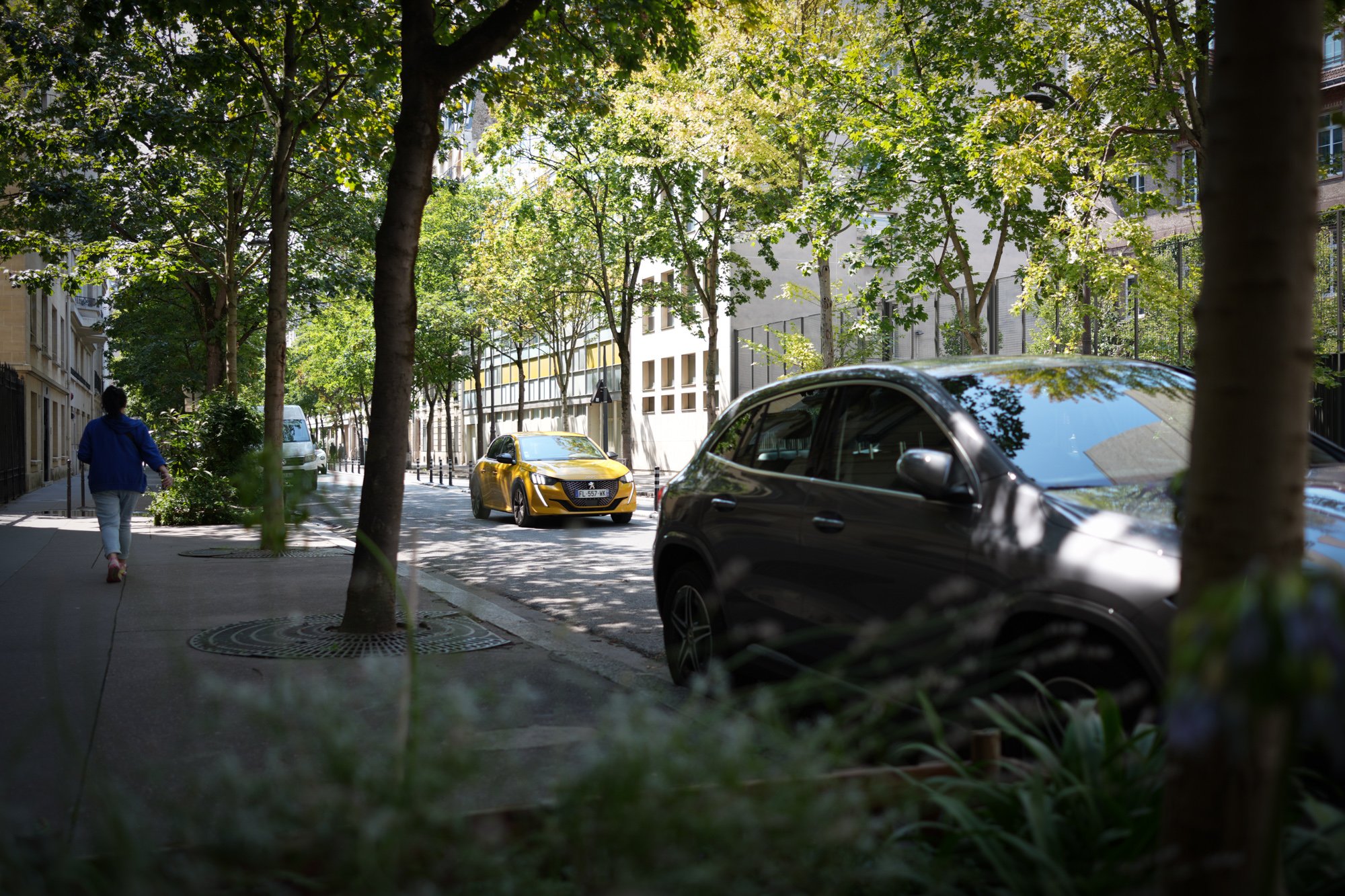
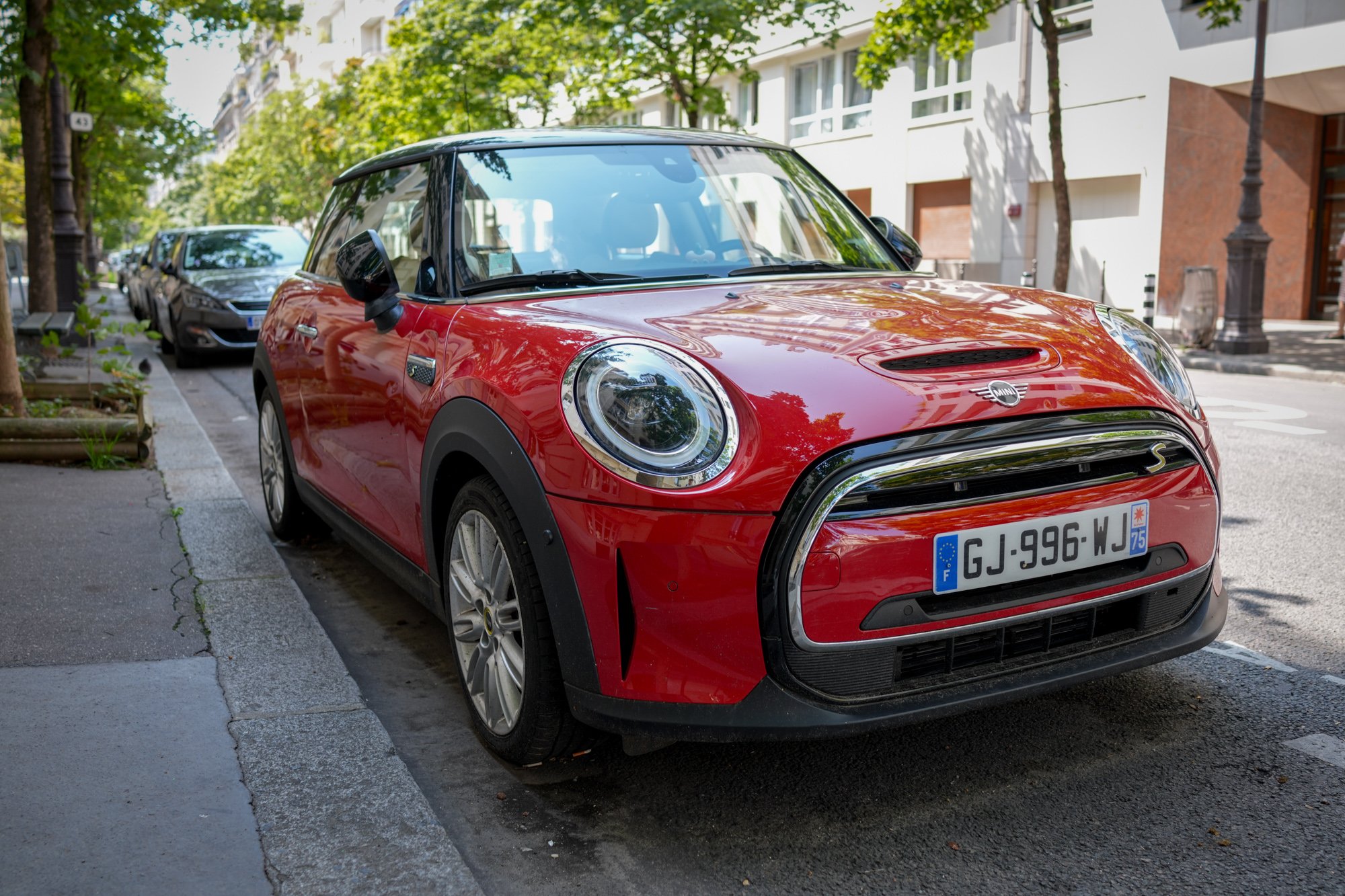
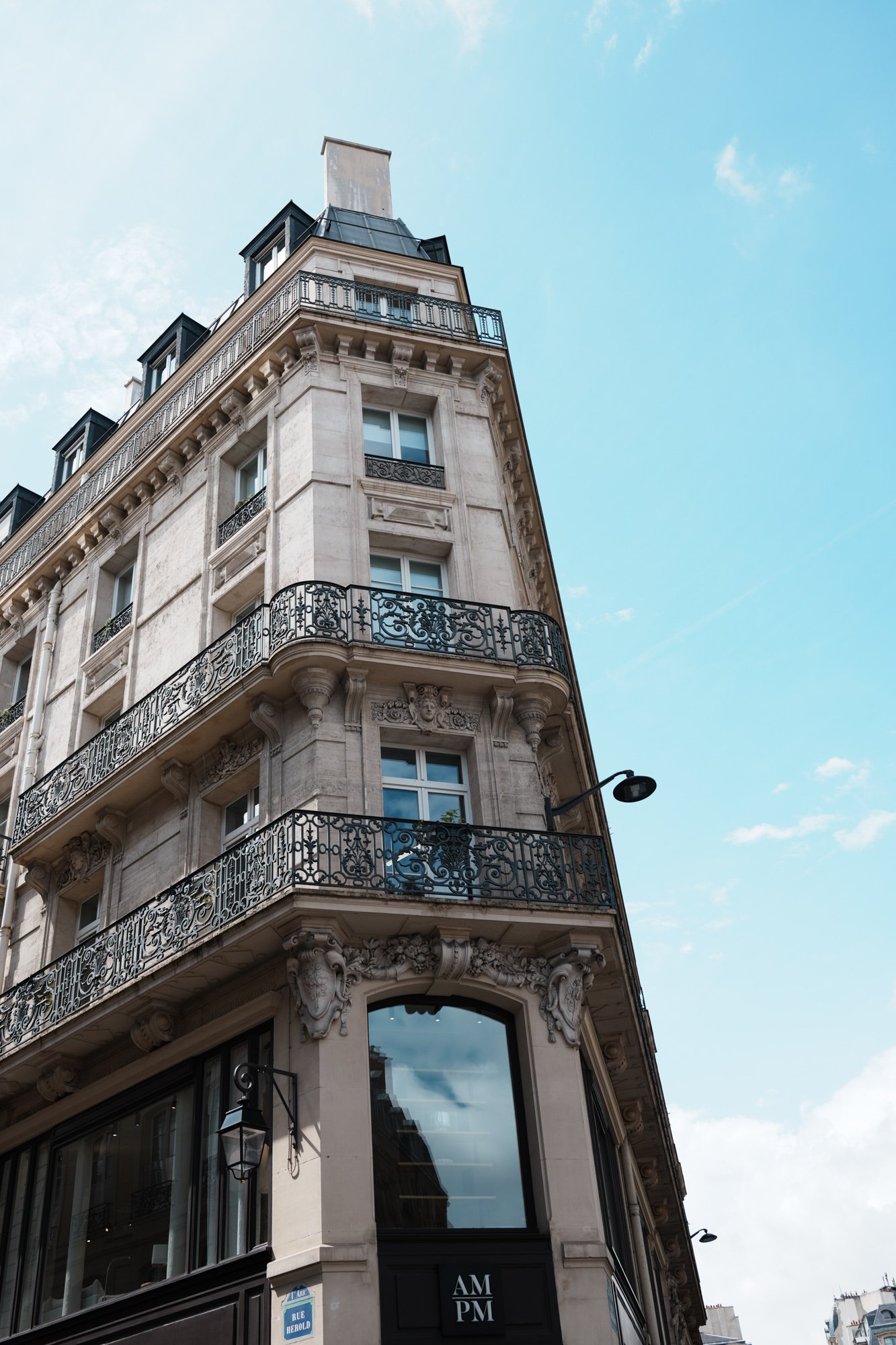
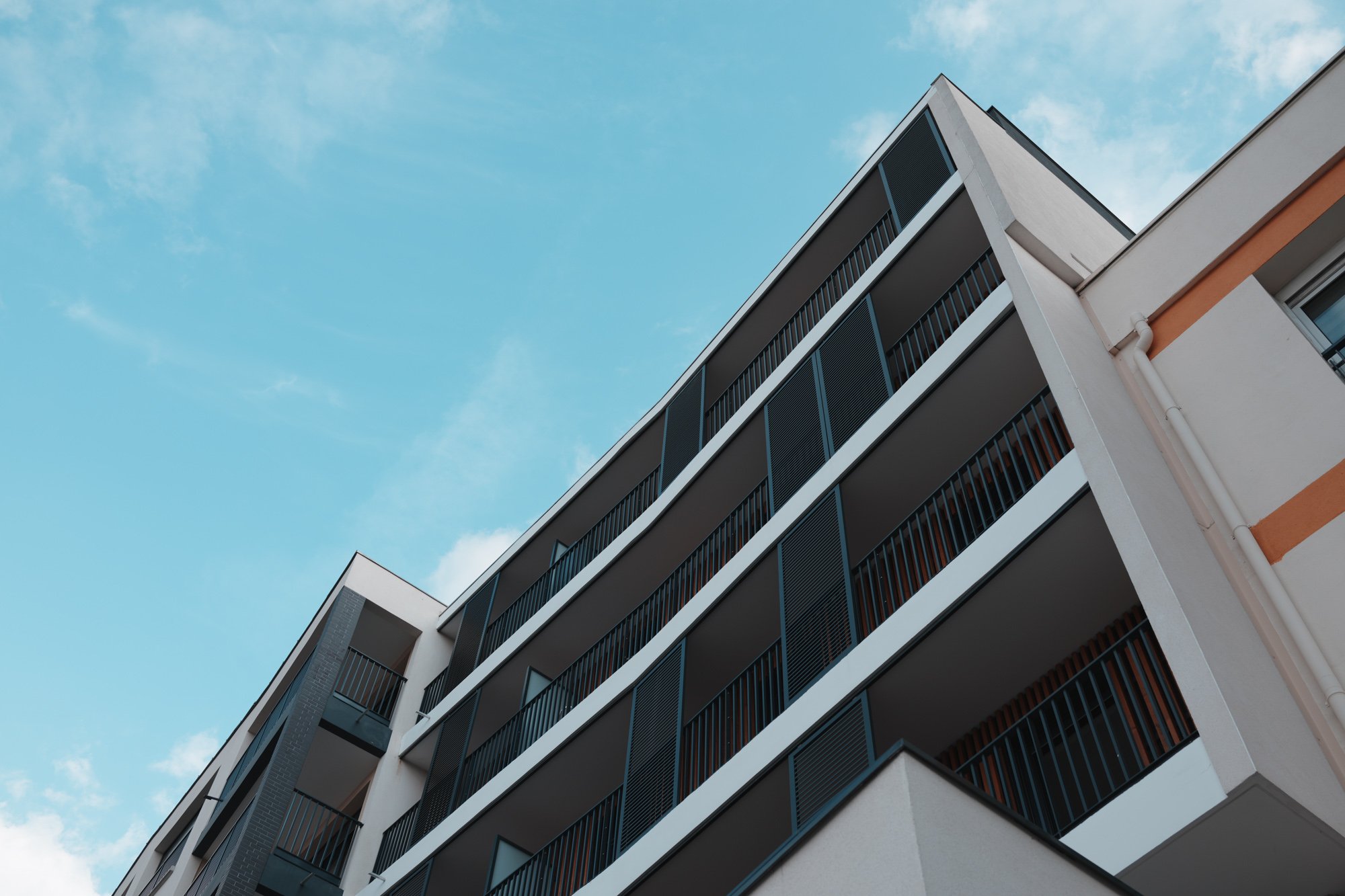
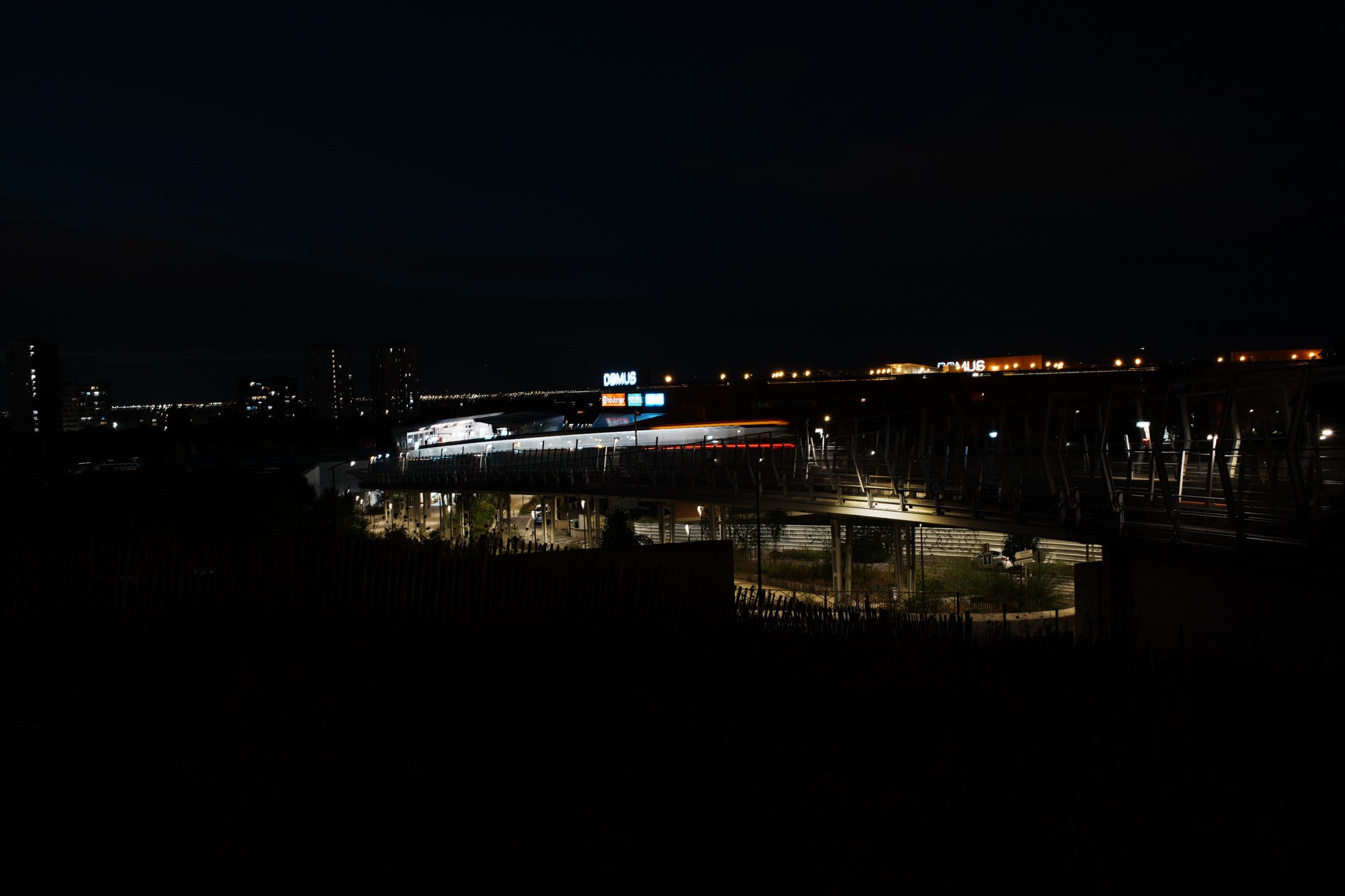
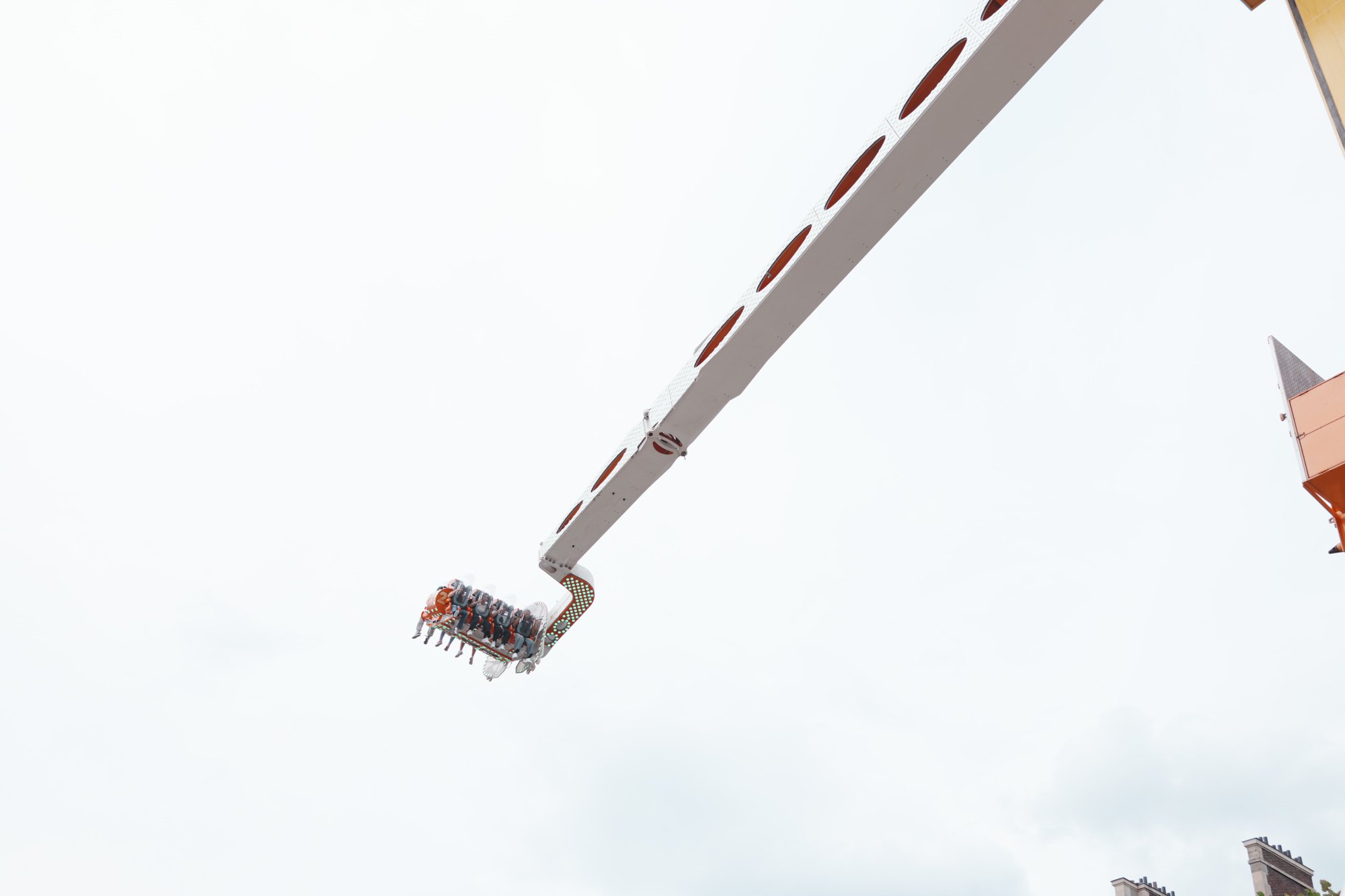
Here is a selection of photos taken with the Sony RX1R III:































Video: the RX1R III, a backup camera
While the Sony RX1R III is perfectly capable of recording video and boasts an ultra-high-performance autofocus, there’s little chance it will become a true ultra-portable video camera. Indeed, no 8K and not even 4K 60 fps. Here, the body is limited to 4K UHD 30p in 4:2:2 10-bit (300 Mb/s). If the Sony A7C R already saw its video capabilities trimmed compared to the A7R V, the RX1R III loses even more options.
While the footage is of very good quality, it falls quite short of what the competition offers.

The lack of stabilization – despite electronic assistance – doesn’t help improve the picture. Still, handheld and with well-controlled movements, the electronic stabilization does a decent job of compensating for shake. The result is quite interesting, although you’ll have to live with a fairly significant crop. With stabilization disabled, using a tripod is essential.
Finally – and this applies to this Sony’s rivals as well – high-resolution, non-stacked sensors are clearly not videographers’ best friends. The sensor readout speed is far too slow and rolling shutter too pronounced to hope for successful footage.
Limited battery life… and limiting
The Sony RX1R III uses the “antiquated” NP-FW50 battery. This small 1050 mAh cell had been replaced by the NP-FZ100 on most of the brand’s cameras since its introduction on the A7 III. In 2025, perhaps only the veteran Sony A6400 still uses it.
According to Sony, this battery can last between 270 and 300 shots, depending on whether you use the viewfinder or the screen. That’s modest, but still better than the RX1R II and its tiny NP-BX1 battery still found in the brand’s other compact cameras.
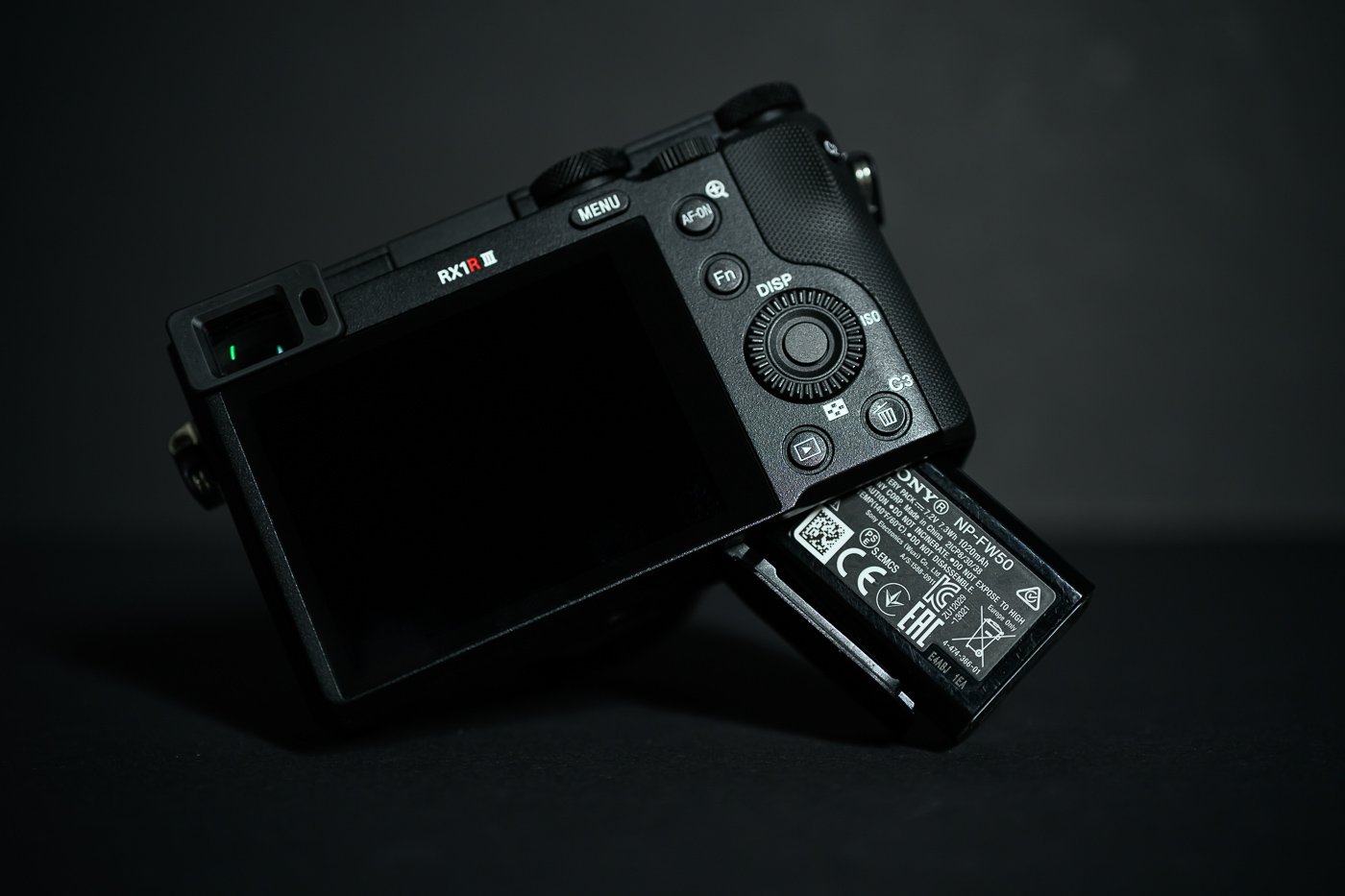
In the field, we managed to reach 370 images and a few (short) video clips before the battery gave out. That’s not very impressive, and you’ll need to bring one or two spare batteries to get through the day.
Fortunately, this isn’t a camera where you’ll be shooting for long sessions, and it can be easily recharged via its USB-C port.
Connectivity and storage
In terms of connectivity, the RX1R III doesn’t overdo it. The body features a USB-C port, a micro HDMI port, and a 3.5mm jack (microphone).
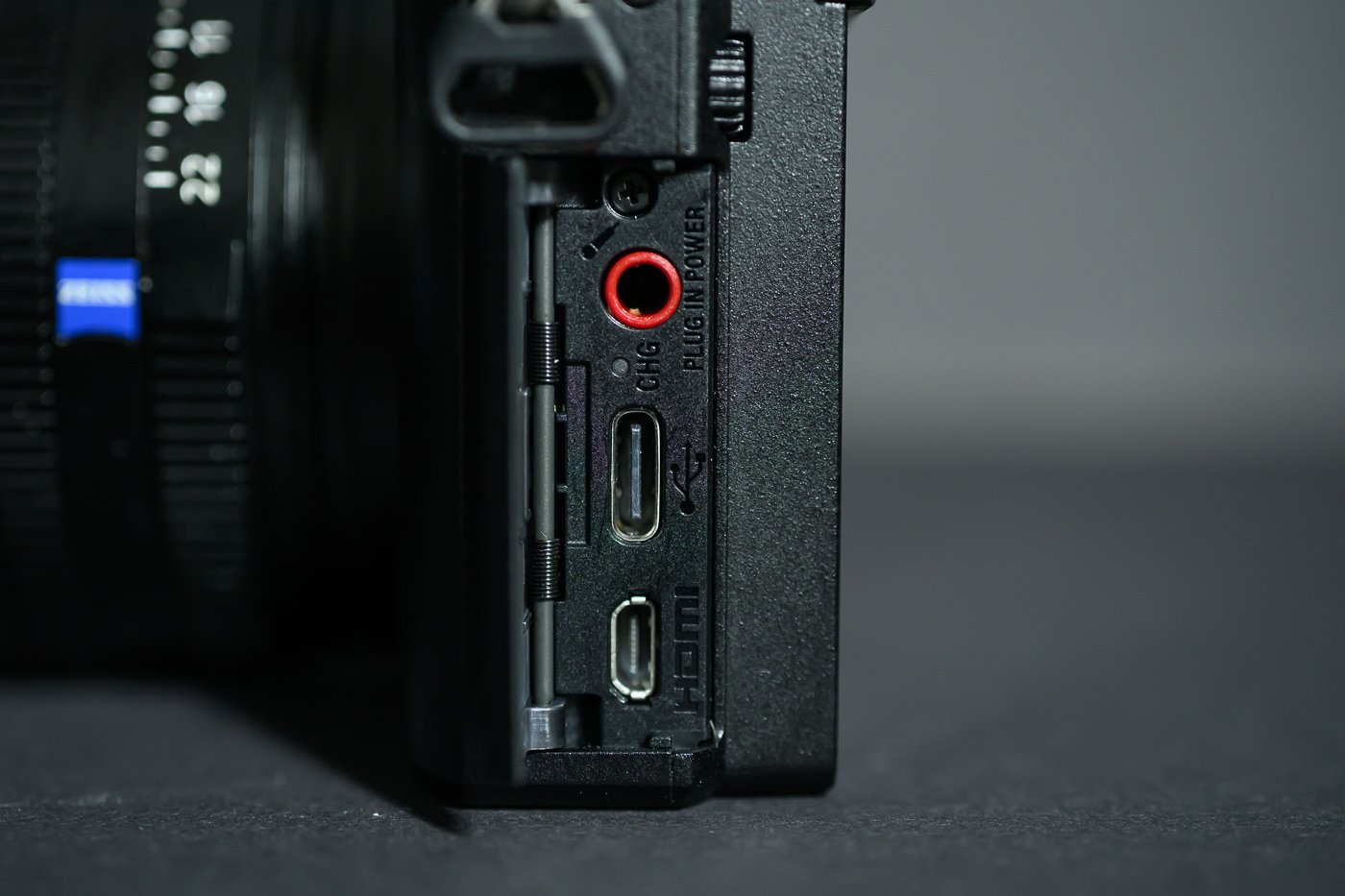
In short: the body offers the bare minimum for charging, data transfer, and connecting an external monitor if needed, or a microphone. For headphone monitoring, you’ll need an adapter, sold separately. Since the hot shoe accepts a digital microphone, it’s rather odd that Sony didn’t choose to include a headphone jack instead.
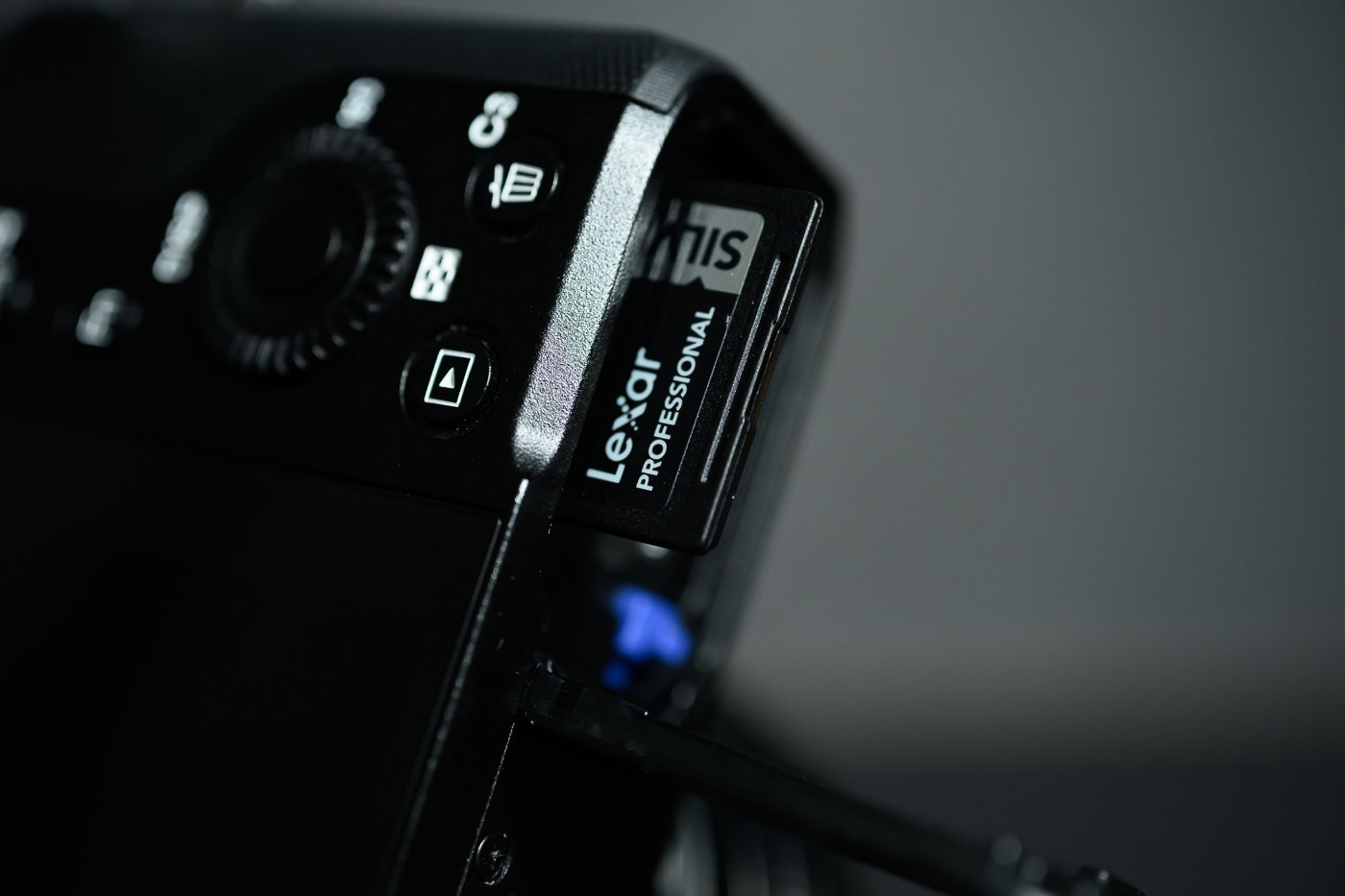
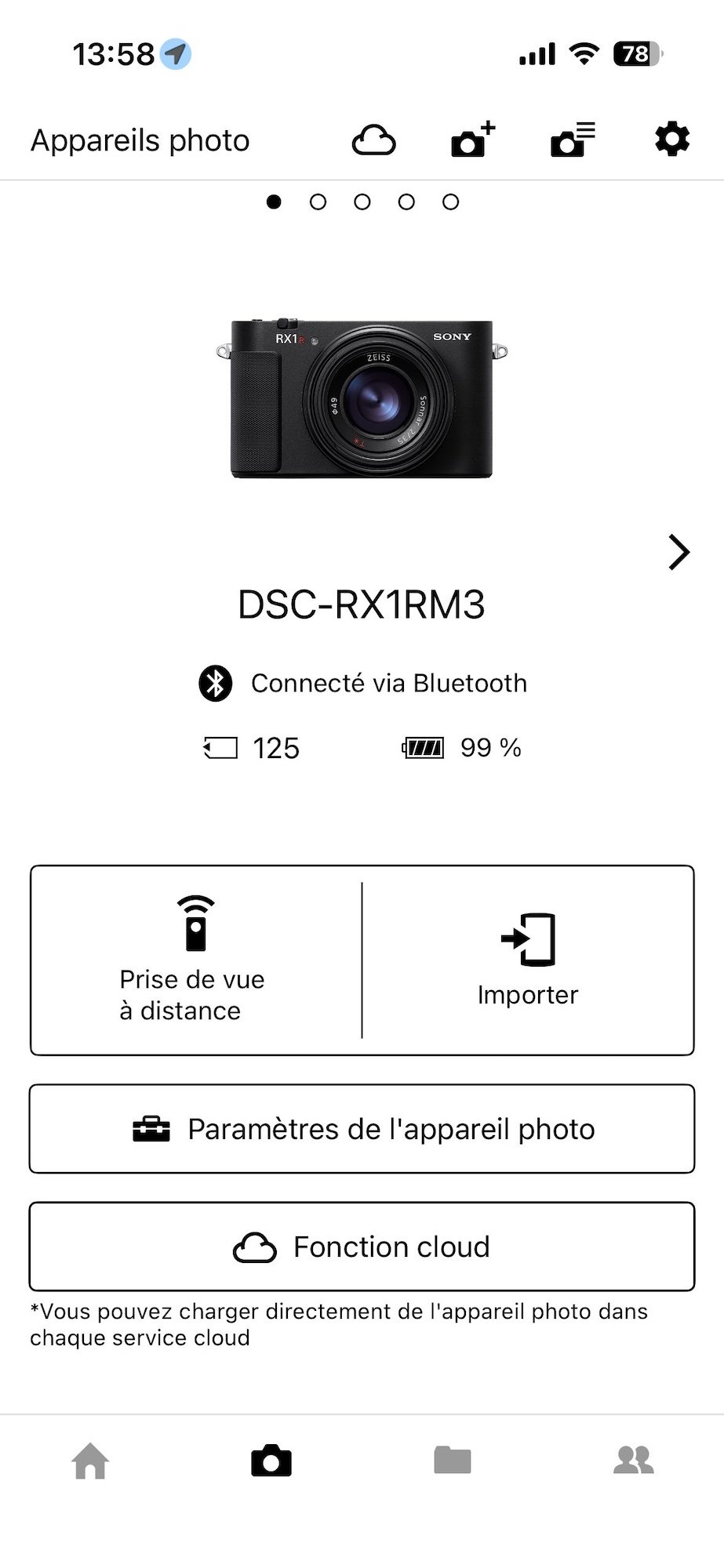
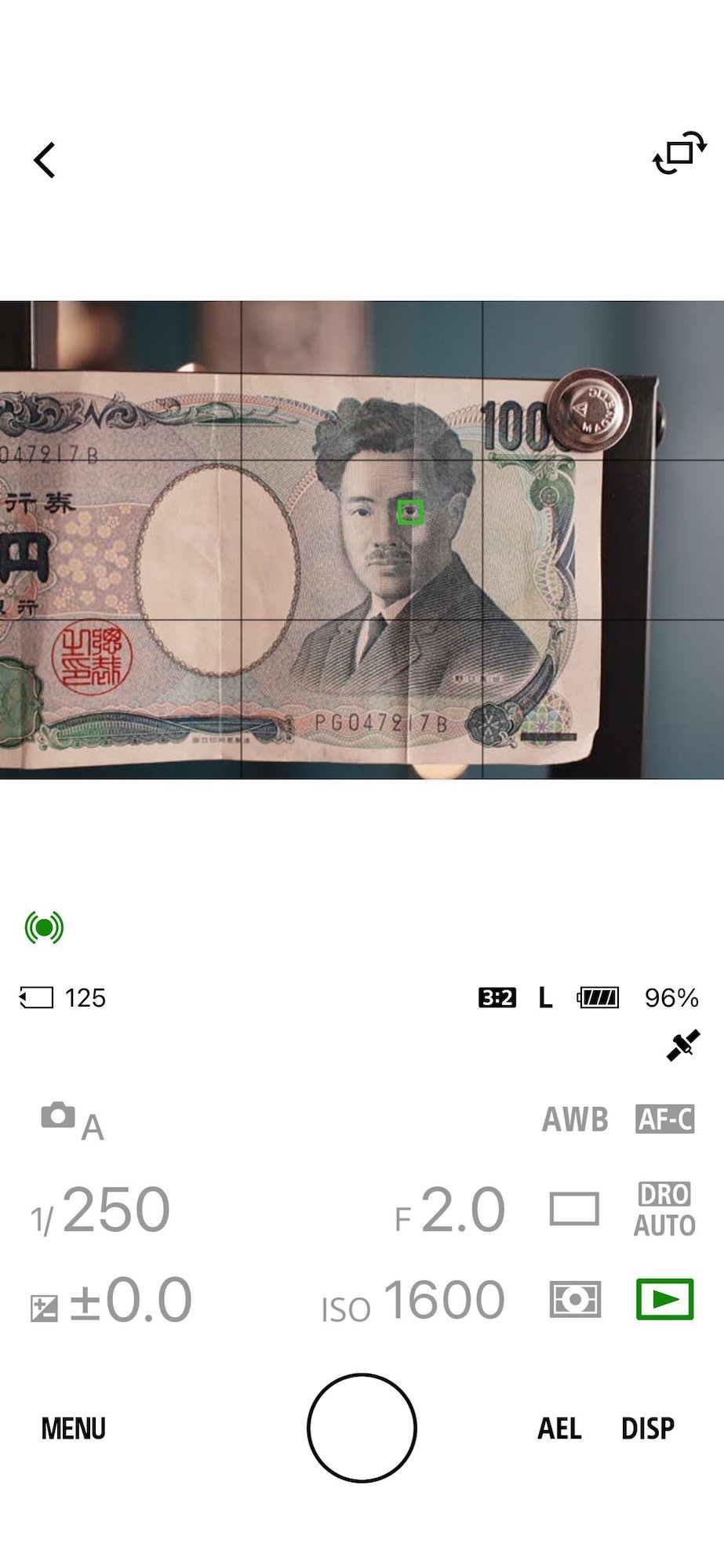
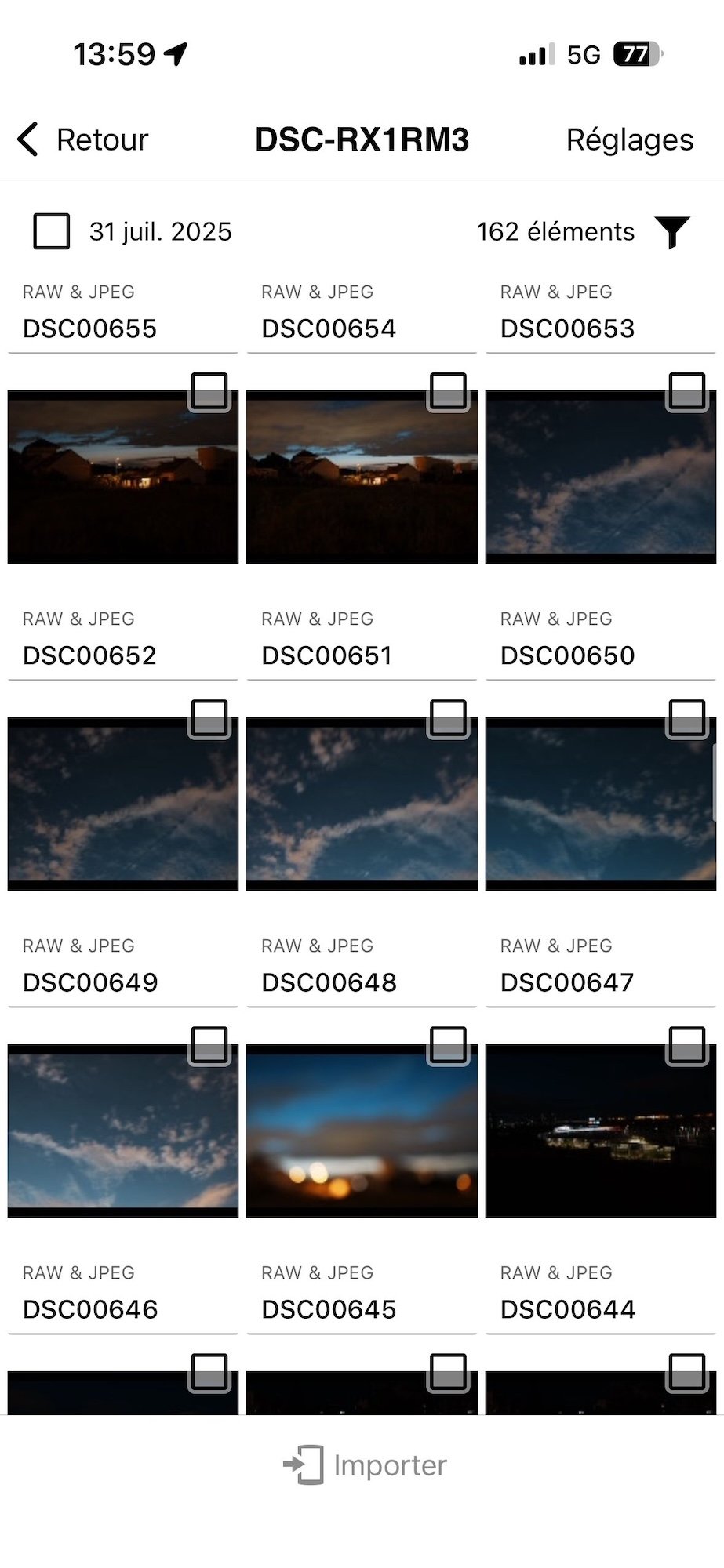
Data storage is handled by a UHS-II SD card located in the battery compartment. The body works very well with the Sony Creator’s App – the connection is fast and smooth, allowing you to transfer your photos or update the firmware.

Sony RX1R III: the most appealing and the most frustrating compact camera
Like many insiders, the author of these lines had been waiting for ages for Sony to renew (resurrect would be more accurate) its RX1 lineage.
Above all, with the “proliferation” – heavy quotation marks needed – of models on the premium compact market, it was clear that Sony, THE brand synonymous with miniaturization, had a card to play.
But it must be said that the company is playing a peculiar game. On one hand, the RX1R III retains what made previous models so appealing: a full-frame sensor and a fast lens, all in a tiny body.
Moreover, Sony equips its compact camera with its best sensor (excluding stacked designs) and its most advanced autofocus system. The result: a remarkably effective and reliable combo. The images are beautiful, detailed, and offer a precision never seen before on compact cameras (premium or otherwise).
On the other hand, Sony brings no magic, no revolution here. Every “new” component or improvement comes, without exception, from the manufacturer’s other product lines. The only truly new addition is the two FL2 and FL3 picture profile variations. We’ve seen more ambitious efforts.
Sony even shows a puzzling conservatism by carrying over a Zeiss 35mm f/2 lens that’s nearly 15 years old, while the manufacturer arguably makes the best lenses on the market! We also regret the total lack of stabilization, the cramped viewfinder, and above all the fixed screen, going against everything the competition offers (Ricoh aside). It’s also a step backward from the RX1R II…
But above all, it’s hard not to mention the price tag. Typically, the logic is that a premium compact camera should offer a better value proposition than the mirrorless / rangefinder body it draws from, paired with a similar lens. This holds true for the Leica Q3 or the Fujifilm GFX100RF / X100VI. It was also the case for the Sony RX1R II in 2015. Here, that logic evaporates on the altar of opportunism – unless it’s tariffs?
Indeed, the Sony RX1R III is priced at… $5,098, while a Sony A7C R paired with a nearly equivalent compact lens (Sigma 35mm f/2 DG DN Contemporary, or even the Sony FE 40mm f/2.5 G, FE 35mm f/1.8, or even FE 28mm f/2) comes in at roughly $3,700 to $4,100. The same applies with the Sony A7R V, where you’ll always stay under $5,000, with a far better-equipped body.
So here’s the dilemma. For us, the Sony RX1R III remains undeniably attractive. For those seeking a more minimalist approach to photography, without compromising on image quality or AF precision, the RX1R III is a gem. A marvel of engineering that you’d want to carry with you at all times, overlooking the lack of stabilization, the antiquated viewfinder, or the hopelessly fixed screen on the back.
But what about the price? Under $4,000, we would have praised (or at least acknowledged) the fair value proposition of this body, which would have minimized certain imperfections. But Sony does things like nobody else and leaves us with an RX1R III… that we love to hate.
The Sony RX1R III is available at a price of $5,098.