

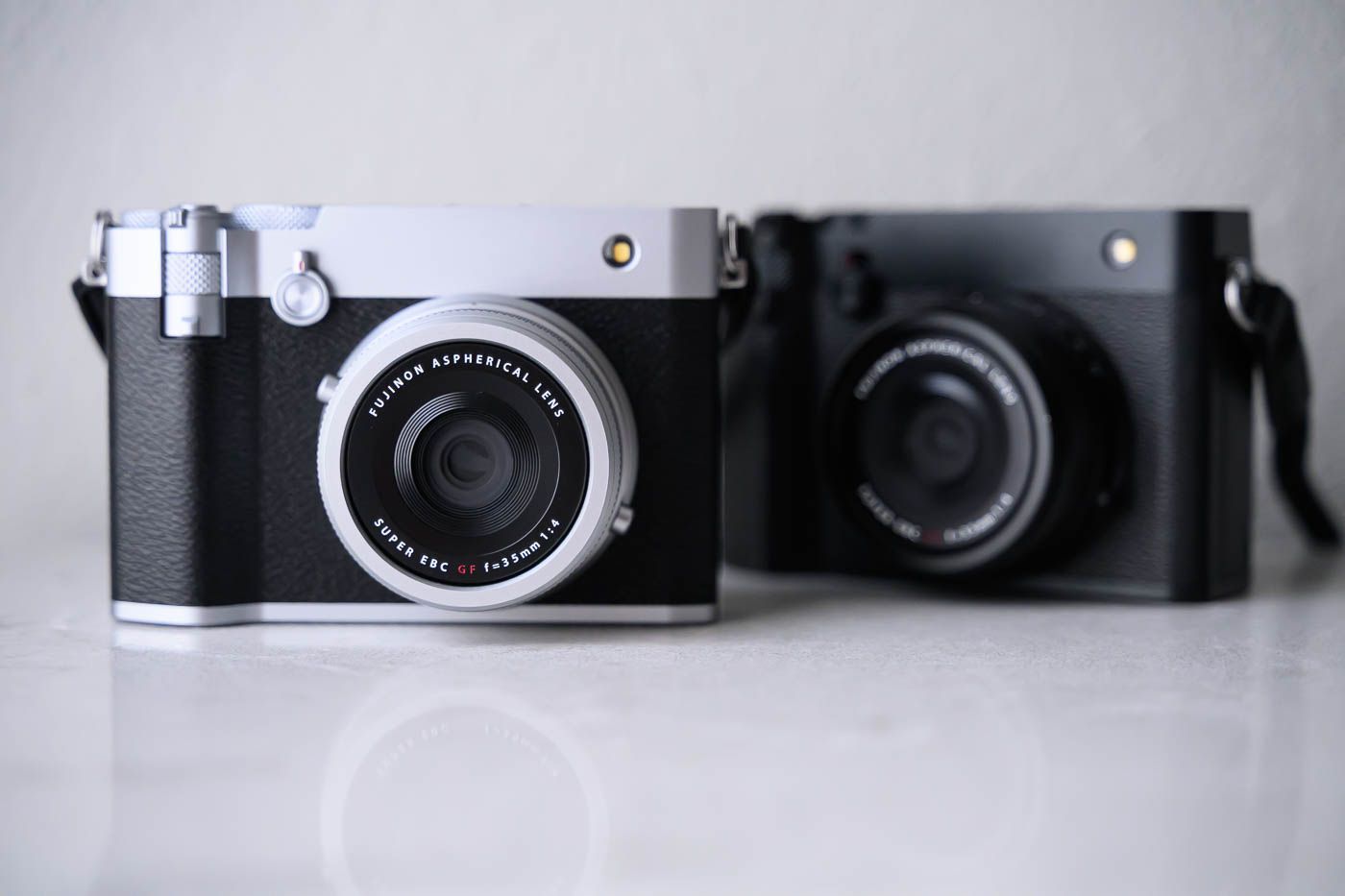

Unveiled in March 2025, the Fujifilm GFX 100RF marks a major turning point for the manufacturer. The first compact camera with a medium format sensor on the market, it sits at the crossroads between the X100VI and the GFX 100S II, packing a 102 MP sensor into a remarkably compact body.
Built around a clean, minimalist design, it features a fixed 35mm lens, equivalent to 28mm at f/4, which can be “extended” through several levels of digital crop. It also offers a 4K 30p video mode. These specs are designed to appeal to street and travel photographers looking for maximum resolution and image quality without the bulk.
On paper, this camera impresses. But does it deliver on its promises in the field? Has Fujifilm managed to build the ultimate compact camera? We used it for several weeks, and here is our full review of the Fujifilm GFX 100RF.

This article has been updated since our initial hands-on with the GFX 100RF published on March 21, 2025.
Sommaire
- Fujifilm GFX 100RF: the GFX 100S II’s technical foundation in an expert compact camera
- Design and build quality: a study in restraint
- Fujifilm GFX 100RF ergonomics: well-thought-out manual controls and comfortable viewfinding
- Performance and image quality of the Fujifilm GFX 100RF
- Autofocus: nearly flawless
- Burst rate and buffer of the Fujifilm GFX 100RF
- (Lack of) stabilization
- The GFX 100RF and video: 4K 30p on board
- Comfortable battery life
- Connectivity and storage
- Conclusion: mission accomplished with the GFX 100RF?
Fujifilm GFX 100RF: the GFX 100S II’s technical foundation in an expert compact camera
After having (widely) popularized fixed-lens expert compact cameras, Fujifilm now aims to bring medium format within reach of all photographers (or nearly so), for everyday use or travel. That is how the GFX 100RF was born, the first expert compact camera featuring a 44 x 33mm sensor and a fixed lens (non-interchangeable). This is reflected in the “RF” designation (Rangefinder Fixed lens).
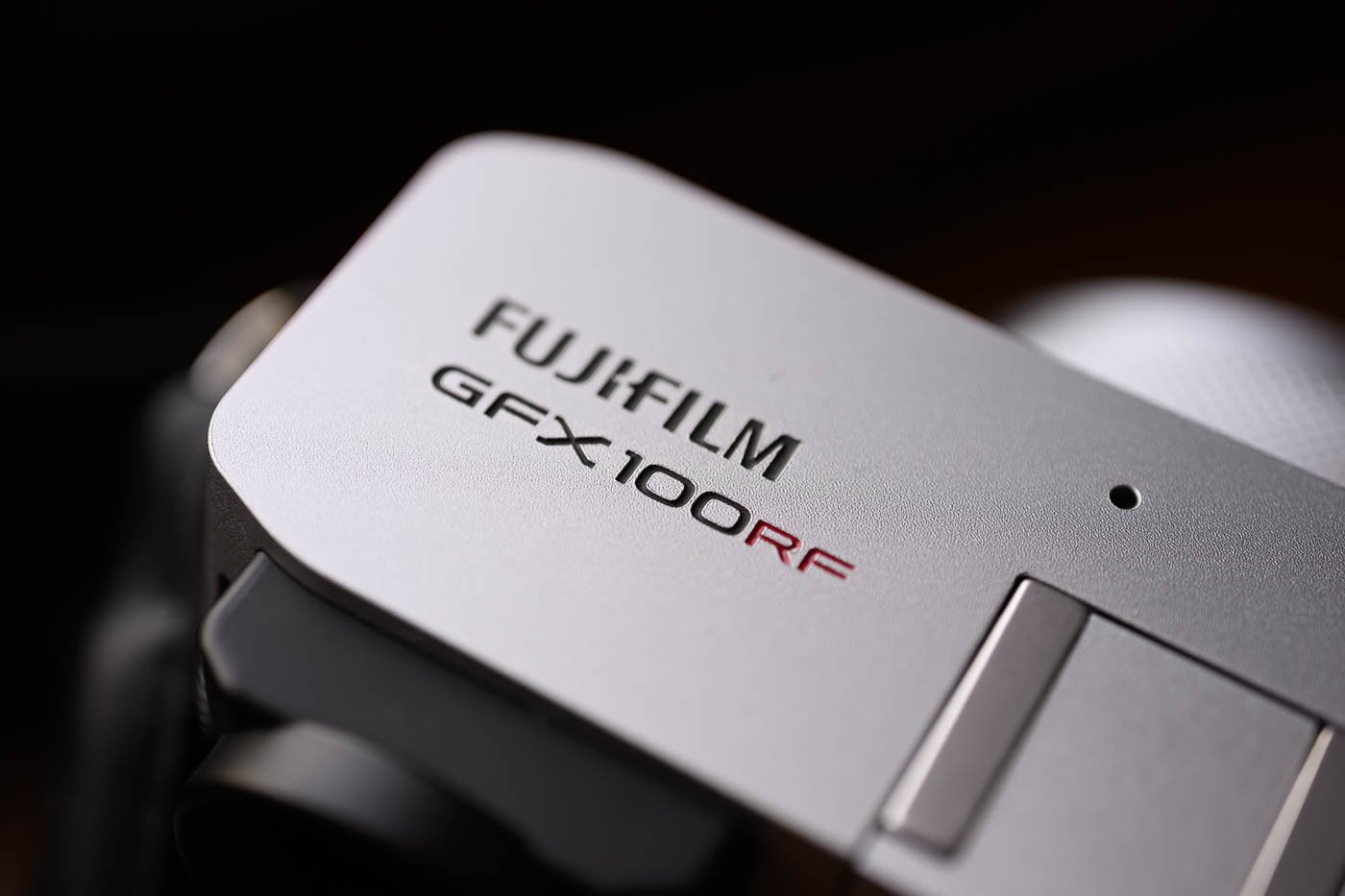
With the GFX 100RF, Fujifilm makes its ambitions clear: take the winning formula of the X100V and X100VI, but with a medium format sensor, significantly larger than APS-C. A serious miniaturization challenge, especially on the optics side, as we will discuss later.
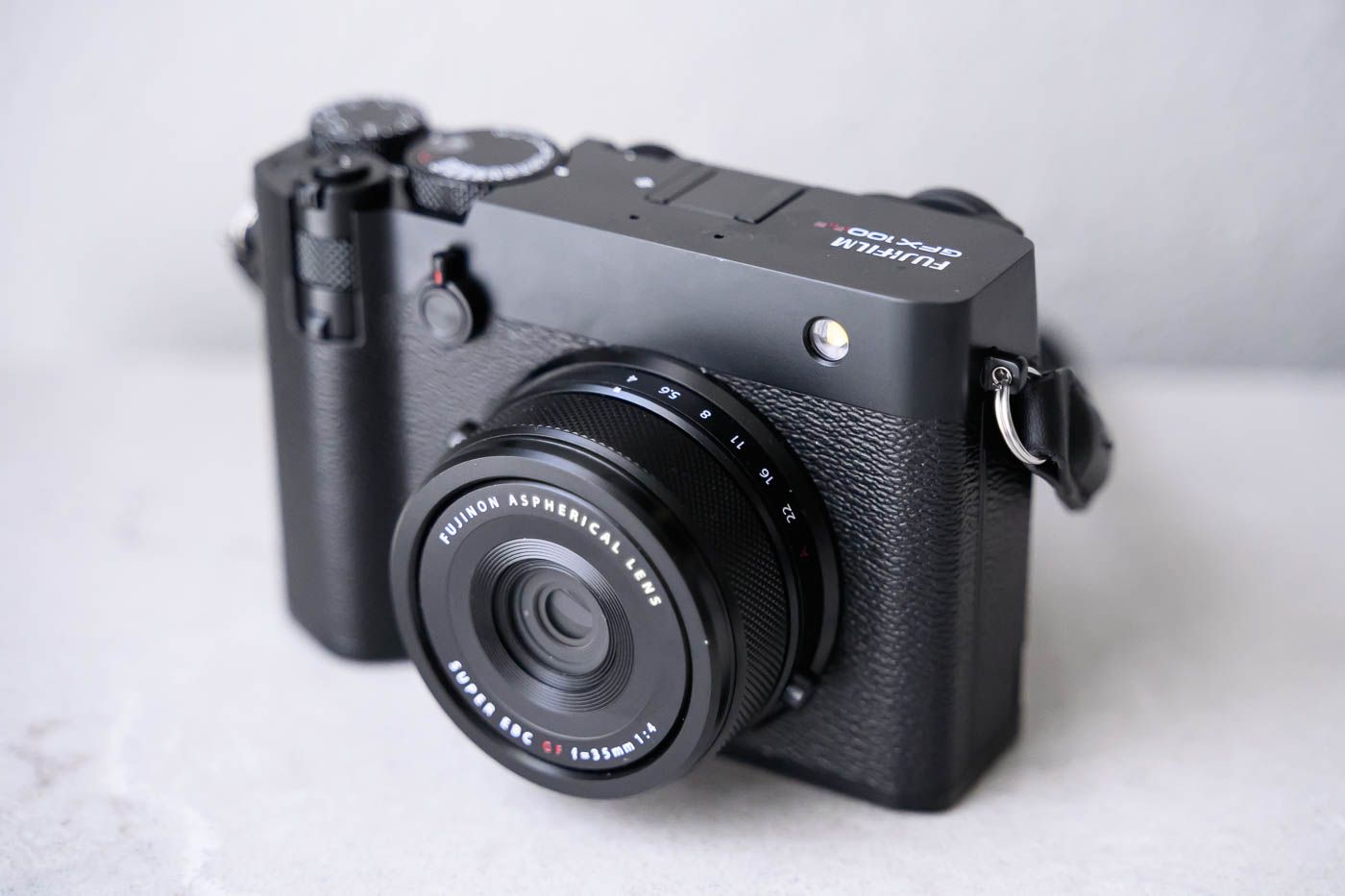
For more details on the Fujifilm GFX 100RF’s specs, feel free to (re)read our article published when the camera was announced. As a reminder, the GFX 100RF uses the same sensor and processor combination as the GFX 100S II, launched 9 months earlier. This means we get an ultra-high-resolution 102 MP sensor paired with the X-Processor 5.
The Fujinon 35mm f/4 Super EBC lens offers a focal length equivalent to 28mm in full frame, well suited for street photography, landscapes, urbex and architecture. The maximum aperture of f/4 is dictated by the camera’s compactness. The manufacturer told us that a faster aperture would have required the rear element to span the entire height of the body!
Unique for a GFX body, the lens features a leaf shutter taken directly from the X100VI.
Design and build quality: a study in restraint
At first glance, three things stand out about the GFX100RF:
- its build quality and level of finish;
- its compactness and portability;
- the number and layout of manual controls.
In terms of finish, Fujifilm is clearly playing in the big leagues and is not afraid to take on Leica head-on. The body, entirely made in Japan, is built from metal. The top plate, base plate, and all dials and control wheels are precision-machined aluminum. The leatherette covering provides excellent grip.
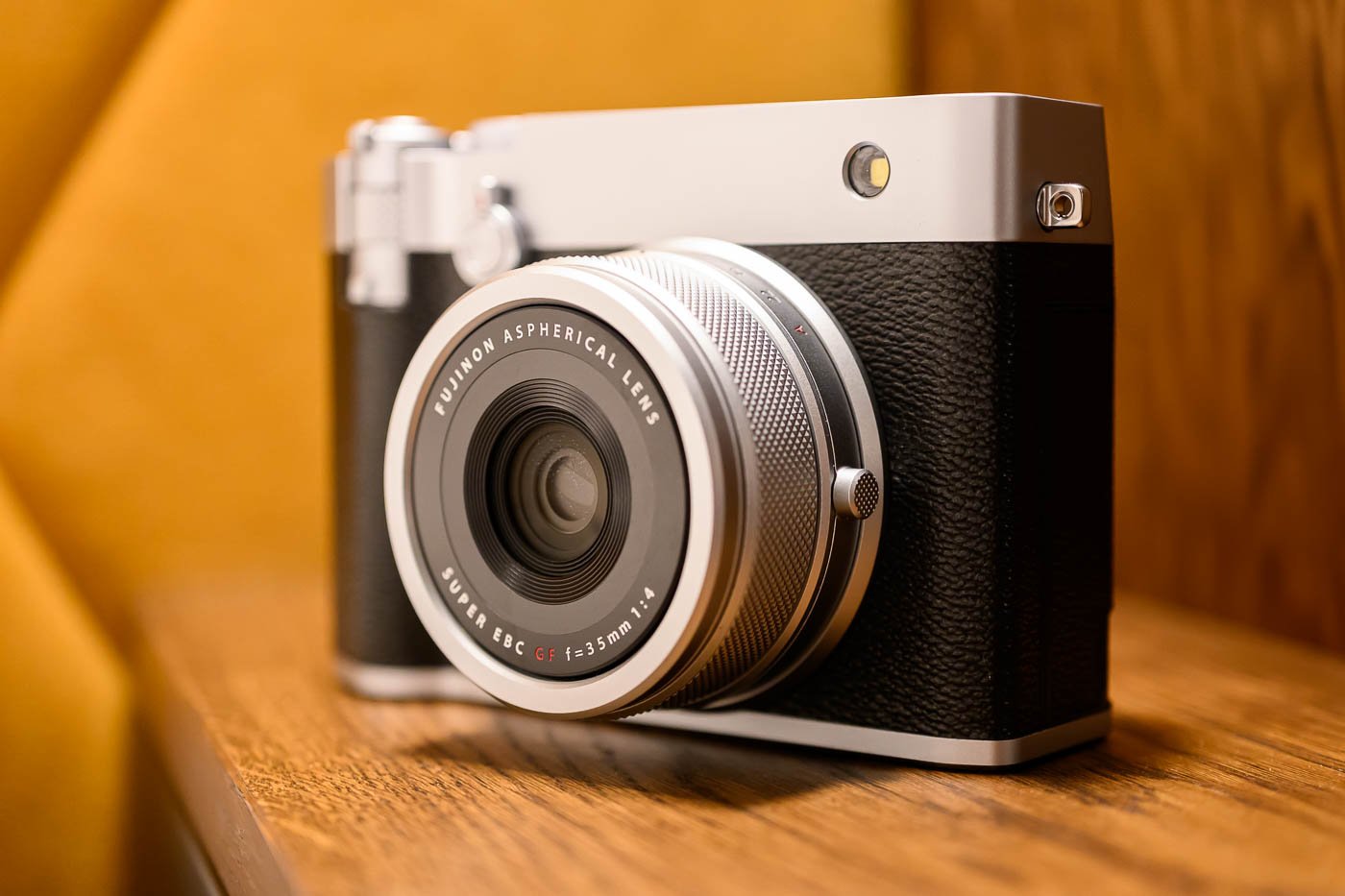
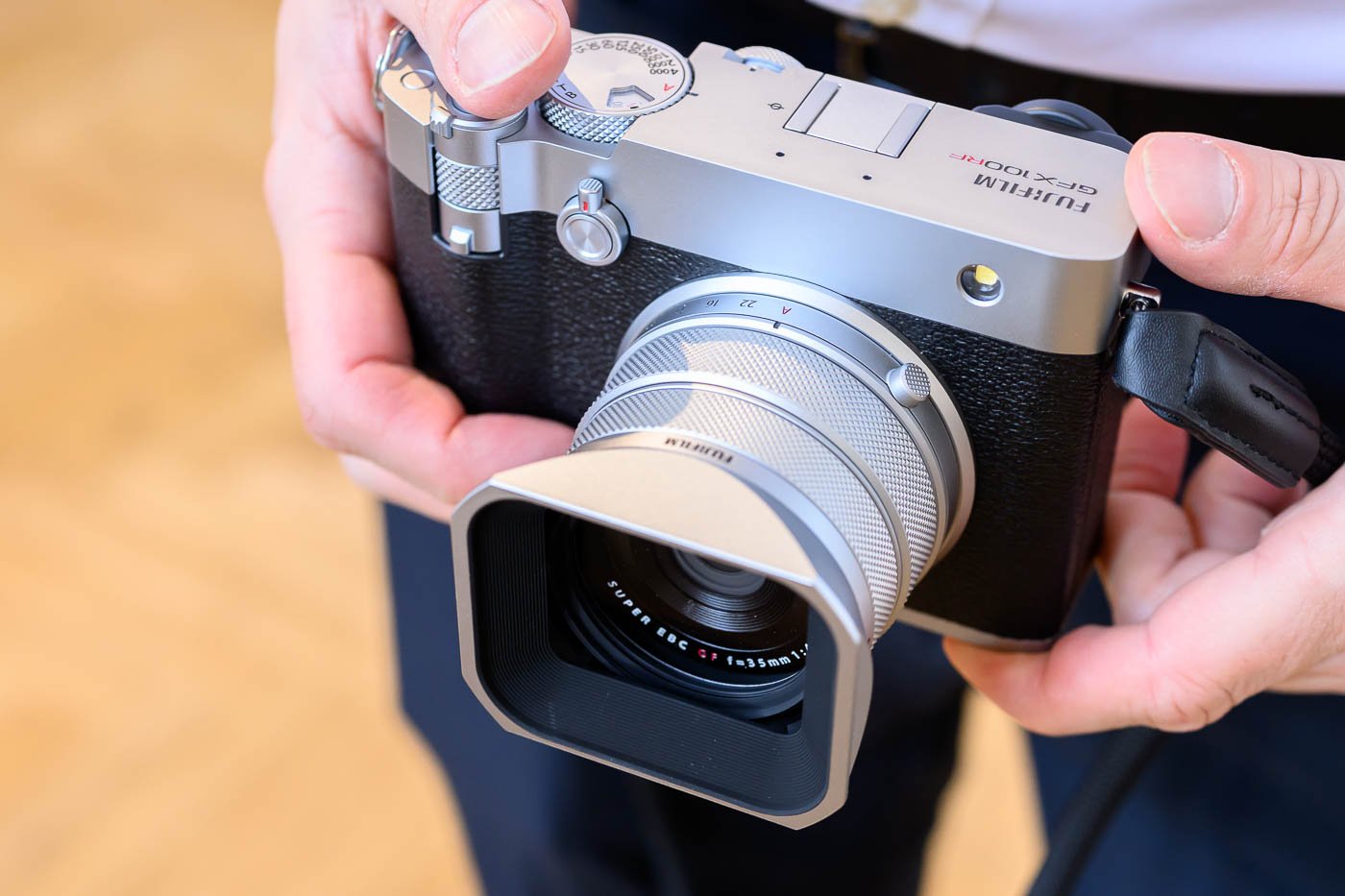
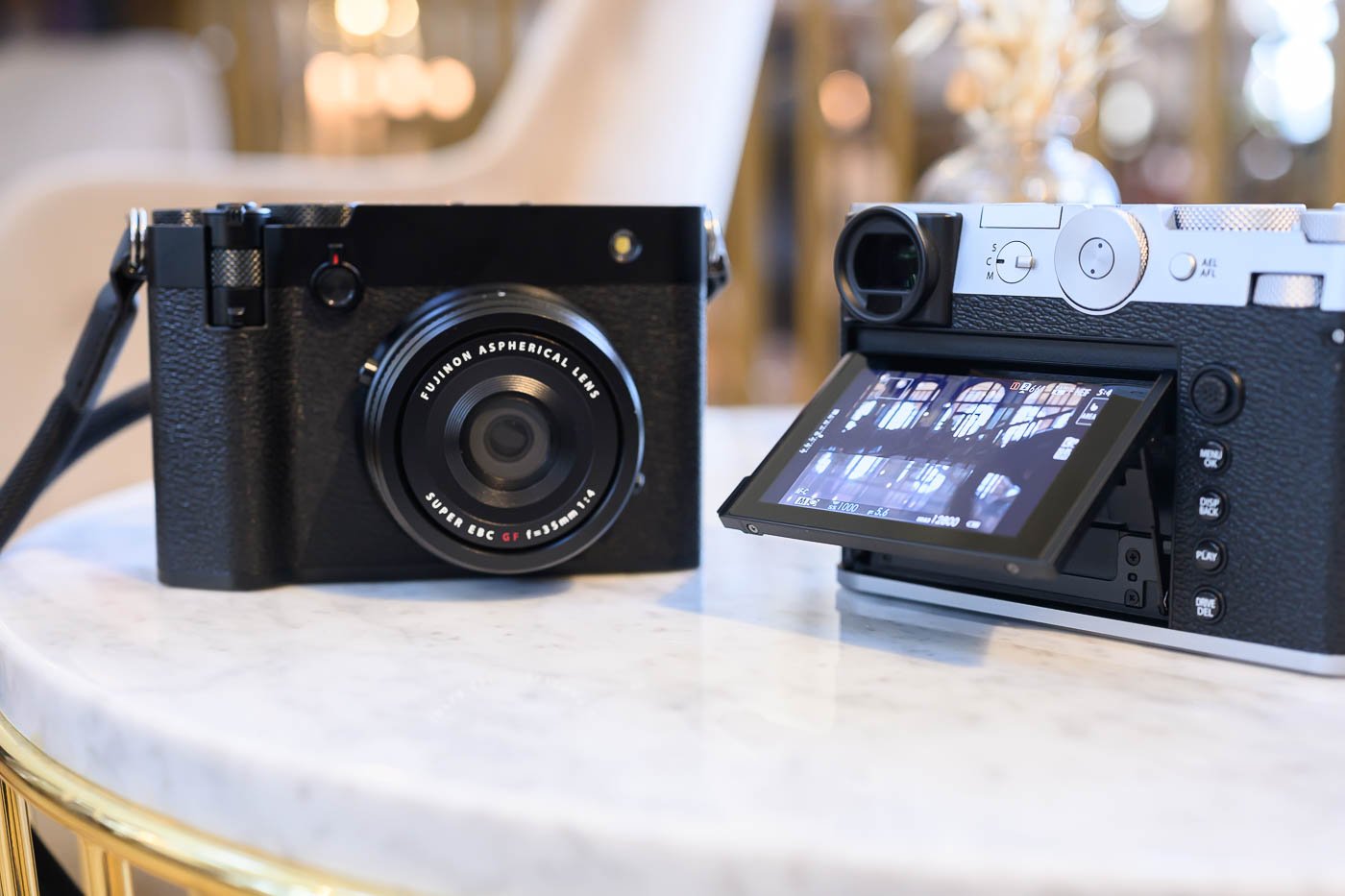
The overall look is remarkably understated. Its decidedly vintage design is reminiscent of the X100 series, but also of the GFX 50R. Once again, we particularly appreciated the version with the silver top plate and lens ring. For a more discreet look, an all-black version is also available. Either way, the body conveys a genuine sense of quality. In this regard, the GFX 100RF impresses.
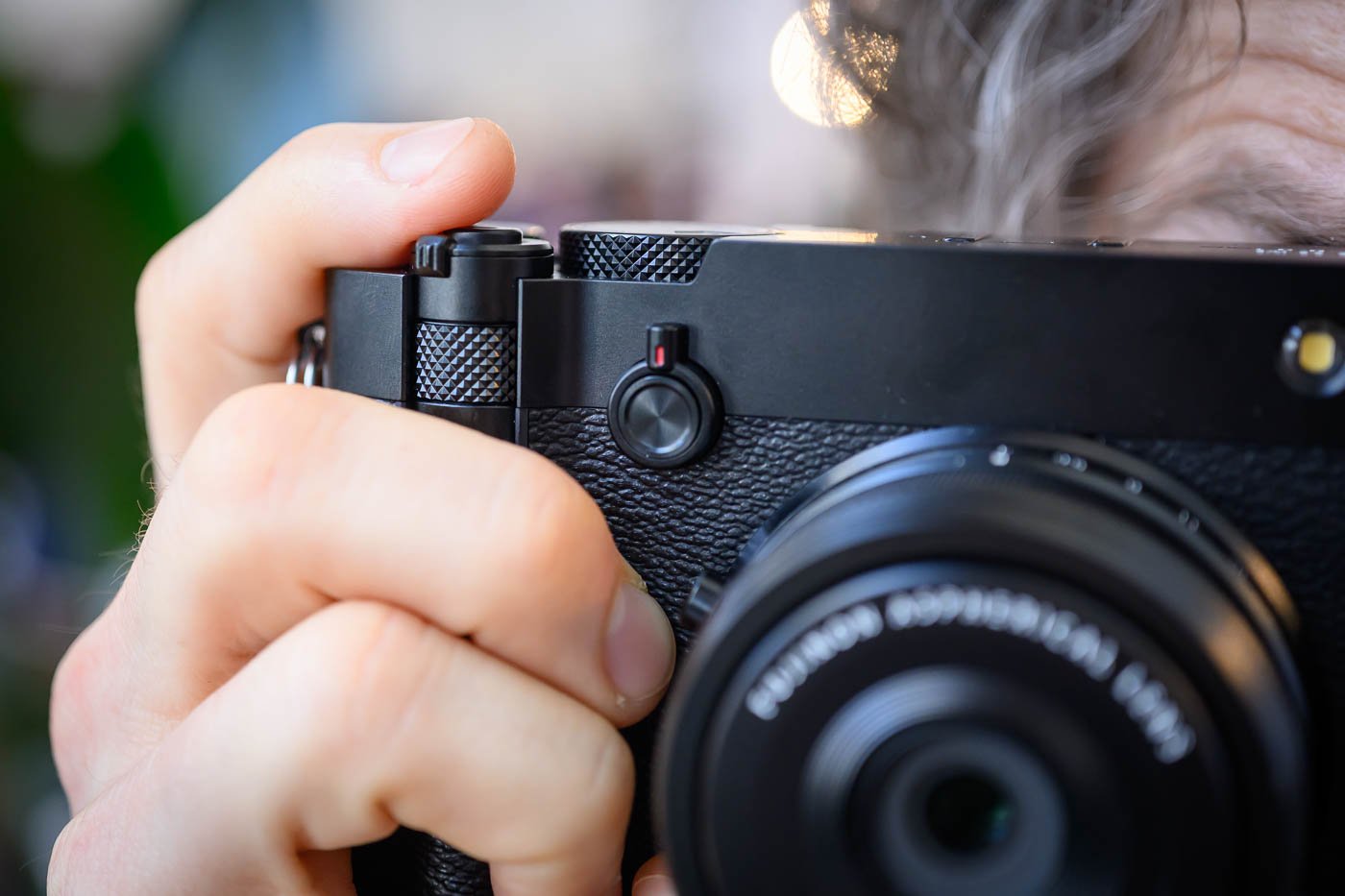
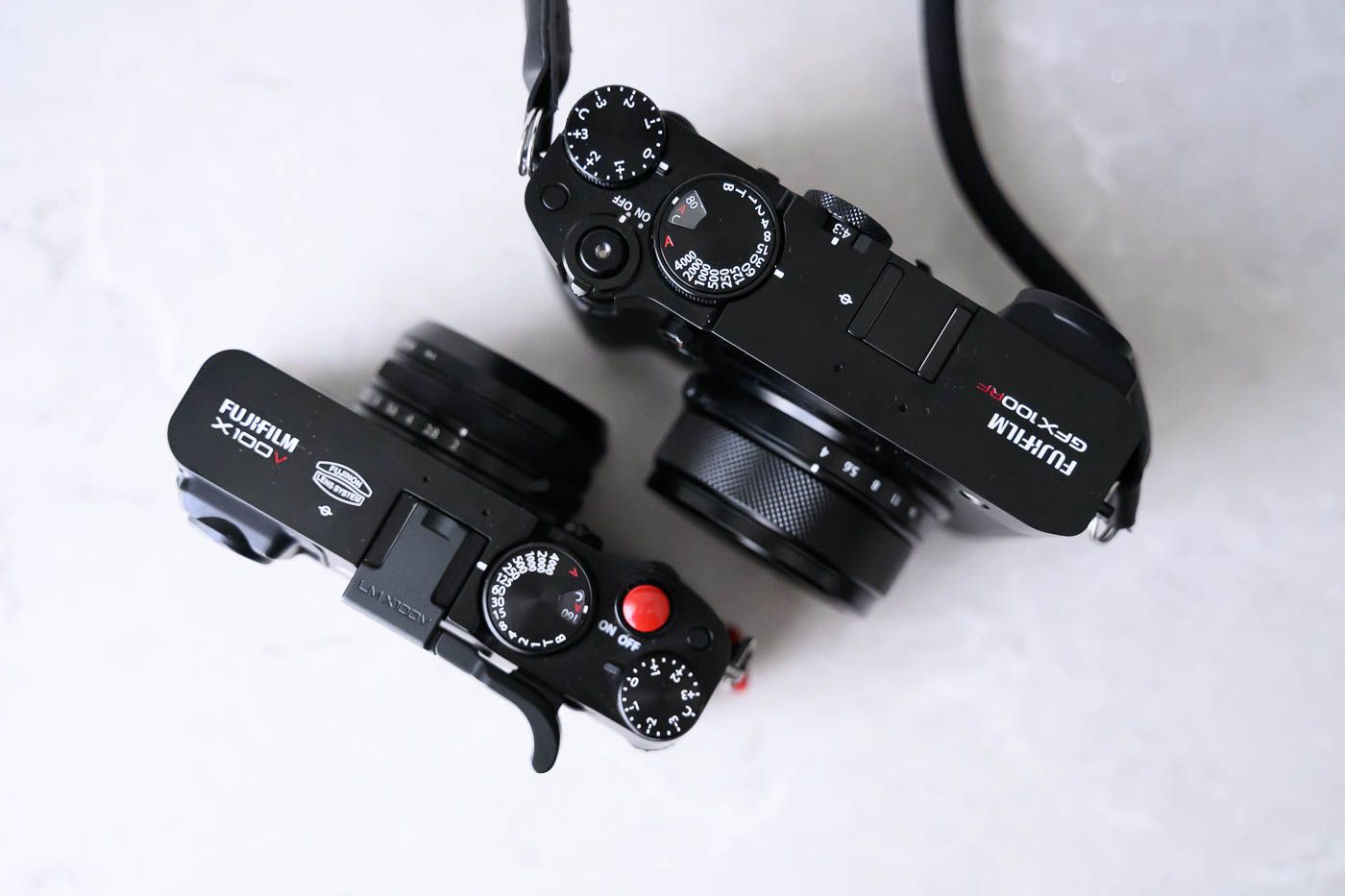
The body is also quite remarkable for its compactness, even more so when you consider the size of its sensor. It measures just 13 cm wide, 9 cm tall and about 3.5 cm deep. That is barely more than a camera like the Instax Mini Evo. With the Fujinon 35mm f/4 lens attached, the total depth reaches 7.7 cm. However, for street photography, the camera is a touch less discreet than an X100V/VI or a Ricoh GR…
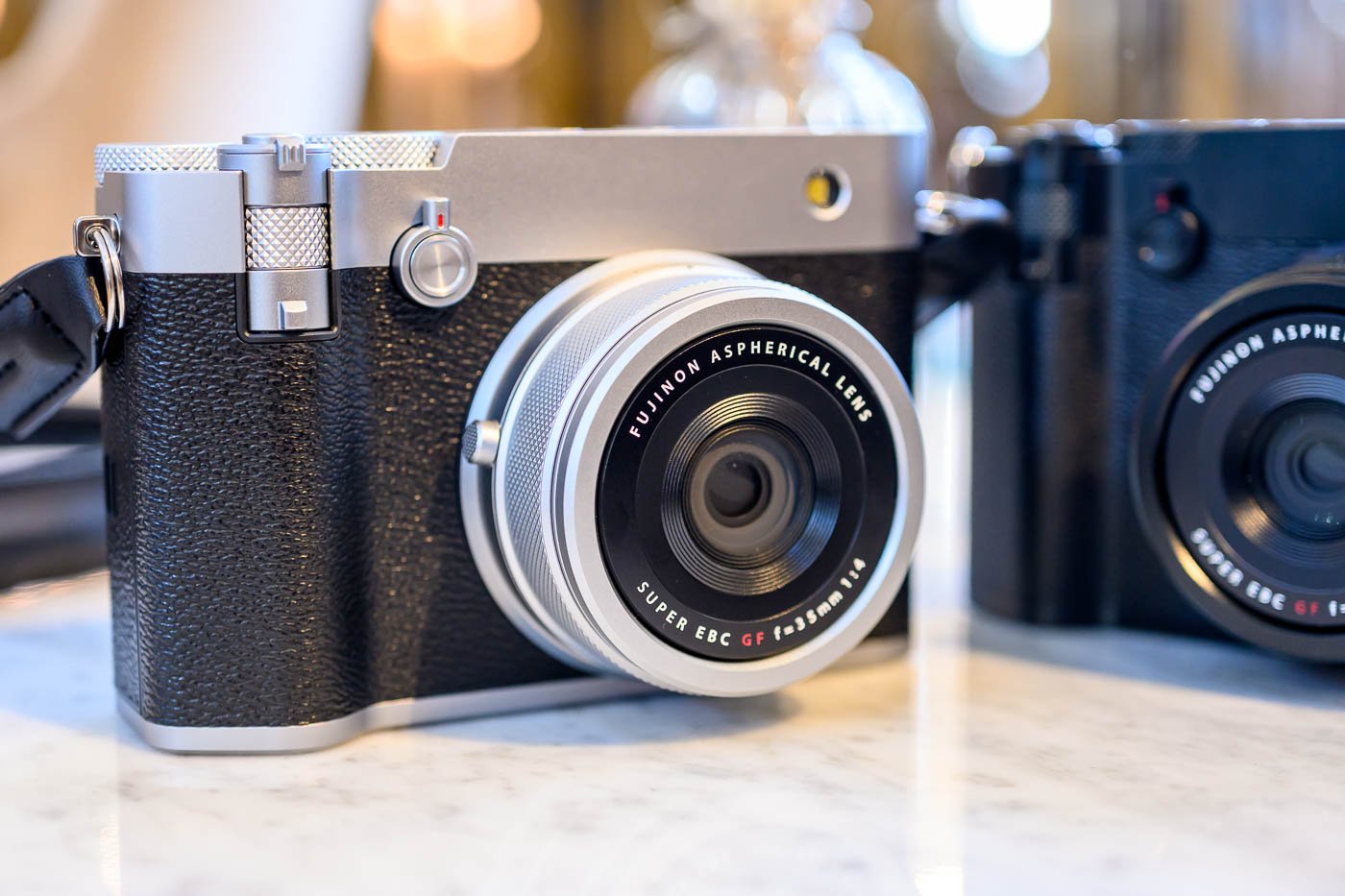
At first, its weight of 735 g (with battery and memory card) may seem surprising. But you quickly remember that a GFX 50R paired with an equivalent lens (such as the GF 30mm f/3.5 R WR) easily exceeds 1.2 kg. Another useful reference: a Leica Q3 weighs 788 g. Despite its weight, the body offers a remarkable sense of balance and fits naturally into any camera bag.
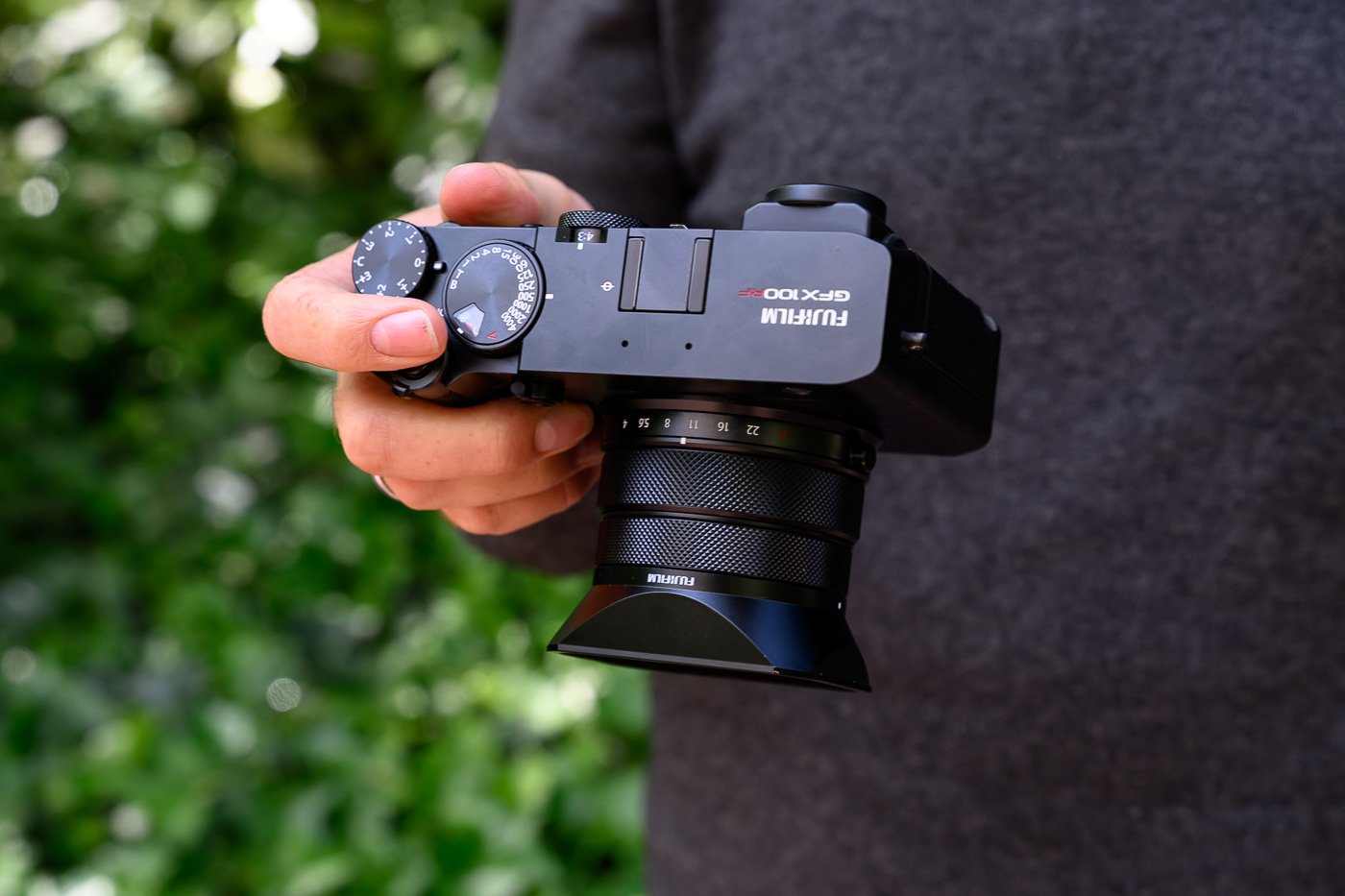
In the field, the Fujifilm GFX 100RF offers very good handling, and it is a real pleasure to use. We really like its slightly rounded sides, as well as the small grip. The camera never feels like it might slip from your hand.
The GFX 100RF comes with an elegant braided strap, a rectangular aluminum lens hood that looks great, and an adapter + filter (PRF-49) designed to protect the lens and provide weather protection.
Fujifilm GFX 100RF ergonomics: well-thought-out manual controls and comfortable viewfinding
In terms of manual controls and viewfinding, the Fujifilm GFX 100RF draws heavily from the X100V/X100VI and X-Pro 3. Long-time Fujifilm users will feel right at home.
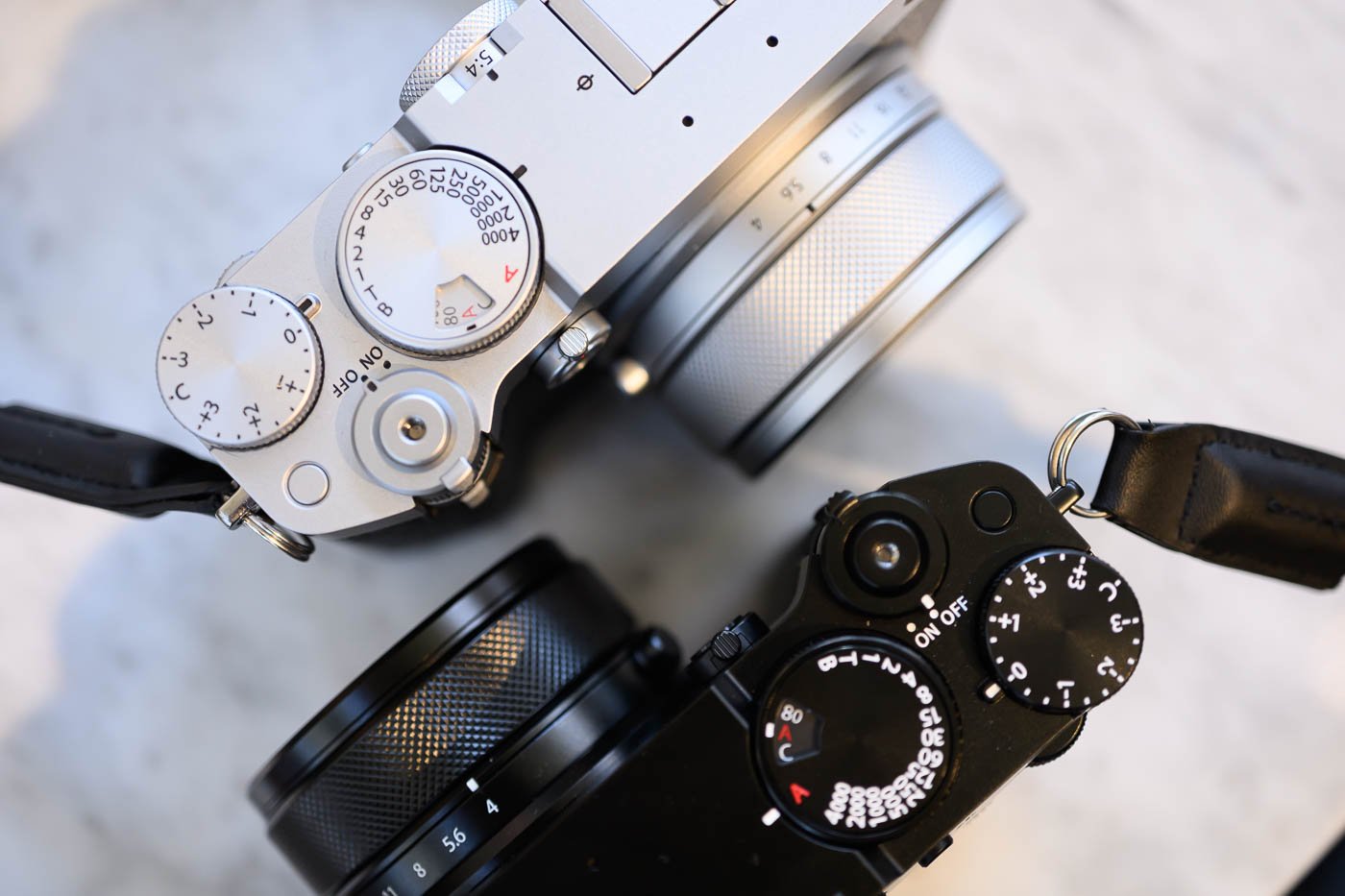
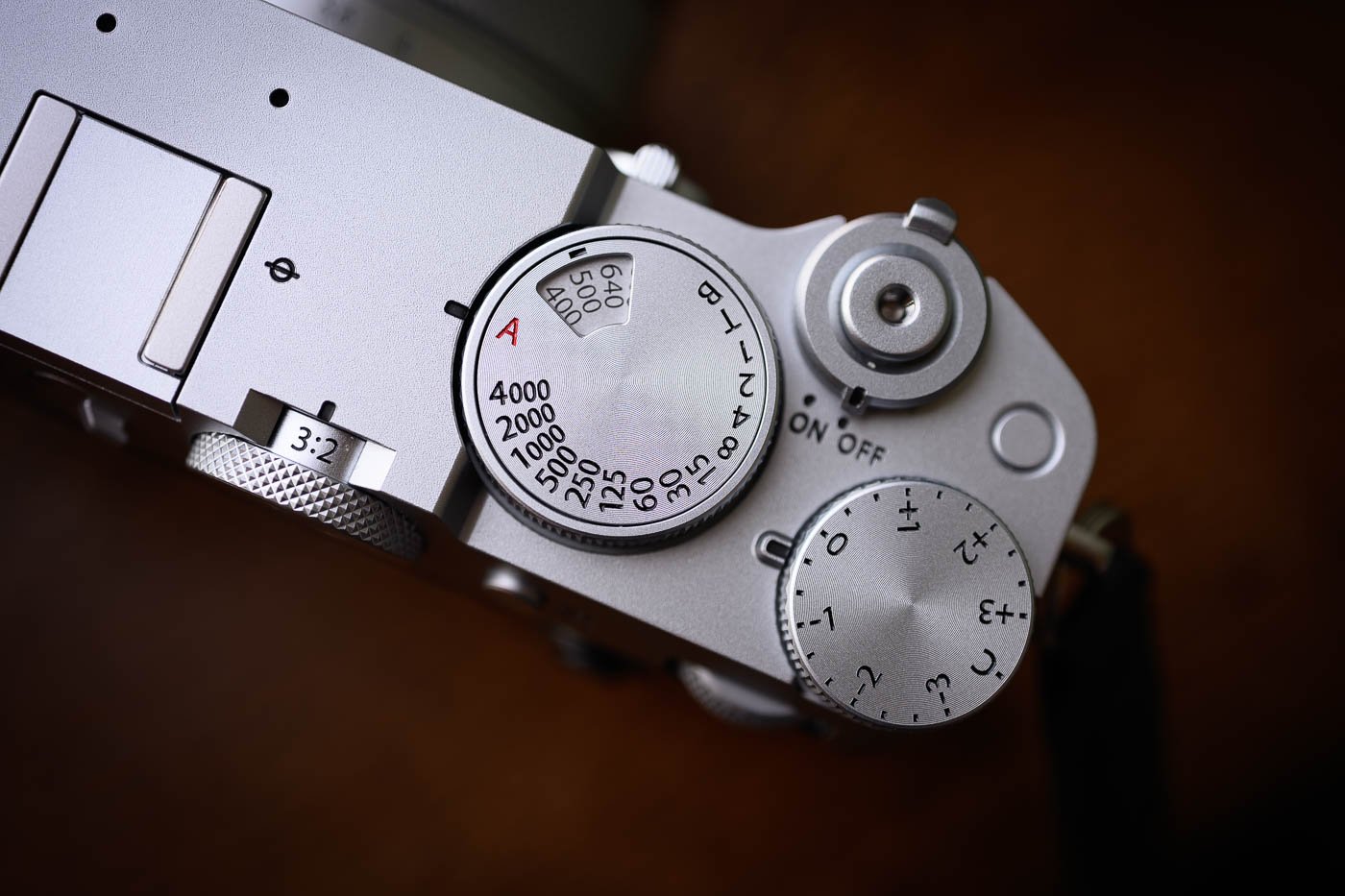
On the top plate, a large dual dial controls shutter speed and ISO. A second dial is dedicated to exposure compensation. A customizable button sits next to the shutter release: by default, it is assigned to automatic eye detection. However, there is no dedicated video button: to start recording, you use the standard shutter release.
On the rear, there is a joystick, access to the Q quick menu, and the usual buttons. The Drive/Del button also provides access to video mode, which is not always practical when you want to switch quickly between photo and video.
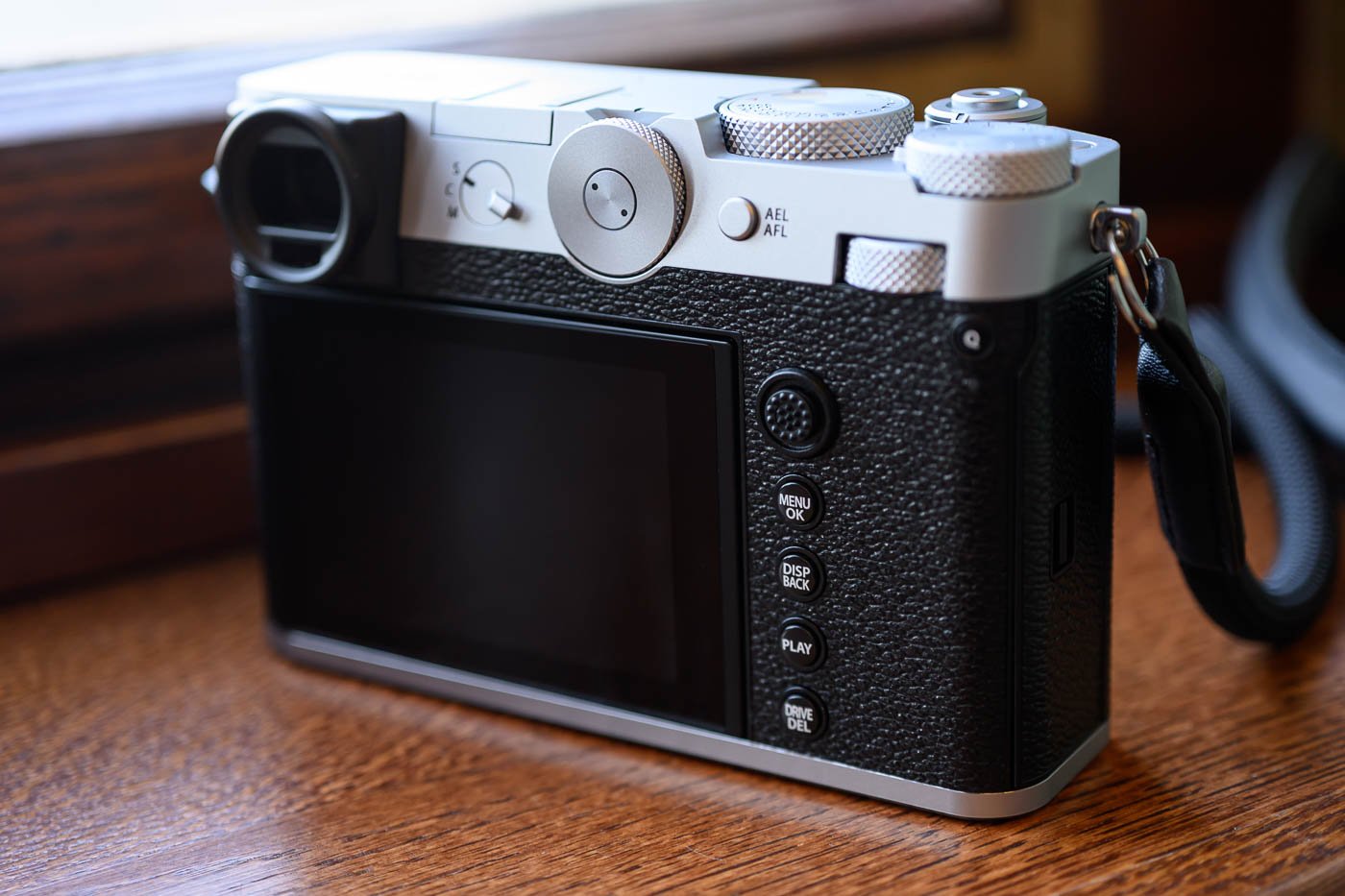
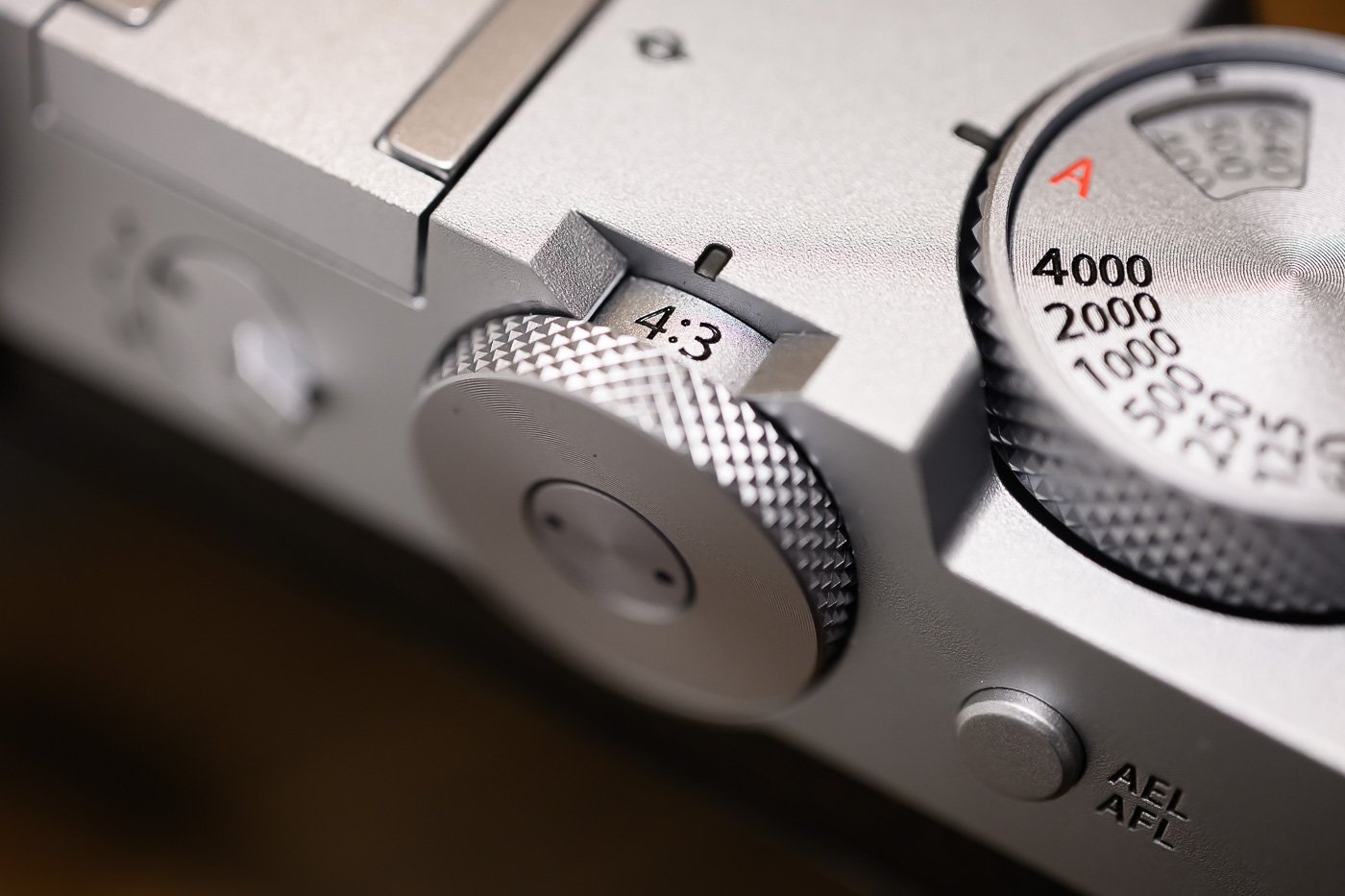
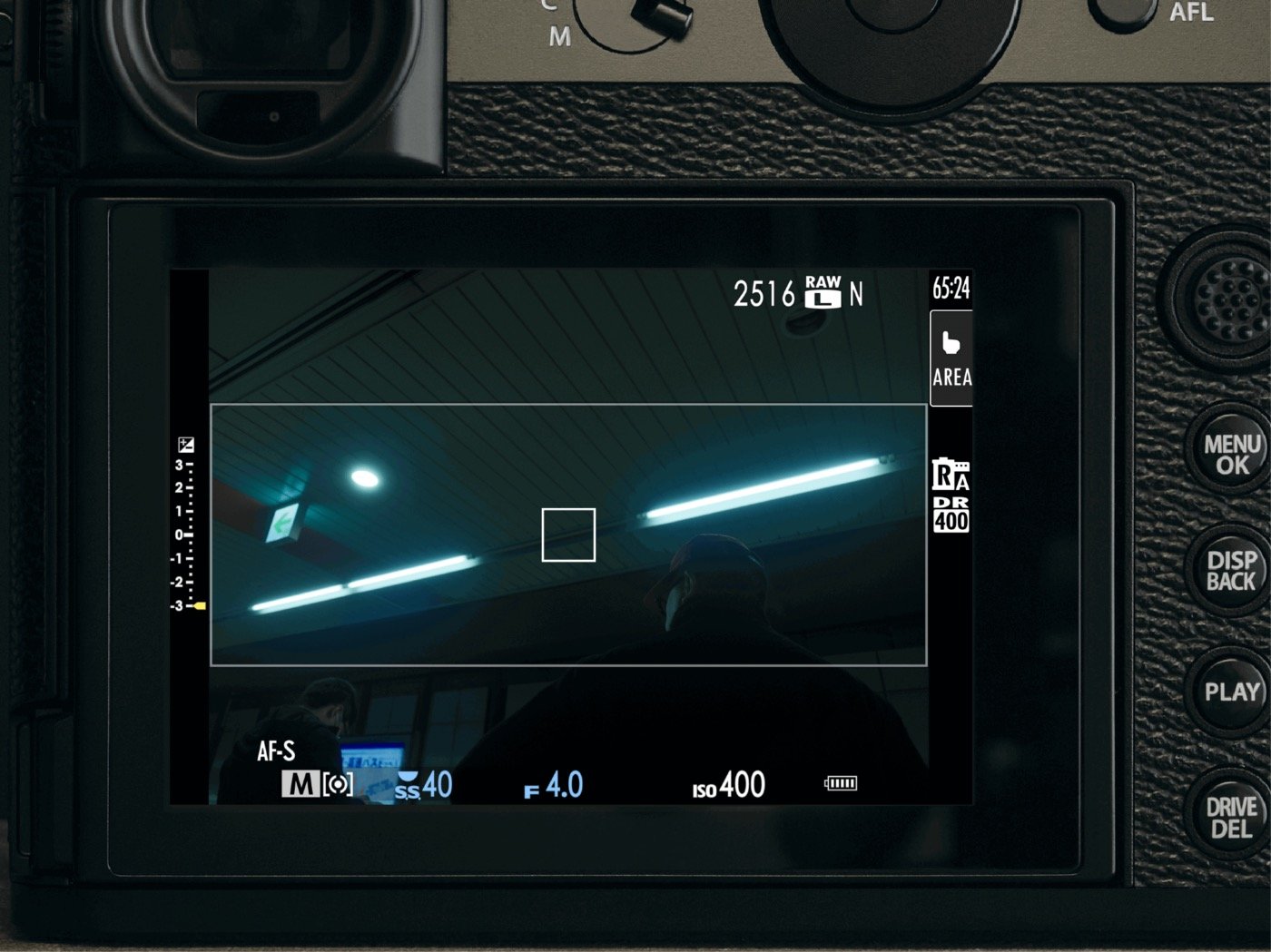
The GFX 100RF moves the focus mode selector (S, C, MF) to the rear. More importantly, it features a new aspect ratio dial. You can easily switch between 4:3, 3:2, 16:9, 65:24 (the famous X-Pan), 17:6, 3:4, 1:1, 7:6, 5:4 and Custom ratios. This encourages you to experiment with framing right at the time of shooting.
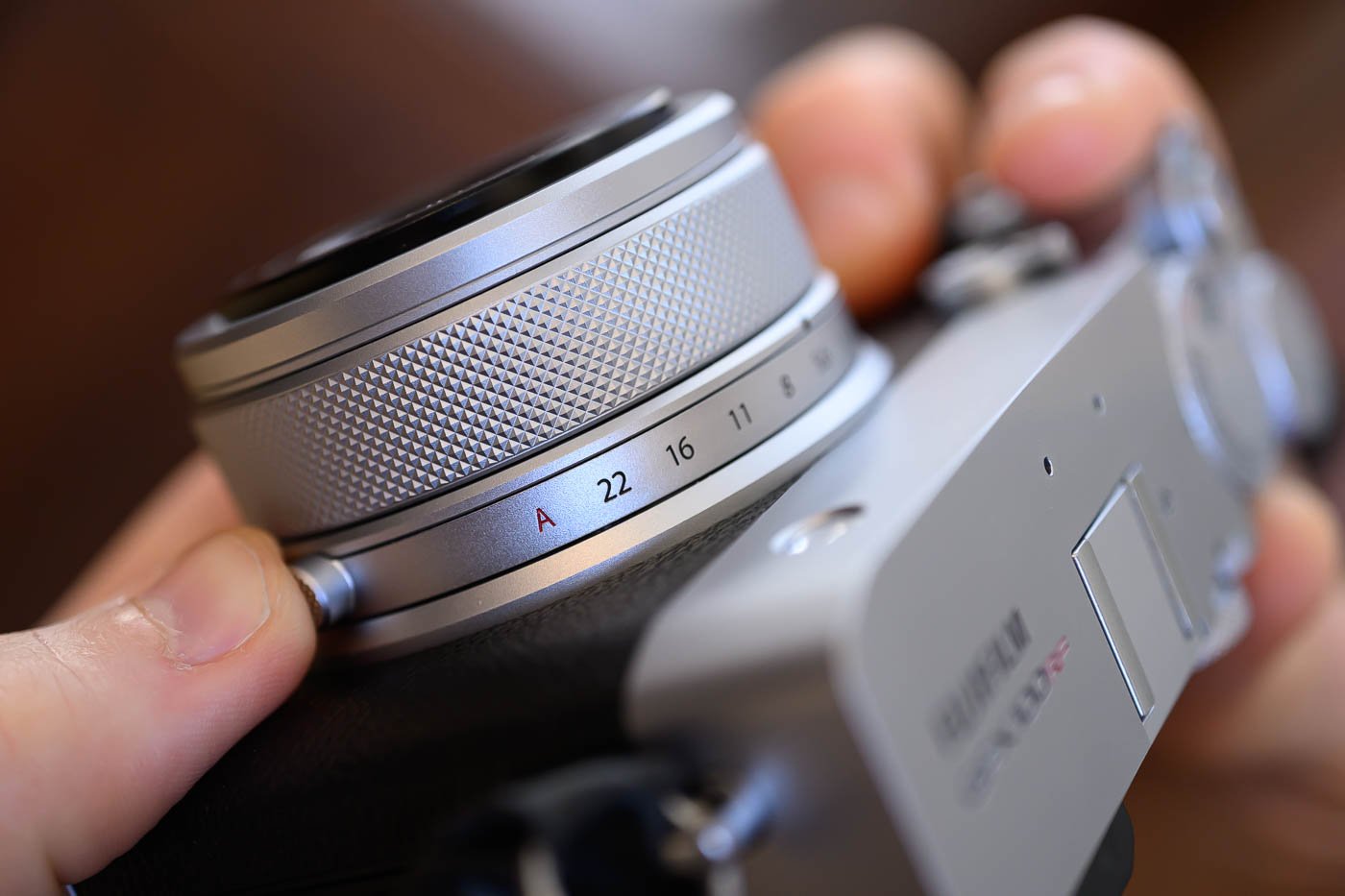
On the lens, a thin ring (non-declicked) lets you choose the aperture (from f/4 to f/22, with an Auto position). Like on the X100 series, two small tabs make it easier to manipulate. A second (linear) ring is assigned by default to manual focus in MF mode. You can also assign it to white balance or film simulation selection (in AF-S or AF-C mode) after a trip into the menus. Note that this ring turns very smoothly.
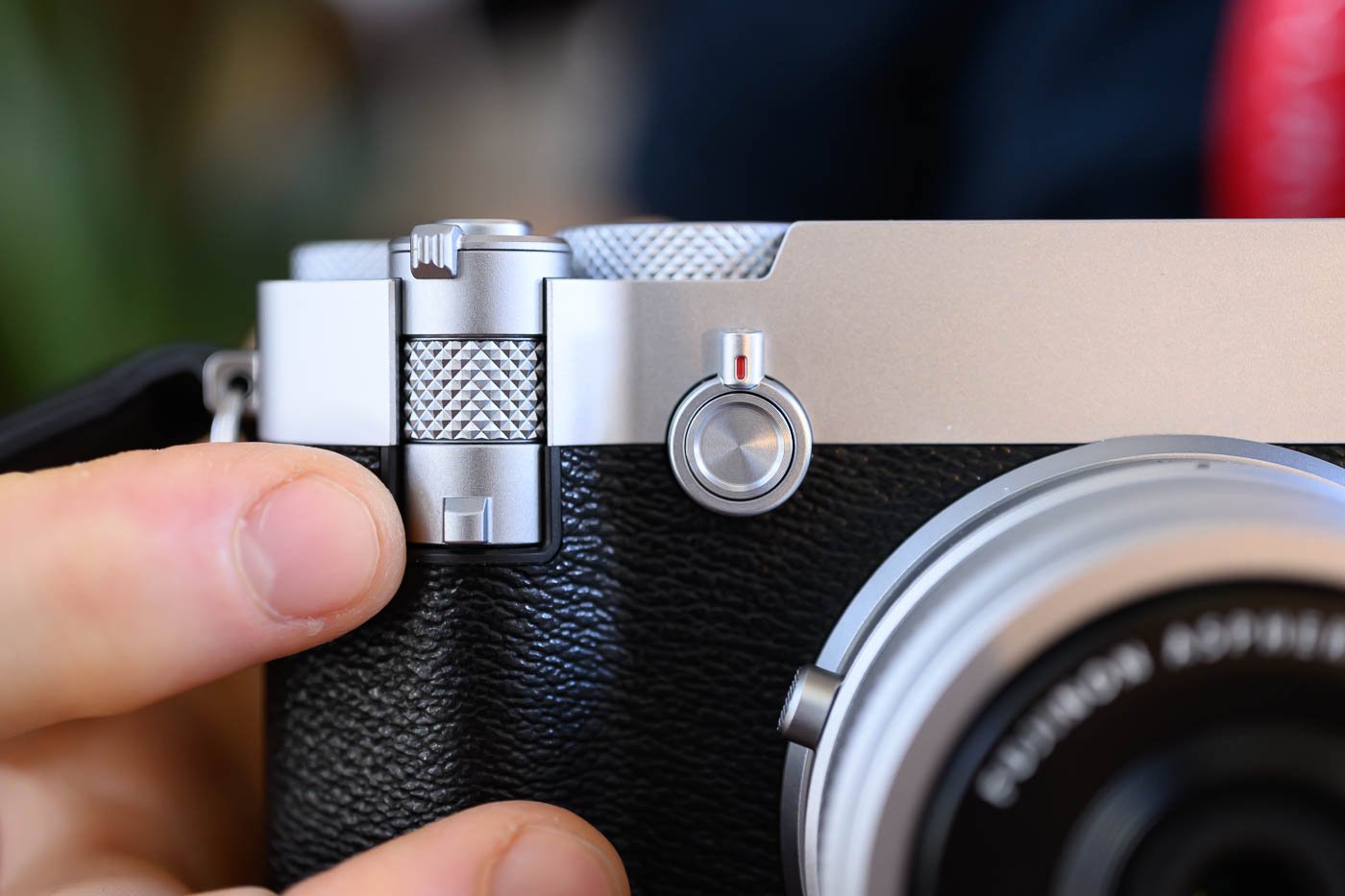
On the front, below the shutter release, you will find a control dial and a lever dedicated to selecting the crop level (digital teleconverter, more on this below). The stacking of these three controls is very successful aesthetically. If we had to nitpick, the control dial does not always feel very accessible, as it does not protrude enough from the camera’s surface.
Finally, there is the viewfinder switch, taken directly from the X100 series… at least in appearance. Since there is no hybrid viewfinder, it is instead assigned 4 customizable functions!
By default, pressing it to the left toggles between the screen and the EVF, while pressing it to the right changes the crop behavior (standard zoom into the image or display of a small frame around the cropped area).
Fujifilm has also given this lever additional functions accessible via a long press (3 seconds). Pressing left lets you change the focus ring behavior in AF-S/AF-C mode (white balance or film simulation). Pressing right enables or disables the ND filters. These commands are, of course, customizable.
The problem is that this method is explained nowhere in the camera’s menus (aside from a few unclear pictograms), and the 3-second delay to access the options is far too long in practice. Furthermore, the menus remain dense and austere, and some abbreviations (in the French interface) are truly cryptic.
As for viewfinding, the Fujifilm GFX 100RF uses the same EVF as the GFX 100S II, with a 5.76 MP OLED panel. There is no “hybrid” viewfinder (optical + electronic) as found on the X100 or X-Pro series.
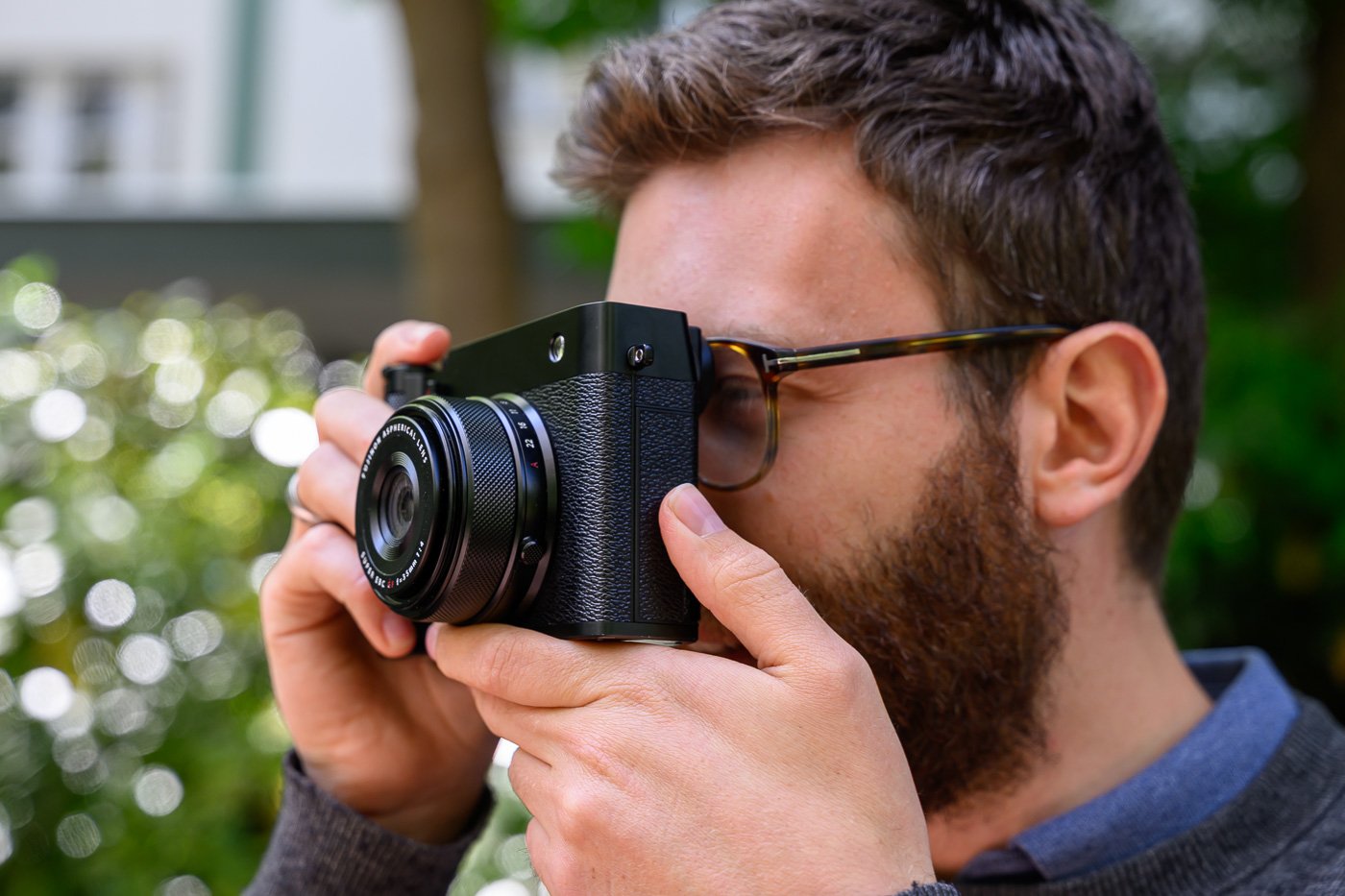
Fujifilm justifies this by explaining that a “hybrid” viewfinder would have offered lower magnification and would have been much less pleasant to use in the field. In any case, this electronic viewfinder proves comfortable, both in terms of size and resolution.
The camera also features a 3.15-inch LCD screen (2.1 MP) mounted on a dual-hinge mechanism, making it easy to frame at waist level, at arm’s length, or close to the ground. A feature already seen on the X100 series and on the Leica Q3. It offers good readability, except in bright sunlight.
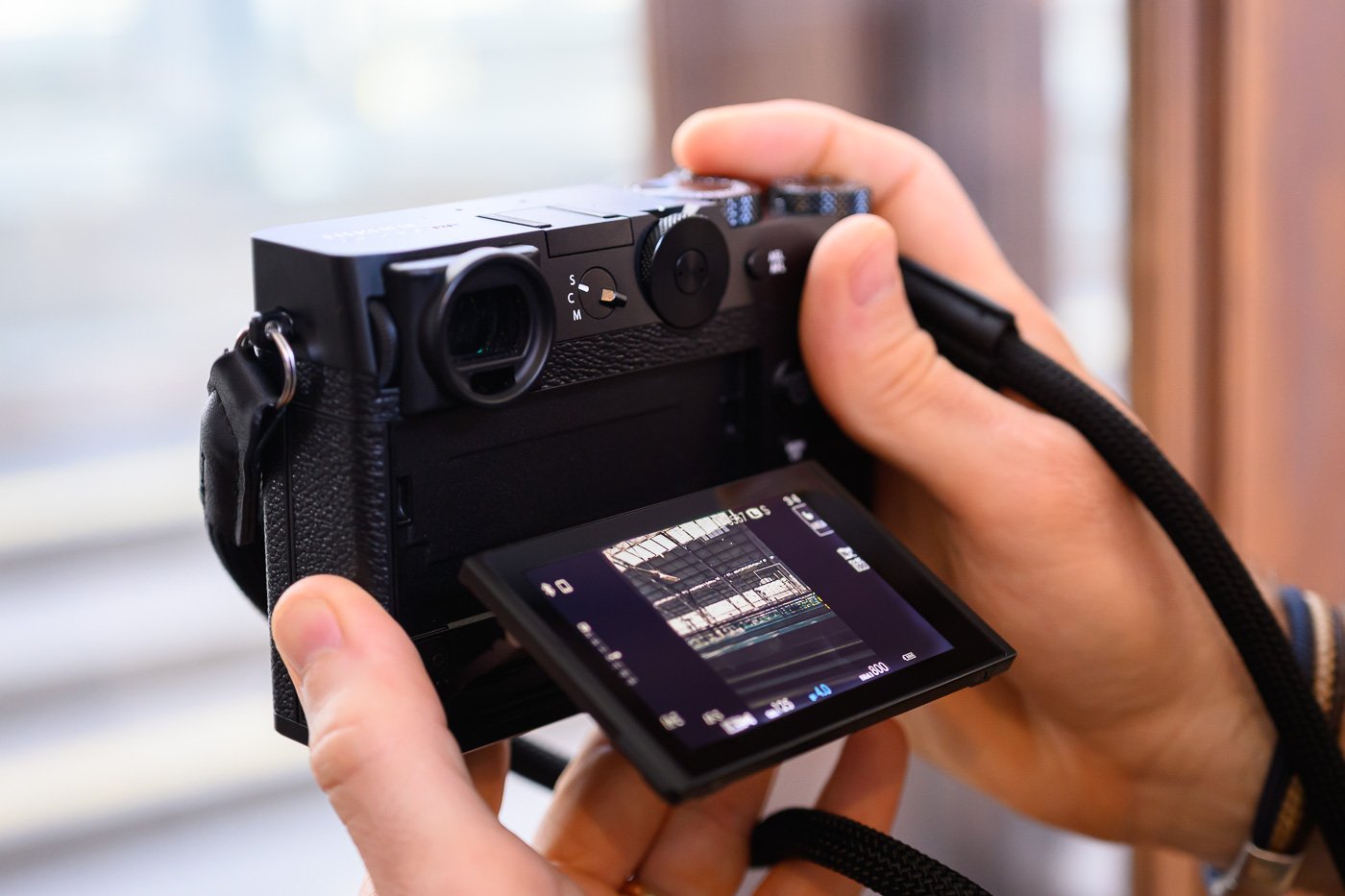
All in all, the Fujifilm GFX 100RF is well designed and proves very pleasant to use in the field. The Japanese manufacturer delivers a satisfying blend of efficiency and restraint. It is just a shame that some ergonomic details can be occasionally frustrating!
Performance and image quality of the Fujifilm GFX 100RF
One thing is certain: the Fujifilm GFX 100RF is capable of delivering very beautiful images, day and night. However, its maximum aperture of f/4 and the complete absence of stabilization (optical and sensor-based) do lead to some compromises.
Feel free to click on the photos in this review to view them at higher quality.



102 MP medium format sensor
As mentioned above, the GFX 100RF uses the same sensor and processor as the GFX 100 II and GFX 100S II. Specifically, it features the GFX 102MP CMOS II HS sensor and the X-Processor 5. Overall, the camera is very responsive, whether at startup, when navigating through menus, or in terms of AF performance.

As with other GFX bodies, images are captured in a 4:3 ratio and measure 11648 x 8736 pixels. In uncompressed mode, 16-bit RAW files weigh approximately 200 MB. To save on storage, you can opt for Lossless Compressed mode, where files weigh around 110 MB.

Exposure metering and white balance are flawless. Color reproduction is very pleasing, and it is a joy to work with Fujifilm’s signature 20 film simulations.
Black-and-white enthusiasts will be delighted with the Acros and Monochrome modes, while fans of cooler tones will gravitate toward Reala Ace or Classic Chrome.
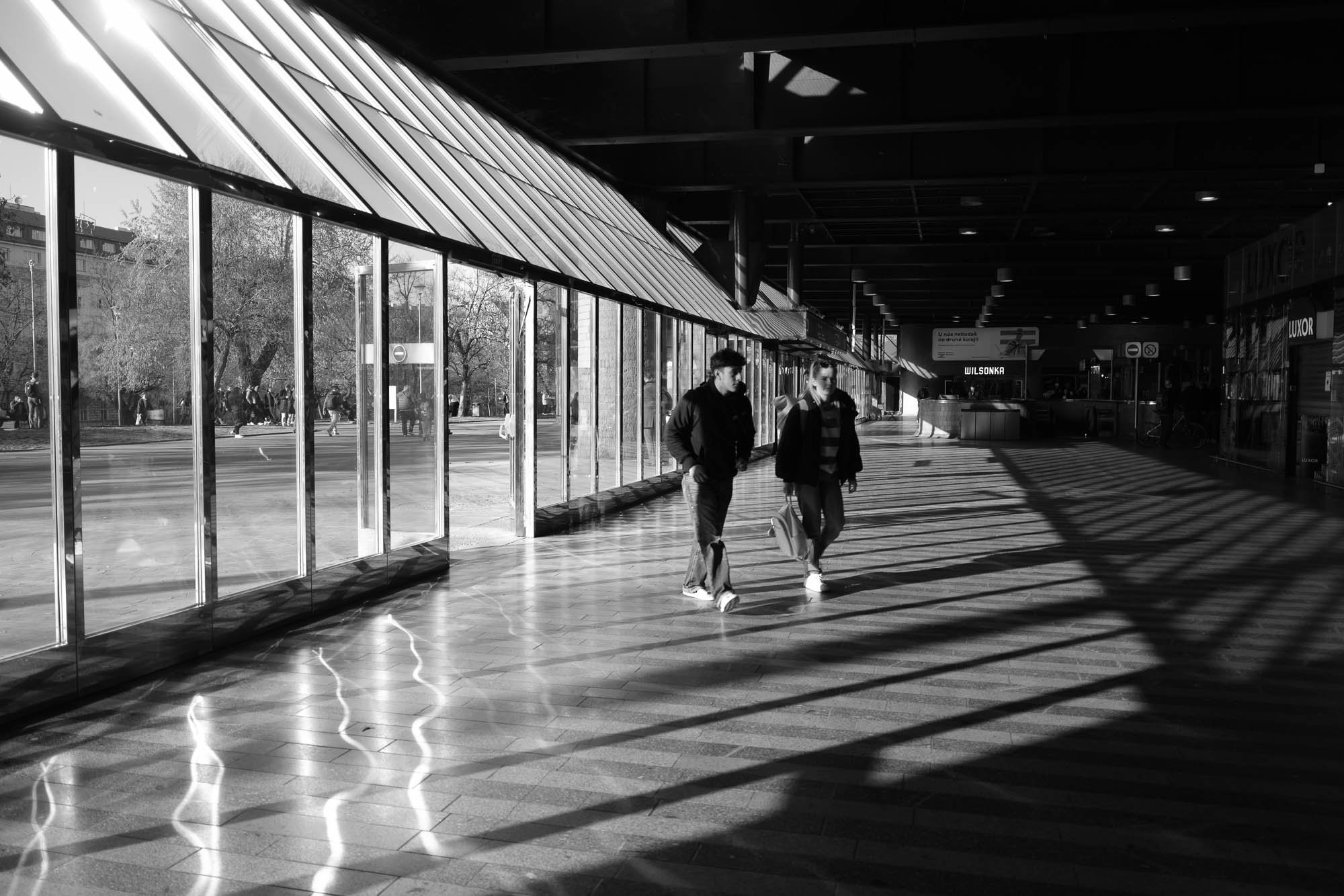
Digital crops and aspect ratios
The sensor’s ultra-high resolution truly comes into its own with the crop modes. You can crop heavily into the image while retaining high resolution and a very good level of detail.



The camera offers three “virtual” focal lengths in addition to the native 35mm: 45mm, 63mm or 80mm by cropping into the image (equivalent to 36, 50 or 63mm in 35mm terms).
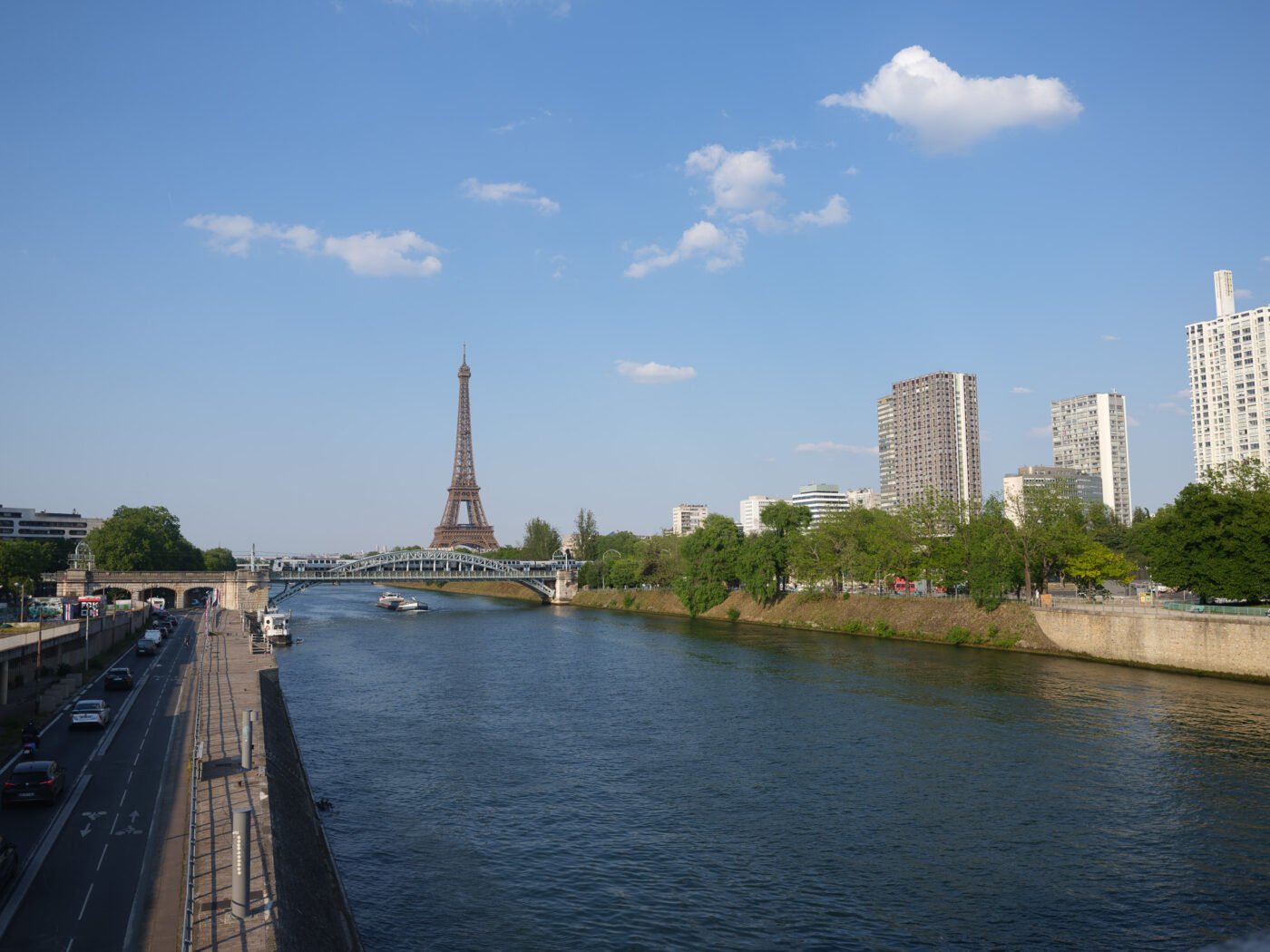



Thanks to the 102 MP sensor, an 80mm crop still yields 19.3 MP files. That is significantly better than the Leica Q3, where you end up with only 8 or 6 MP at the most aggressive crop levels.
Here is a detailed breakdown of the file sizes at each crop level:
- 35mm (eq. 28mm): 102 MP
- 45mm (eq. 36mm): 61.5 MP
- 63mm (eq. 50mm): 31.2 MP
- 80mm (eq. 63mm): 19.3 MP


In practice, this digital “quasi-zoom” proves extremely useful, and the camera gains real versatility. We only wish Fujifilm had added one more crop level (eq. 80 or 90mm), as Leica did with the Q3. In any case, this feature is much more developed than on the X100V/VI (1.4x and 2x only), though admittedly those have a lower-resolution sensor.


The crop is applied directly to JPEG/HEIF files. On RAW files, it is embedded in the metadata and displayed automatically by Lightroom or Photoshop. The benefit: since it is a digital crop, you can “un-crop” the image or adjust the framing after the shot, something that is impossible with a traditional optical zoom. A feature we already appreciated on the Leica Q3/Q3 43.
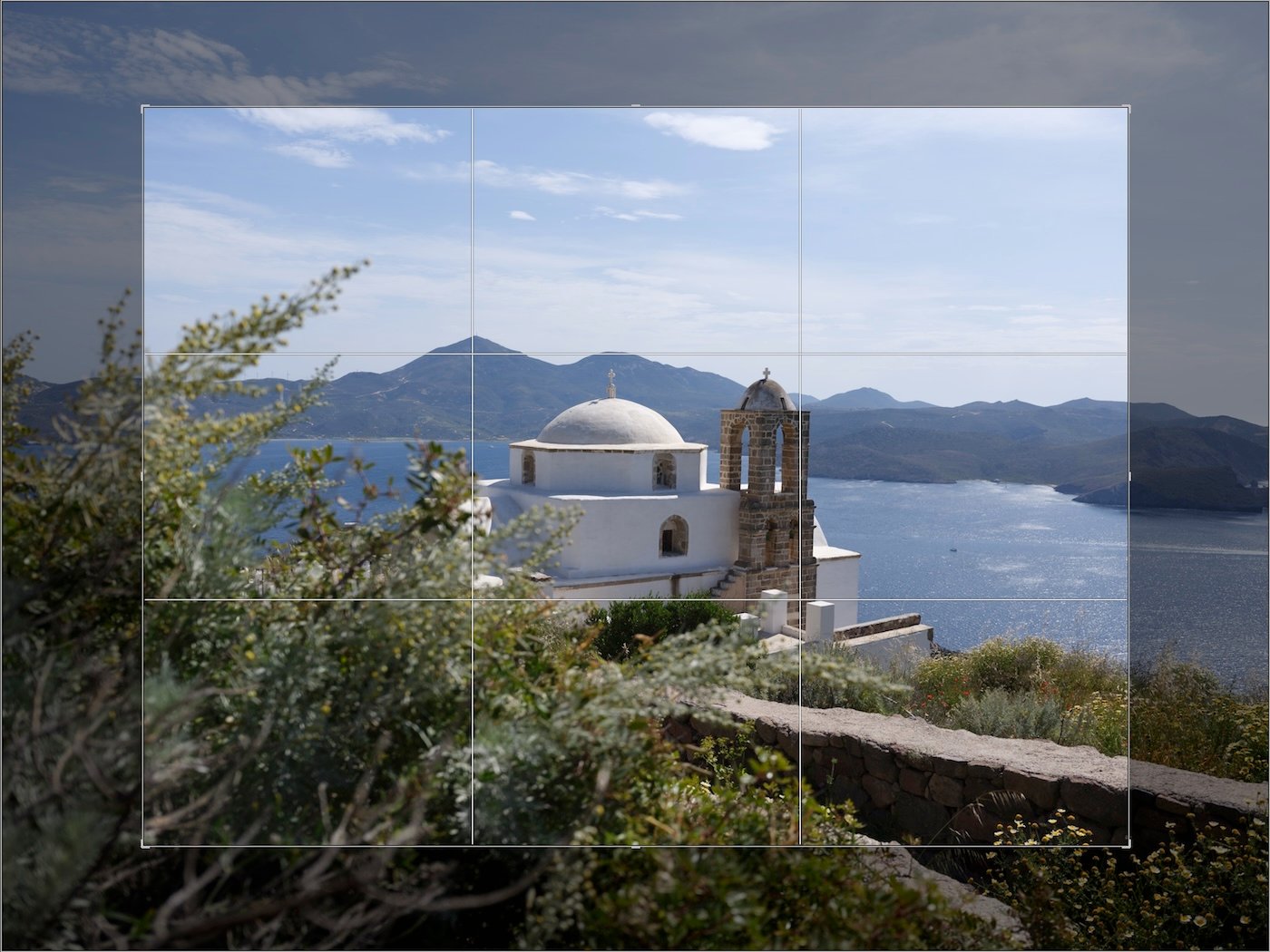

The camera also lets you play with different aspect ratios. By default, photos are captured in 4:3. But you quickly find yourself enjoying shooting snapshots in square format or in X-Pan format! Here too, the crop is applied directly to JPEG files, but in RAW the full image is preserved.


Fujinon 35mm f/4 Super EBC lens: a resounding yes, but with two caveats!
As mentioned above, the Fujifilm GFX 100RF uses a Fujinon 35mm f/4 Super EBC lens. It consists of 10 elements in 8 groups and includes 2 aspherical elements.

In the field, the sharpness of this lens is already well defined at wide open (f/4). However, performance improves by stopping down a few clicks. The sweet spot is reached at f/5.6. This is also the value where uniformity across the frame is optimal. Be careful with diffraction, though, which becomes quite noticeable beyond f/11.
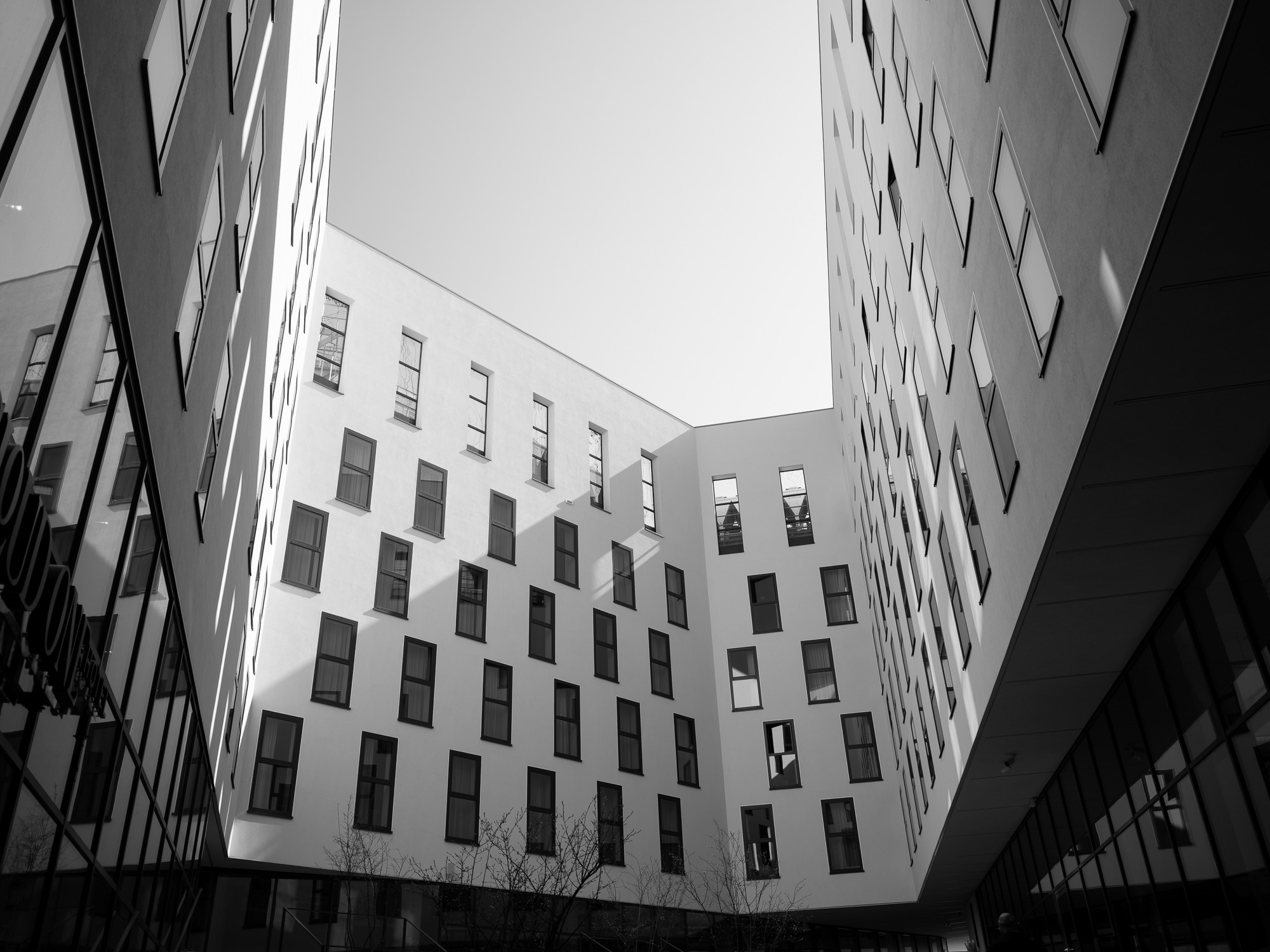
Optical aberrations are very well controlled. Chromatic aberration is virtually nonexistent, and ghosting is similarly absent. We only noticed a slight loss of contrast when shooting into the light, along with a minor flare effect near very bright light sources. The starburst effect, however, is not particularly impressive, with the rays struggling to stand out clearly.

When it was announced, the camera generated much debate due to its “mere” f/4 maximum aperture. In the field, the GFX100RF does allow you to play with depth of field, but under certain conditions. You need to get very close to the subject, and the subject must be sufficiently separated from the background. On that note, the minimum focusing distance is not outstanding (20 cm from the front element).


Similarly, we struggled to find the modeling and “3D effect” typically associated with images shot on a medium format sensor: in this regard, a full-frame body paired with a fast lens does (much) better. This is one of the true limitations of this f/4 lens.
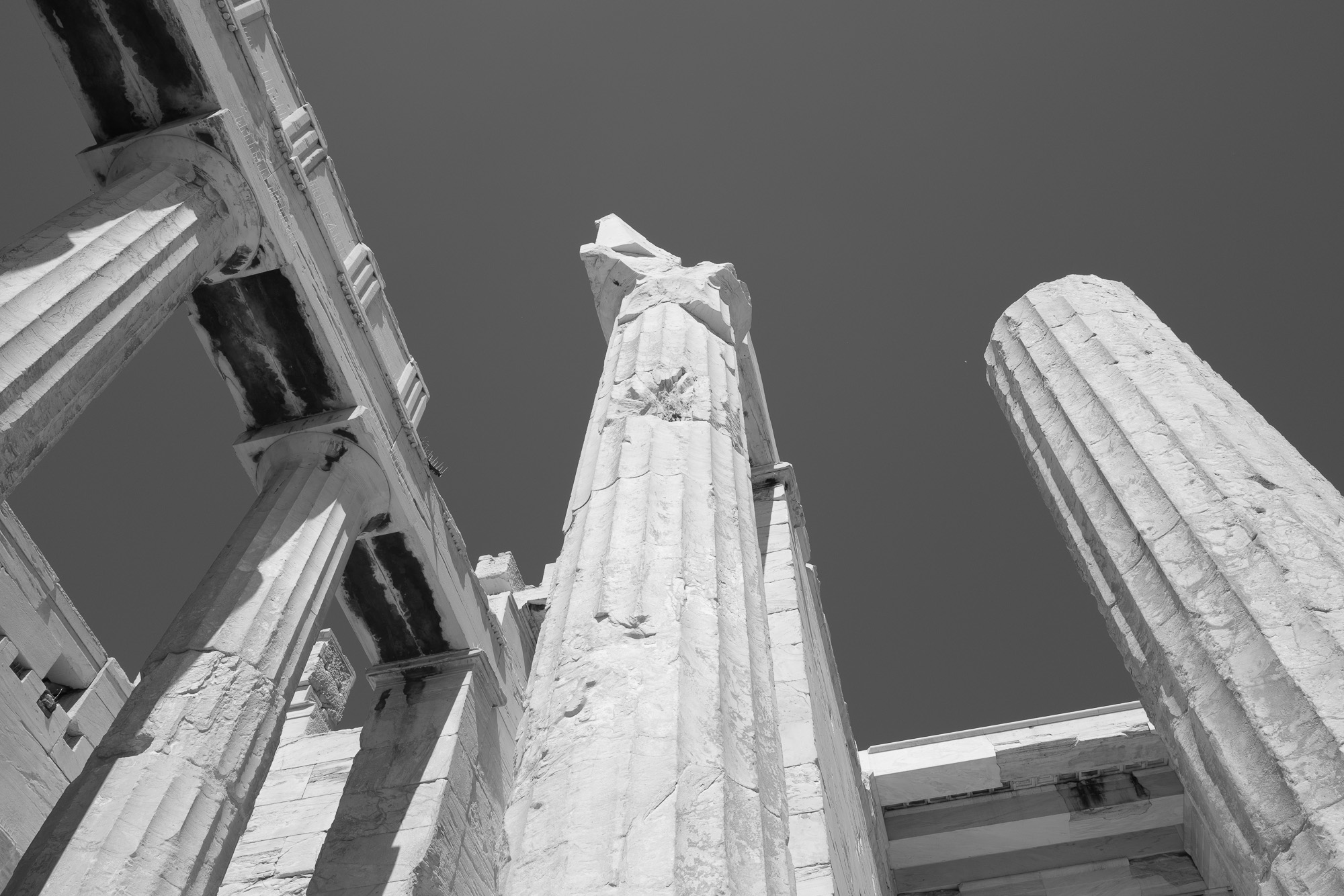
Finally, the f/4 aperture also means you need to push the ISO quite high in low light, especially since the body lacks any form of stabilization (more on that later).
High ISO performance and dynamic range
In terms of high ISO performance, the Fujifilm GFX100RF is generally a solid performer. By default, the ISO range spans from 80 to 12,800, and can be extended up to 102,400, in mechanical shutter mode only.
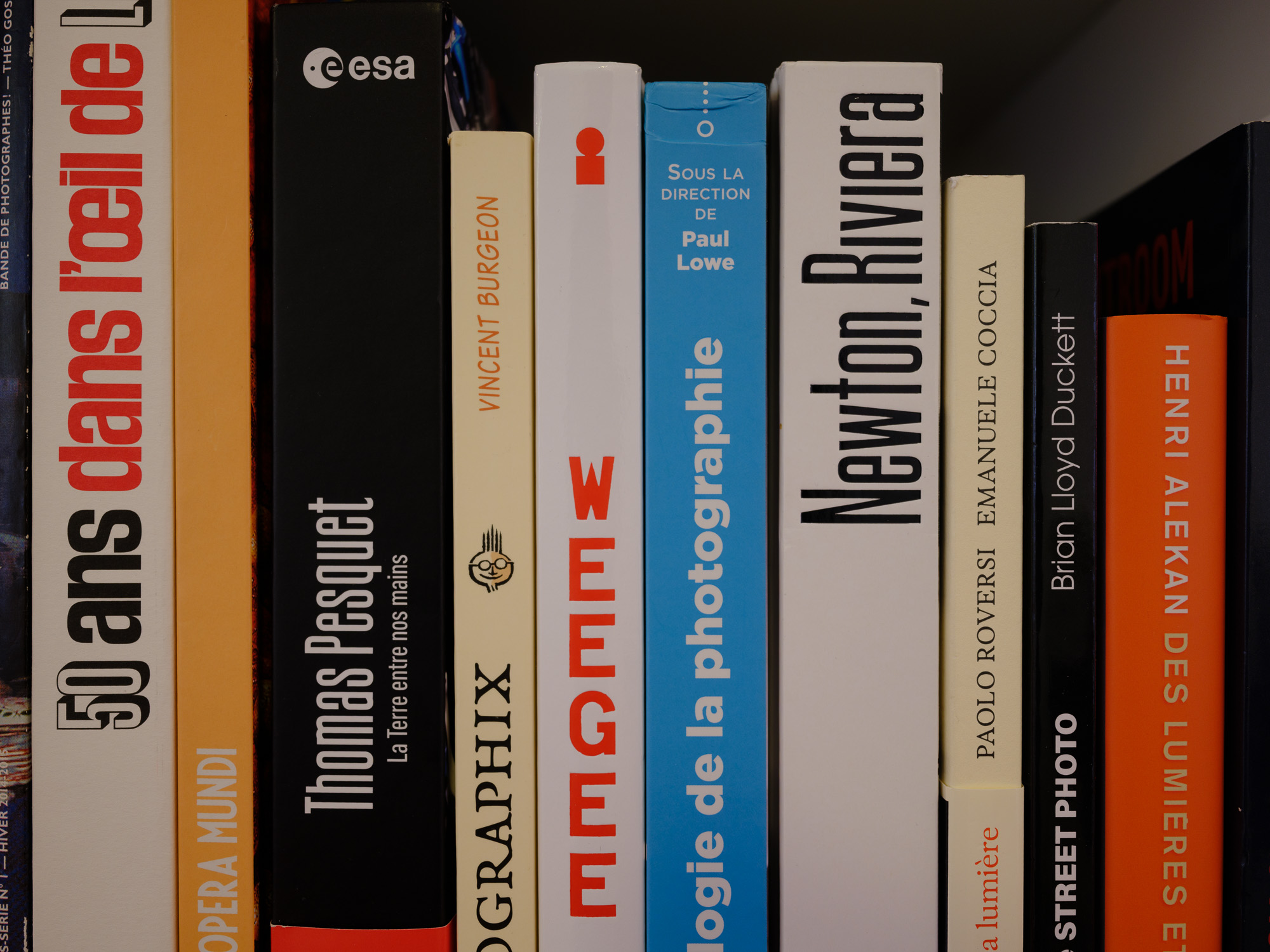
In practice, the results are virtually identical to the GFX100 II. Marginal at ISO 1600, noise starts to appear at ISO 3200. It becomes slightly more visible at ISO 6400. However, detail rendering becomes less precise at ISO 12,800. This is fairly limiting when shooting handheld in low light.
In extended ISO mode, things deteriorate quite noticeably. While images remain acceptable at ISO 25,600, detail smearing and color drift appear at ISO 51,200. At ISO 102,400, there are no miracles: the image is heavily degraded and noise is pervasive. A “grid-like” pattern can also be observed. In short, extended ISO values should be reserved for situations where you need to freeze a fast subject in low light.
On the dynamic range front, no surprises. As with the GFX100 II, you can recover a significant amount of shadow detail (-4 EV, even -5 EV, though at the cost of a slight color shift). Digital noise when lifting shadows remains very well contained.
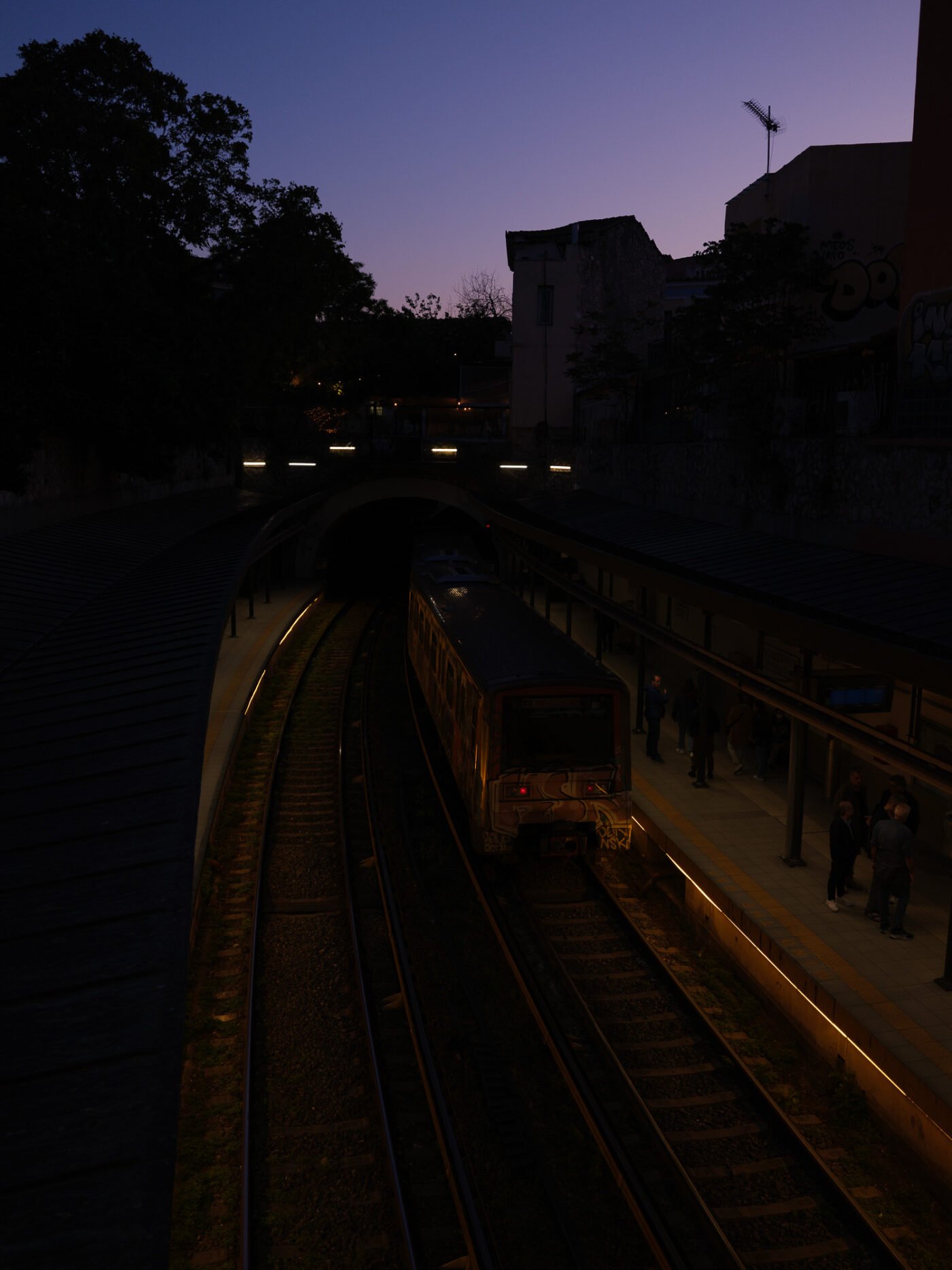

Highlight recovery is more challenging. You can pull back overexposed areas without too much trouble up to +1.6 EV. Beyond that, color drift becomes quite noticeable.



Autofocus: nearly flawless
The Fujifilm GFX100RF uses the same autofocus system as the GFX100 II and GFX100S II. And in the field, the strong performance of those cameras is confirmed. Focusing is instantaneous and accurate. Misfocused shots are rare. Subject tracking is generally effective. For street photography, the AF gave us no trouble. What a long way we have come since earlier medium format cameras!

You also get the same algorithms as on other bodies equipped with the X-Processor 5, which can detect and track the following subjects:
- Humans (eyes, face)
- Cats and dogs (head, eyes, body)
- Birds (head, eyes, body)
- Cars
- Motorcycles
- Bicycles
- Trains
- Airplanes (fuselage, front, cockpit)
In the field, subject detection (including eye detection) is very fast, though the camera can occasionally get confused when multiple subjects are in the frame.

The autofocus’s effectiveness holds up in low light. Even with moving subjects, the camera manages to lock focus without difficulty.

However, as with the GFX 100 II, the autofocus shows its limits with subjects making sudden and/or erratic movements: in those cases, the AF struggles to lock on and track the subject effectively. Full-frame bodies still have the edge here.

Burst rate and buffer of the Fujifilm GFX 100RF
The Fujifilm GFX 100RF is not really designed for sports and action, and it shows! The burst rate tops out at 6 fps with the leaf (mechanical) shutter and just 3 fps with the electronic shutter (with AE/AF tracking).
Moreover, the buffer is far from generous. You can expect 17 frames in uncompressed RAW and only 12 frames in RAW + JPEG mode. This limitation is likely dictated by the storage medium (SD UHS-II). In the field, the camera starts to slow down after about 10 shots (in RAW + JPEG mode).
With the electronic shutter, unsurprisingly, rolling shutter is very pronounced. In this regard, full-frame bodies with lower-resolution sensors (even non-stacked) perform significantly better.
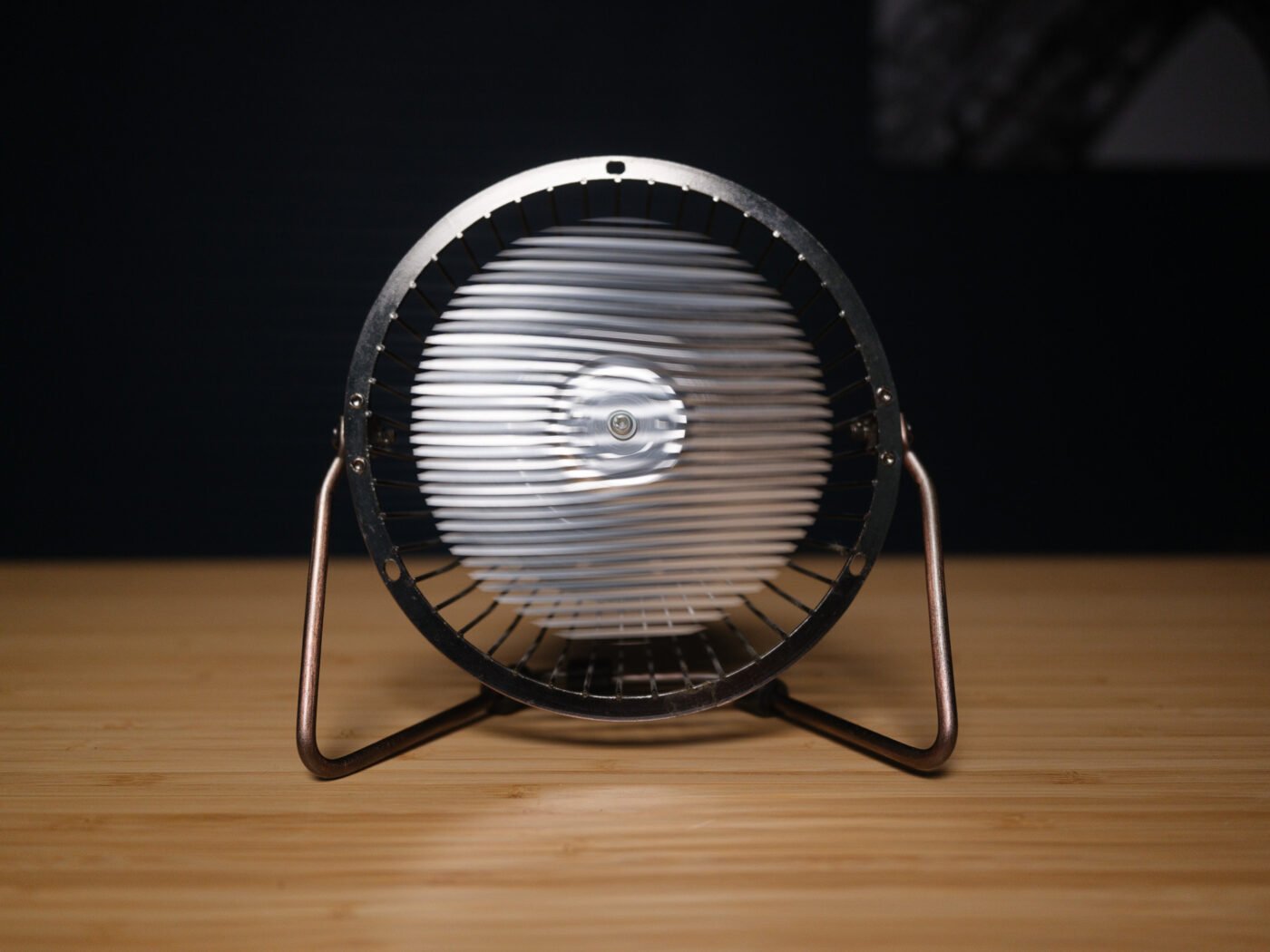

Finally, note that the leaf shutter makes the GFX100RF the first Fujifilm body to break free from the 1/125s flash sync limitation. You can sync all the way up to 1/4000s, which is no small feat!
(Lack of) stabilization
At launch, the f/4 maximum aperture overshadowed the complete absence of optical or sensor-based stabilization. A choice that Fujifilm, once again, justifies by the pursuit of compactness.
Unfortunately, this is quite penalizing. Yes, it is possible to shoot handheld in low light, but only if you pay very close attention to your shutter speed and accept pushing the ISO quite high. Given the sensor size, even the slightest camera shake is particularly visible.

In practice, it is difficult to go below 1/50s. To work around this constraint, the good old tripod becomes essential once again. However, capturing moving subjects will be more challenging.

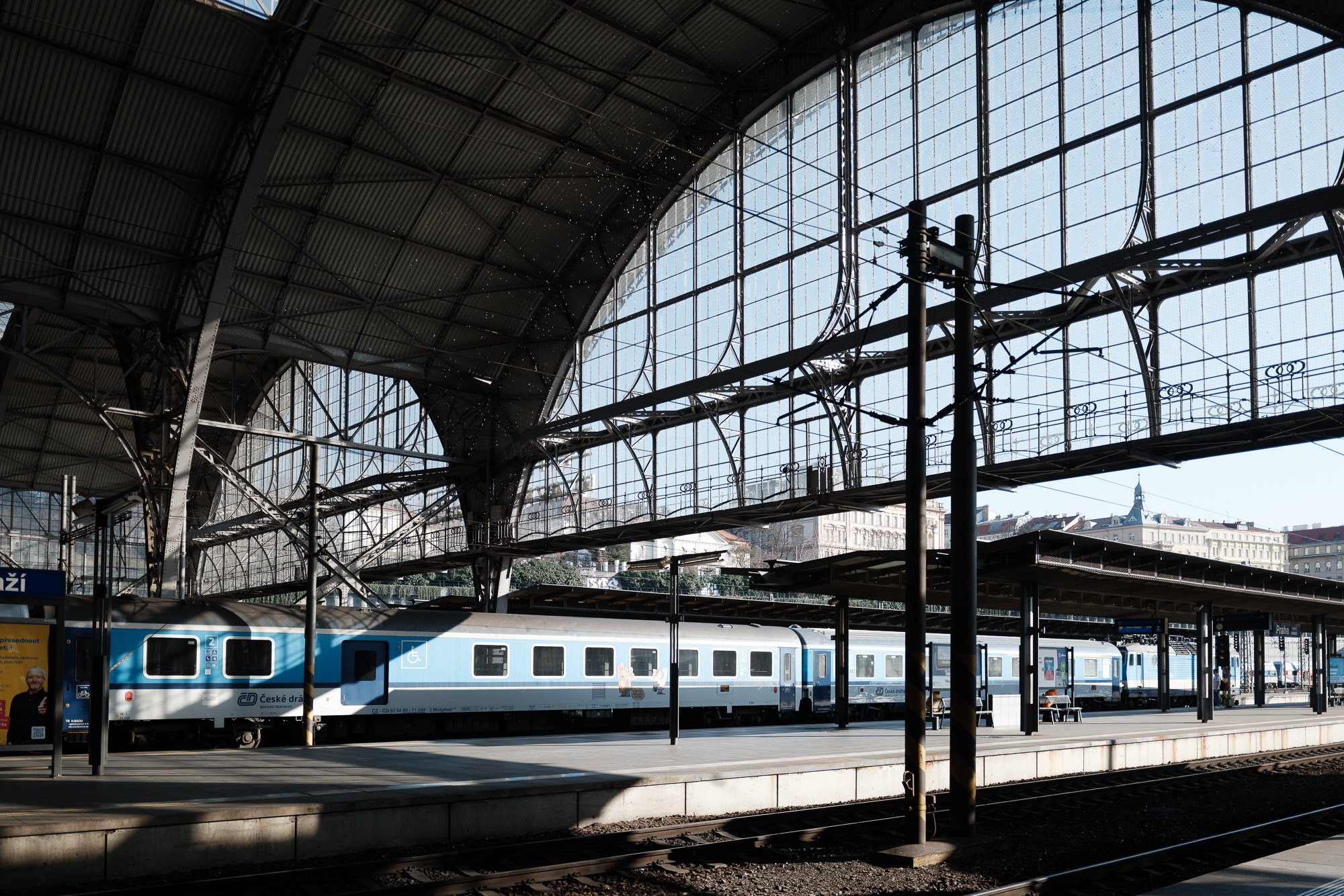
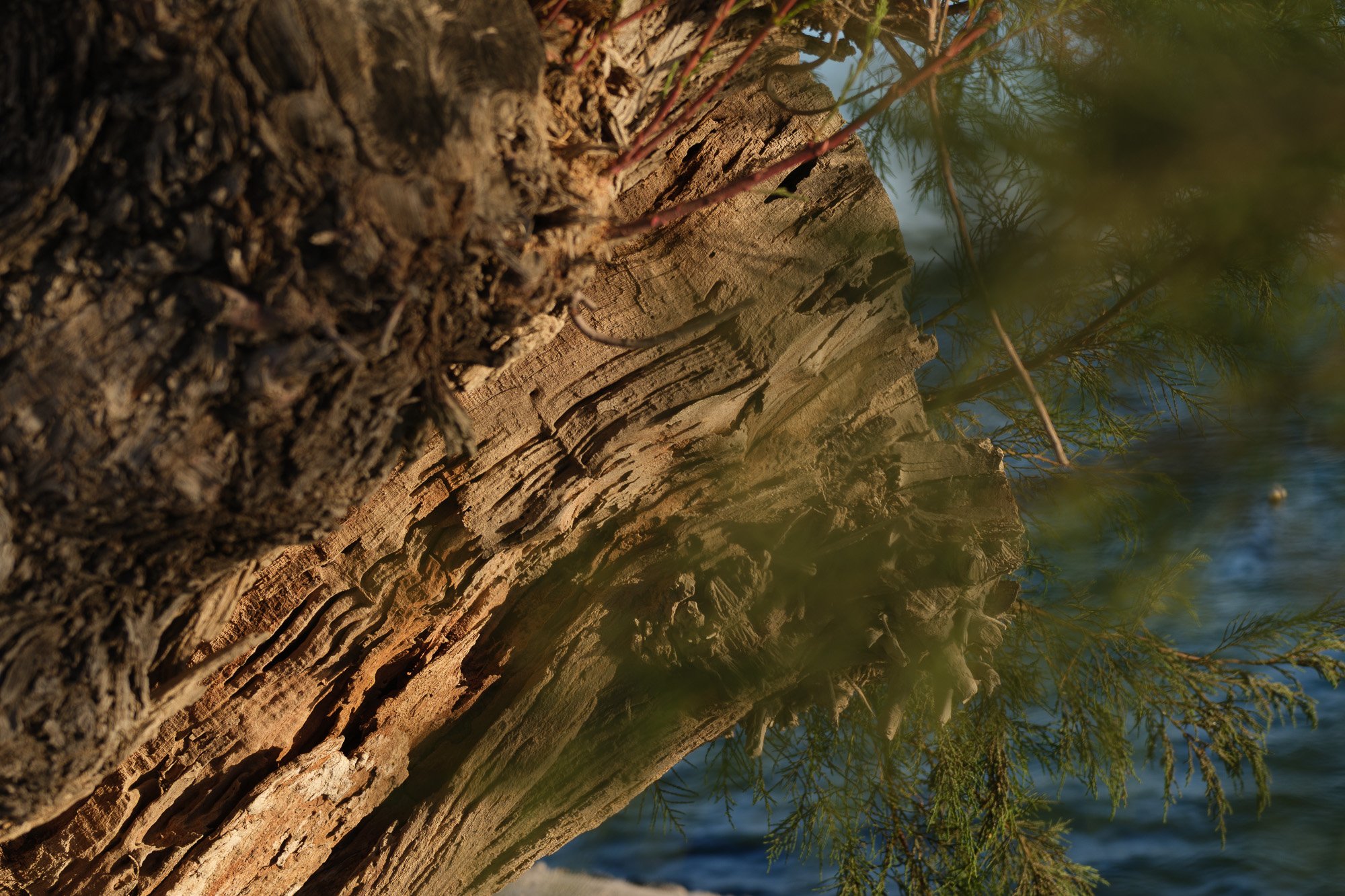
Below is a gallery of photos taken with the Fujifilm GFX 100RF:










The GFX 100RF and video: 4K 30p on board
On the video side, the GFX 100RF keeps things fairly modest. There is no 8K like some competing models (you know who you are), but “only” 4K DCI at 30 fps in 4:2:2 10-bit. A limitation likely dictated, once again, by the storage medium and the compact form factor, which could lead to overheating.
That said, it is possible to record directly to an external SSD: you lose some ease of use but gain access to Apple ProRes.
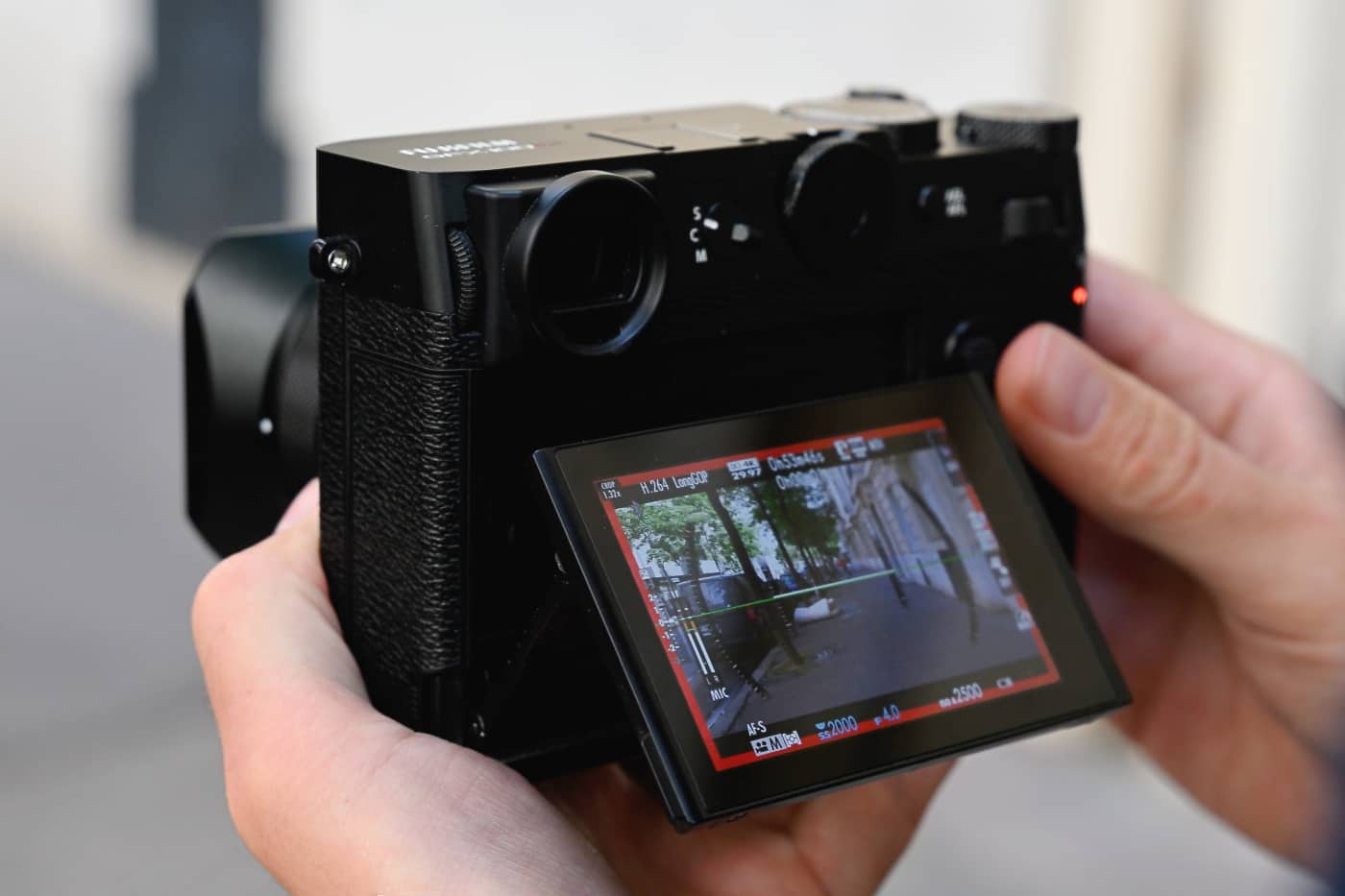
In the field, the camera performs satisfactorily. Autofocus is convincing: there is (almost) no hunting to speak of. The tap-to-track subject selection feature on the touchscreen is present.
Finally, the digital stabilization, with a 1.32x crop, proves very effective for moderate movements. That said, the 4K 30p spec confirms that the GFX100RF remains primarily a stills camera rather than a video tool.

Comfortable battery life
The Fujifilm GFX 100RF uses the NP-W235 battery. Good news if you already own a GFX 50S II, GFX 100 II, or even an APS-C body from the brand, as you can reuse your batteries without any issue.
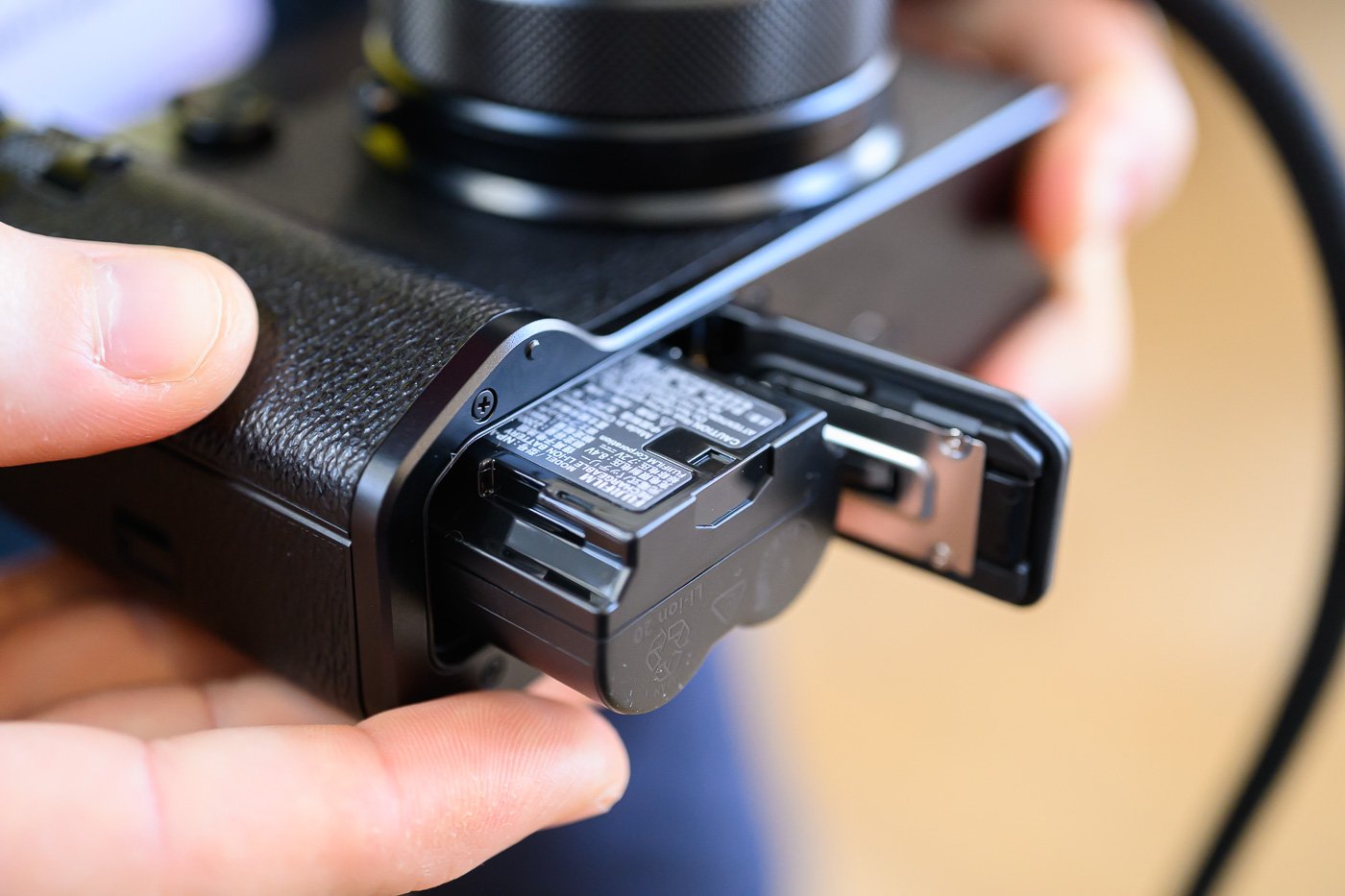
In terms of battery life, Fujifilm claims 820 shots or 100 minutes of 4K 30p video. A fairly realistic figure, as we managed to capture nearly 700 images and about ten video clips on a single charge, without draining the battery completely. In this regard, the GFX100RF is very satisfying.
Connectivity and storage
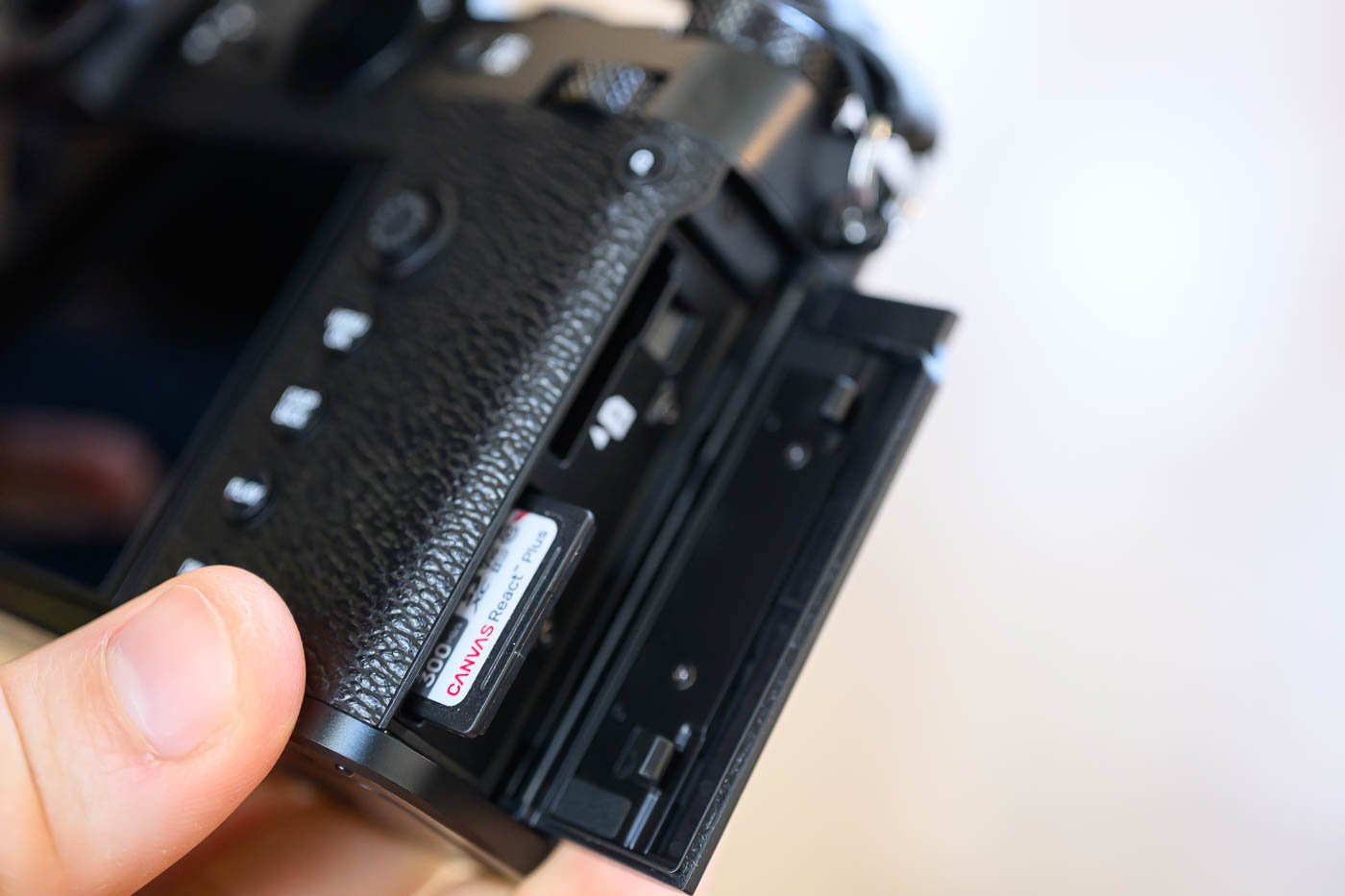
On the connectivity front, the Fujifilm GFX100RF takes a minimalist approach, without being stripped bare. All ports are grouped on the left side (two 3.5mm jacks, one USB-C port, one micro HDMI). On the right side, there is a dual SD UHS-II card slot.
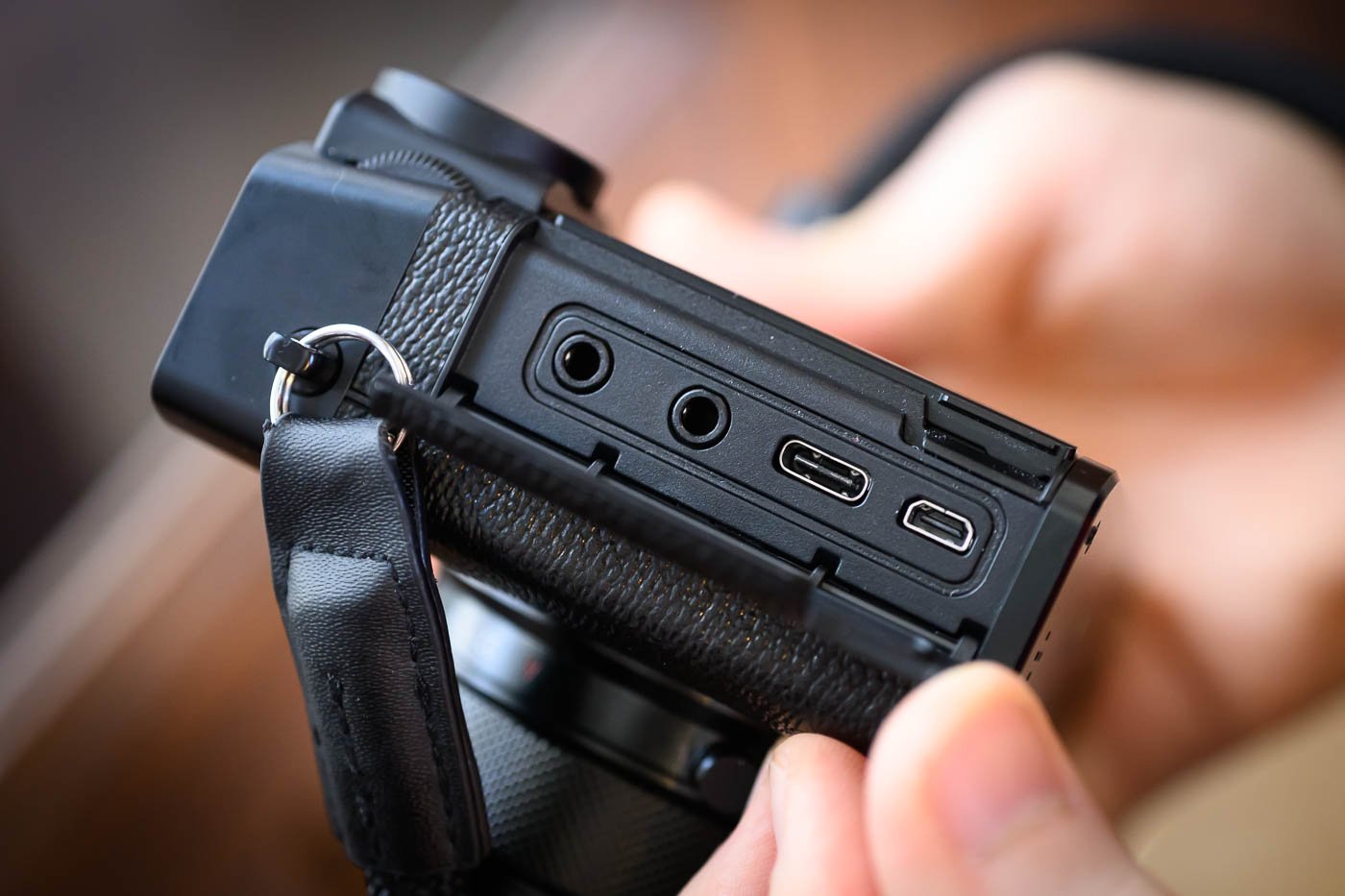
The absence of a CFexpress slot is likely aimed at avoiding overheating and saving space. However, it is still possible to connect an external SSD, which is particularly useful for video (see above).
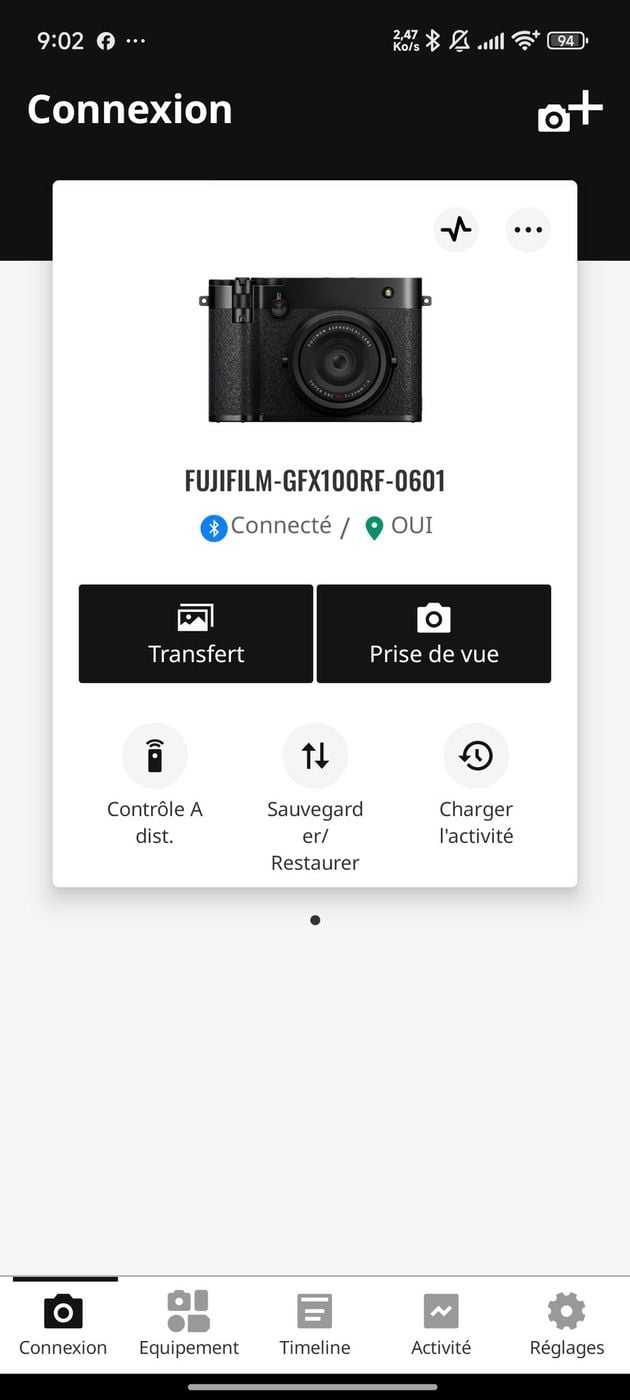
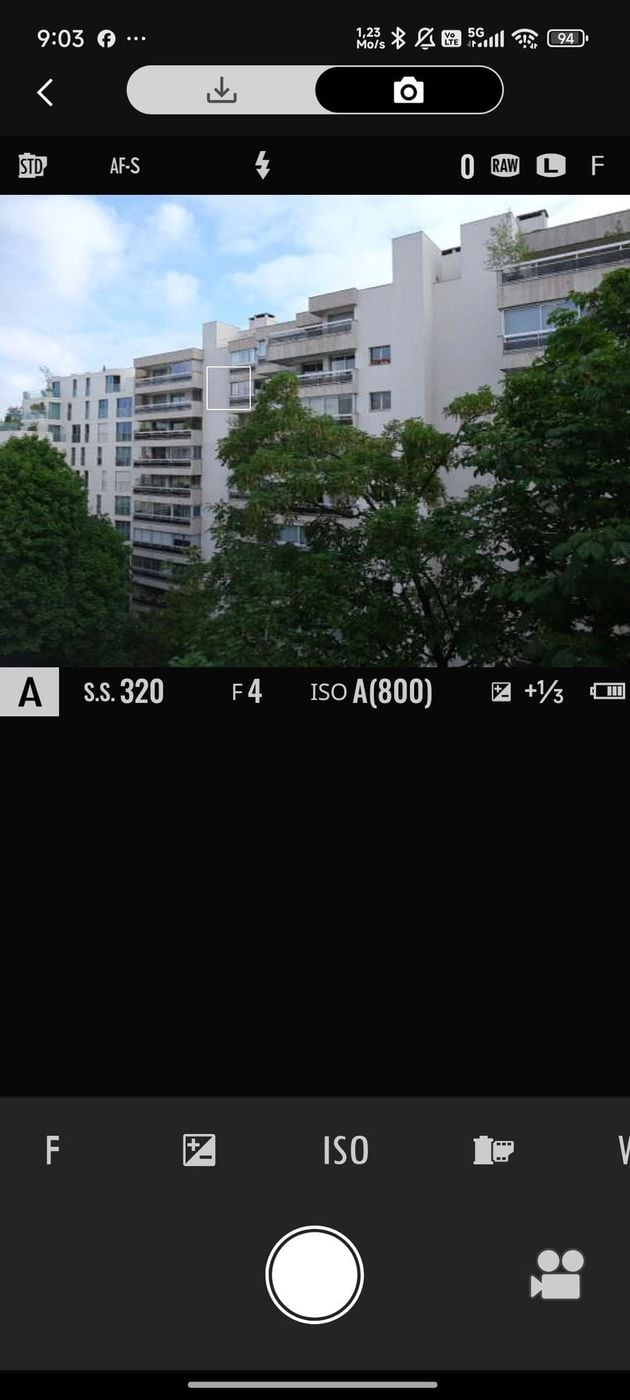
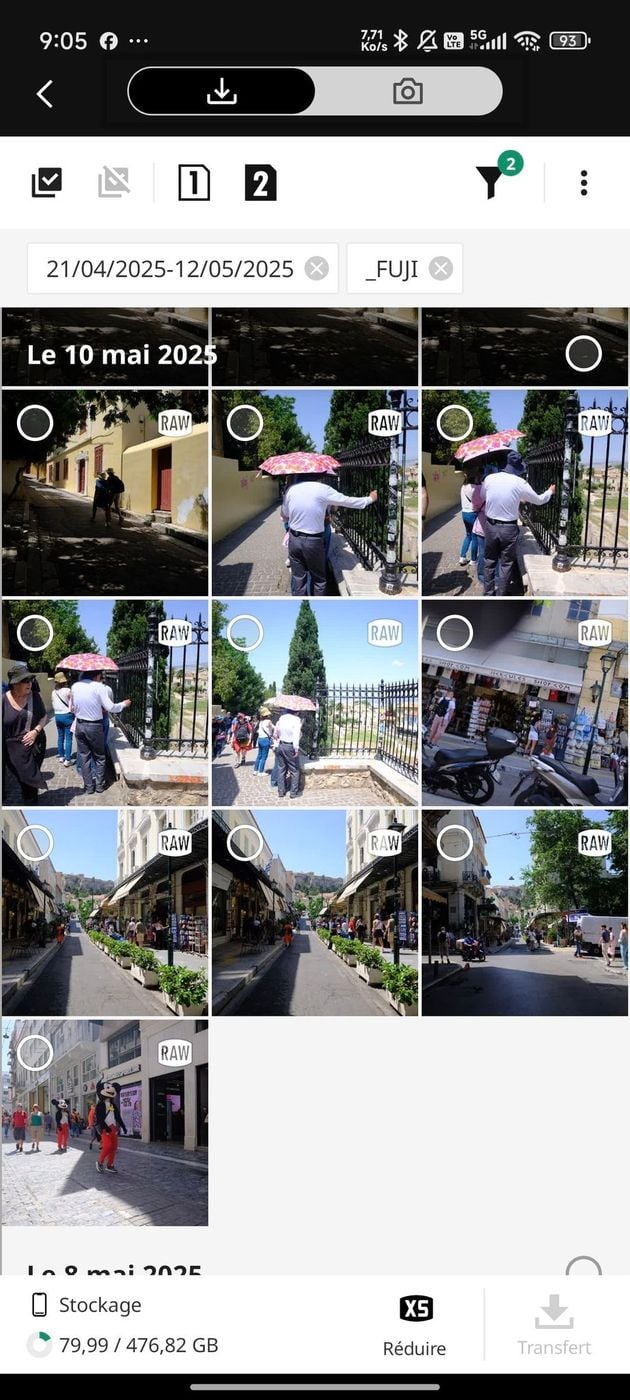
Finally, the camera features Wi-Fi 5 and Bluetooth 4.2. It can be used with the Fuji X App (iOS and Android). The pairing process is quick and easy. Remote shooting works well, though some lag is noticeable. RAW file transfers to an iPhone are still not available, which is understandable given the file sizes here. Another disappointment: some settings are not accessible remotely (digital crops and aspect ratio changes, for instance).
Conclusion: mission accomplished with the GFX 100RF?
With the GFX100RF, Fujifilm’s ambition was to deliver an X100VI with a medium format sensor. Mission accomplished? In terms of design and ergonomics, the goal is met: the camera is compact, lightweight and a pleasure to use. Its sensor, carried over directly from the GFX 100 II and GFX 100S II, delivers excellent image quality, backed by generally strong autofocus performance. The 102 MP resolution offers generous cropping latitude, especially thanks to the built-in crop modes.
However, the maximum aperture limited to f/4 and the total absence of stabilization (neither sensor-based nor optical) are the camera’s two main weaknesses. Subject separation is not pronounced enough. We struggled to achieve the characteristic rendering typically associated with medium format images. In low light, you are forced to push the ISO very high and keep a close eye on your shutter speed. These are all trade-offs that Fujifilm justifies by the pursuit of compactness.
Then there is the question of price: at $4,899, the Fujifilm GFX100RF is actually priced lower than the GFX100S II, while featuring a built-in fixed lens. It also comes in $1,836 cheaper than its main rival, the Leica Q3 ($6,735). However, the Leica delivers better image rendering, particularly in terms of modeling and bokeh, thanks to its much faster f/1.7 aperture.
Ultimately, Fujifilm delivers a camera with no technical equivalent: it is indeed the first expert compact camera with such a large sensor. But in our view, the promise of medium format is not fully delivered with this 35mm f/4 lens. On the other hand, if you are looking for a camera that combines compactness, ultra-high resolution and a delightfully retro look, this body could very well win you over.
The Fujifilm GFX 100RF is available at a price of $4,899. Deliveries will begin on April 7, 2025. Two finishes are available: black and black with a silver top.