



At CP+ 2019 in Japan, we met with Kazuto Yamaki, CEO of Sigma, to talk about the new L-mount that Sigma shares with Panasonic and Leica as a result of their partnership. This major event in the world of photography marks a new turning point for the manufacturer, but also for the full-frame mirrorless camera sector.
We wanted to learn more about Sigma’s vision for the L-mount and product compatibility, but we also discussed the 60-600mm lens, Sigma’s upcoming full-frame mirrorless camera, and the Sigma company itself. Here is our interview.
 Kazuto Yamaki, CEO of Sigma Corp.
2019 is a key year for Sigma with the “L-Mount Alliance“. Is Sigma entering a new era?
Kazuto Yamaki, CEO of Sigma: Yes. We hope to achieve new success with this L-mount. Our mission is to manufacture high-quality products for consumers. Whether it’s the L-mount or not, what we need to do for consumers remains the same. We decided to work together with Panasonic and Leica for the benefit of the customer. From the consumer’s point of view, they would not want to choose a single camera with a single mount. Perhaps it is easier for customers to choose our camera if we work together with Panasonic and Leica, because they will have several choices within the same system, the same mount. Instead of making our own mount, this partnership with Panasonic and Leica should offer customers a better choice. That is why we decided to work together.
Today, you are announcing 11 new L-mount fixed focal length lenses, ranging from 14 to 135 mm. All of the lenses come from the historic Art series of full-frame SLR lenses, which have also been available for the Sony E-mount since last year. What were the challenges in adapting these lenses to the Sony E-mount and then the L-mount?
 The 11 new Sigma L-mount lenses
Kazuto Yamaki, CEO of Sigma: The most difficult part is not in the optical or mechanical field, but in the firmware, the software inside the lens. The autofocus system is different between a DSLR and a mirrorless (hybrid) camera, and the lenses are not designed for hybrids. Our engineers had to work hard to design a smooth autofocus system for hybrids. We developed new firmware, which took about a year. That was the biggest challenge in adapting these lenses.
As we are currently at CP+ in Japan, we would like to know how Sigma is currently perceived in Japan. Are there any products that are more popular here than in Europe, for example?
Kazuto Yamaki, CEO of Sigma: The Japanese are very conservative, perhaps like the French or the British. It takes a long time to be accepted as a brand. I think our brand perception has been improving steadily over the last six or seven years, after launching our Art series lenses, but compared to other markets, the process is still slow in Japan. In the US, the market is faster, and consumers are more receptive to new products. For example, Honda and Toyota, Japanese brands, were first very successful in the US, then in other markets. So the US has a culture that accepts newcomers, but only if they offer good quality. But I think that overall, including in Japan, our brand image is improving. But my goal for Sigma is to become the best in the industry, better than other companies, and we are still in the process of achieving that goal.
 Sigma 30mm F1.4 DC HSM | Art
In terms of products, there are some differences between Japan and Europe. For example, in Japan, compact lenses are very popular, such as the Sigma ART 30mm F1.4 DC HSM for DSLRs and mirrorless cameras, which is very popular in Japan. Otherwise, it’s pretty much the same. Oh yes, telephoto lenses are also popular in Japan, such as the 150-600mm or the new 60-600mm.
The 60-600mm f/5.5-6.3 DG OS HSM Sports was unveiled at Photokina 2018. What has been the public’s response?
Kazuto Yamaki, CEO of Sigma: It’s been very good. Consumer response has been very positive, and in fact we can’t produce fast enough to meet demand. So we’re producing at full capacity to catch up. Our customers report very high quality from 60mm to 600mm—the entire focal range—with very good construction and a lens that is neither light nor too heavy and well balanced thanks to its magnesium construction. So for now, it is very well received by users.
 60-600 mm f/5.5-6.3 DG OS HSM Sports
At your CP+ booth, it’s impossible to miss the number 78, representing 78 lenses already compatible with the L-mount thanks to the new MC-21 adapter (many more if you count lenses from other manufacturers). Given that you include lenses with adapters in this 78, what is your definition of “compatible”? Is the performance with an adapter sufficient for you to make this claim?

Kazuto Yamaki, CEO of Sigma: Ah! Actually, that was my idea. My first idea was to turn this entire wall [he shows us a giant black wall, editor’s note] into a big 78 sign, but my team told me it wasn’t possible, so I gave up and made this board at the front of the booth.
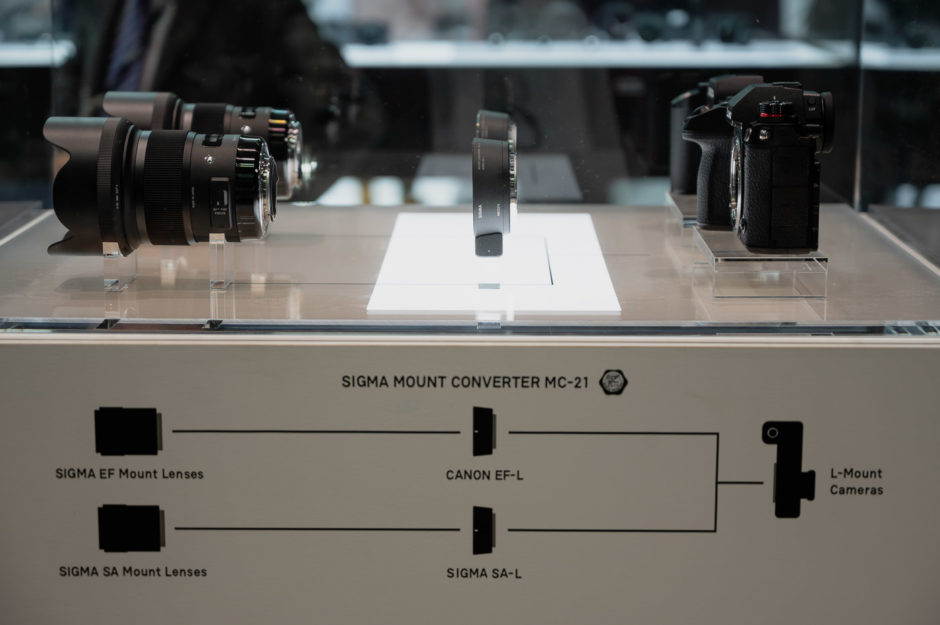 The MC-21 adapter for Canon and Sigma L-mount lenses
To get back to the question, yes. It’s still in development, but our goal is that there will be no disadvantage to using the MC-21 adapter, because it’s our system. So we’ve updated the L-Mount system to perform better with our adapters. The existing L-Mount wasn’t robust enough in the past, so Sigma, Leica, and Panasonic discussed updating the camera firmware to improve compatibility with L-Mount adapters.
 The MC-21 adapter allows Canon EF and Sigma SA lenses to be mounted on the L-mount
Like the adapters for the Nikon Z or Canon RF mount [from Nikon and Canon, editor’s note], I don’t see any loss of performance when using them, especially Canon’s R system, which is very impressive. With our Sigma lenses equipped with an adapter, it couldn’t be better (laughs), but we try to maintain the same quality.
“No compromise” is one of Sigma’s mottos. It’s funny that Panasonic uses the same terms to describe its Lumix S1 and S1R. It really seems like you get along very well, doesn’t it?
Kazuto Yamaki, CEO of Sigma: (laughs) I’m not sure if it’s just a marketing phrase. Maybe it’s just a coincidence, or maybe it proves that we’re looking in the same direction and are on the same path.
Lumix S1 et S1R : l’artillerie lourde de Panasonic en hybride plein format
We know you can’t say much about the new Sigma full-frame L-mount hybrid you’re developing, but is development going in the direction you want?
Kazuto Yamaki, CEO of Sigma: To be honest, we are a little behind schedule, but we are working hard on it.
At Photokina, you said you would offer a trip to Hawaii to anyone who sold the f/2.8 super lens kit, including your famous 200-500mm f/2.8 lens (which sells for over €18,000). Has anyone managed to achieve this challenge?
 At Photokina, Kazuto Yamaki presented this super kit of five lenses covering 14mm to 500mm at f/2.8 and promised a trip to paradise to anyone who could sell it, in a humorous tone (or not?).
Kazuto Yamaki, CEO of Sigma: You have a good memory! I expected Mr. Prové (CEO of Sigma France) to succeed (laughs). Maybe this year (laughs).
At Phototrend, we talk about photography equipment, but we also want to know the stories of the men and women behind it all. Sigma is a family business, and you have been running the company since 2012, following in your father’s footsteps. How do you carry on your father’s vision while adapting to the new market?
Kazuto Yamaki, CEO of Sigma: I share the same vision and philosophy as my father. In fact, I learned this philosophy from my father. After graduating from university, I immediately started working for Sigma. When my father passed away, I had already been working for Sigma for 21 years, so I understood my father’s philosophy perfectly.

In fact, he told me this when I was just a little boy, so I understand it completely. Even though the market has changed, I am simply applying this strategy to the new circumstances, and the basic philosophy remains the same. As a company, our priority is to continue to operate the company to protect our employees and their jobs, and to make consumers happy while contributing to the community, society, and photographic culture. This is the basic philosophy at Sigma, which is the same as my father’s.
Sigma’s factories are located in Aizu—the optics factory and your new magnesium factory. What makes Aizu so special?
Kazuto Yamaki, CEO of Sigma: I was born and raised here [Kazuto points to the ground; we are in Yokohama, near Tokyo, editor’s note]. Well, not here, but I mean in Tokyo. Even from my perspective, Aizu is a little different from the rest of Japan. Its inhabitants still retain the ancient Japanese mindset. Sometimes they may be a little too conservative, but they maintain their beautiful, ancient Japanese mindset: working hard, being very humble, not talking too much, and focusing on what they have to do. This mentality is very different from modern Japan, and it works very well for designing high-quality products like we do at Sigma.

Aizu is a fairly remote rural area and there aren’t many large industries. In fact, there are only two that have more than 1,000 employees: one is Sigma, which employs 1,600 people locally. The other is Olympus, with about 2,000 employees, I believe. This Olympus factory also manufactures optics, but not for cameras, for endoscopes. The mindset of the people in Aizu is very well suited to polishing lenses.
Is it just the people? Nothing about the water quality or anything else?
A long time ago, one of our employees was from Aizu. So he introduced Aizu to my father for recruitment purposes. My father went to Aizu to recruit young people before we moved there. My father wanted to bring these people to our factory in Tokyo, but at that time, the people of Aizu suggested that my father build a factory there. So he decided to build the factory there, because he believed it would be easier to recruit people.
But he also liked Aizu, so he decided to expand the factory. Once again, I think the most important thing is people’s mentality. Many people say that optical factories need very high-quality water, but that doesn’t matter when it comes to lens precision. However, the only places where you can find pure water are in the mountains or hills. In winter, it is very cold and there is a lot of snow, so the people who live in these kinds of places are very tough and work hard, that’s all. This kind of mentality is very good for an optics manufacturer.
Yamaki-san, what are your two favorite lenses?
Kazuto Yamaki, CEO of Sigma: If I can choose two, I would say the 35mm f/1.4 Art series! It is the first lens in the ART range. I personally love this lens. If we had failed with this lens, we probably wouldn’t have been able to survive in the industry. It was a big risk for us to change and launch this new series, but it was a real success that gives us confidence for the future. So the 35mm is a memorable product for me, for us. The second lens is the 18-35mm f/1.8, which is a truly unique lens that no one else has, so I love this lens.

Arigatō gozaimasu (thank you very much) to Kazuto Yamaki for taking the time to answer our questions. Thanks also to Baudouin Prové, CEO of Sigma, and his team for organizing this meeting.