


The least we can say is that the Canon RF 45 mm f/1.2 STM made quite a splash when it launched in October 2025. It must be said that this prime lens offers a virtually unprecedented combination: an ultra-fast f/1.2 aperture, a very compact form factor, a responsive autofocus and… a very accessible price tag of €499.
Canon’s promise: to deliver a remarkable creative tool for bokeh enthusiasts. But in real-world use, what level of performance does this lens actually deliver? What trade-offs did Canon have to make to achieve this aperture-to-price ratio? We used it daily for several weeks: here is our full review of the Canon RF 45 mm f/1.2 STM.
Sommaire
Canon RF 45 mm f/1.2 STM: the everyday prime lens, reinvented
The Canon RF mount celebrated its 7th anniversary in October 2025. Now that it has come of age, the Japanese manufacturer is indulging in a few optical experiments.
Until now, lenses with an f/1.2 aperture were reserved for an elite few. This RF 45 mm f/1.2 STM now sits alongside the RF 50 mm f/1.2 USM, which sells for a cool €2,080 more. There is also the RF 50 mm f/1.8 STM, which represents the entry point of the Canon RF lens lineup.
Canon’s idea is both to make ultra-fast lenses more accessible, but also – and above all – to open up new creative possibilities for bokeh lovers and, more broadly, for beginner and experienced photographers alike. A trend we already observed with the 2 zoom lenses RF 16-28 and 28-70 mm f/2.8 STM launched in 2025.

In terms of usage, this lens also stands out for its unusual 45 mm focal length. Very close to the “classic” 50 mm, it offers a very natural field of view and great versatility: everyday photography, travel, portraits, documentary work, and much more. The f/1.2 aperture makes it incredibly easy to play with depth of field, turning a “simple” prime lens into an unprecedented creative machine.

When asked by Phototrend, the company told us that the short flange distance of the RF mount (20 mm) enabled the creation of more original optical designs than in the past, by moving away from retrofocus configurations. As a result, certain lenses – such as this 45 mm f/1.2 – that were impossible to produce in the DSLR era are now feasible on mirrorless cameras.

Furthermore, focal lengths around 40 mm make it possible to achieve a compact form factor with a fast aperture. Canon therefore seems (for now) to rule out a range of affordable f/1.2 lenses, since longer (or shorter) focal lengths would require larger – and therefore more expensive – elements.

On the technical side, Canon had to accept some notable compromises. The optical formula appears “almost” simplistic. It comprises 9 elements in 7 groups, including 1 PMo aspherical element (Plastic moulded) with Super Spectra coating to reduce flare (but no Air Sphere Coating). Compare this with the 15 elements in 9 groups of the RF 50 mm f/1.2 USM. The f/1.2 aperture is delivered by a 9-blade diaphragm.
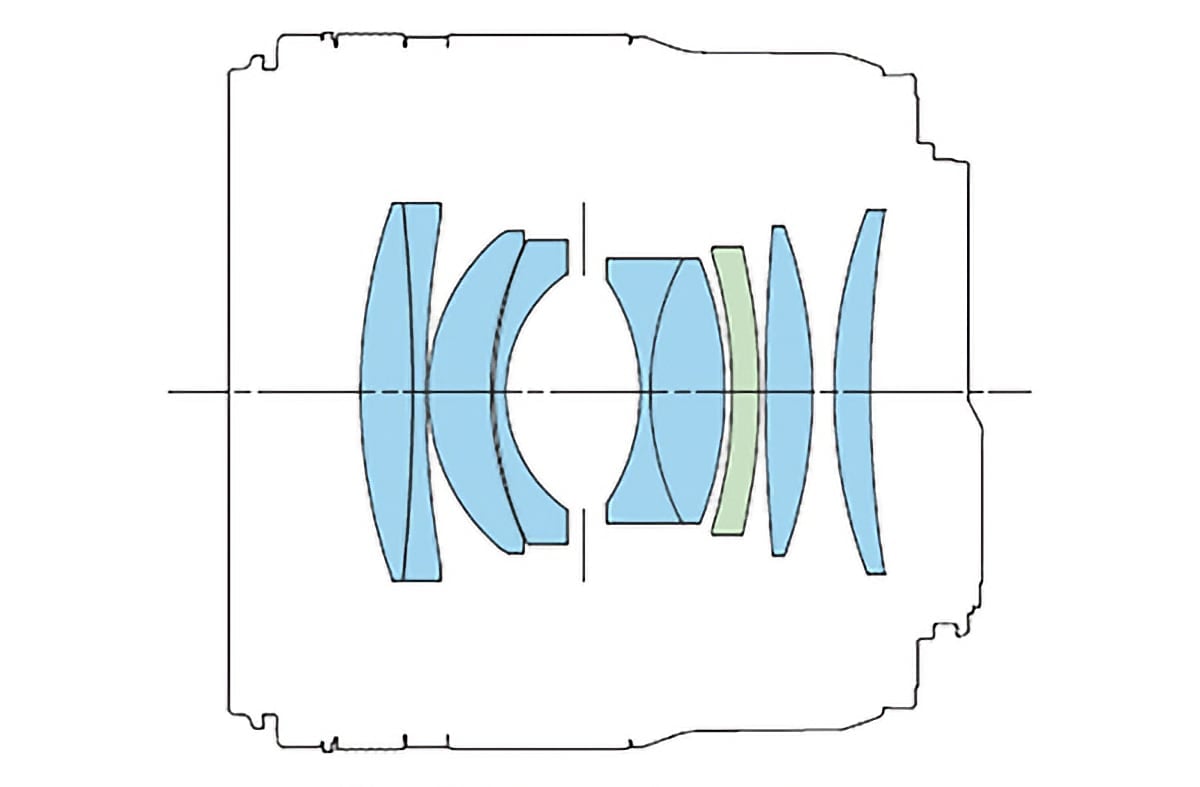
Finally, autofocus is handled by a “simple” STM motor – rather than USM.
Ergonomics and handling of the Canon RF 45 mm f/1.2 STM
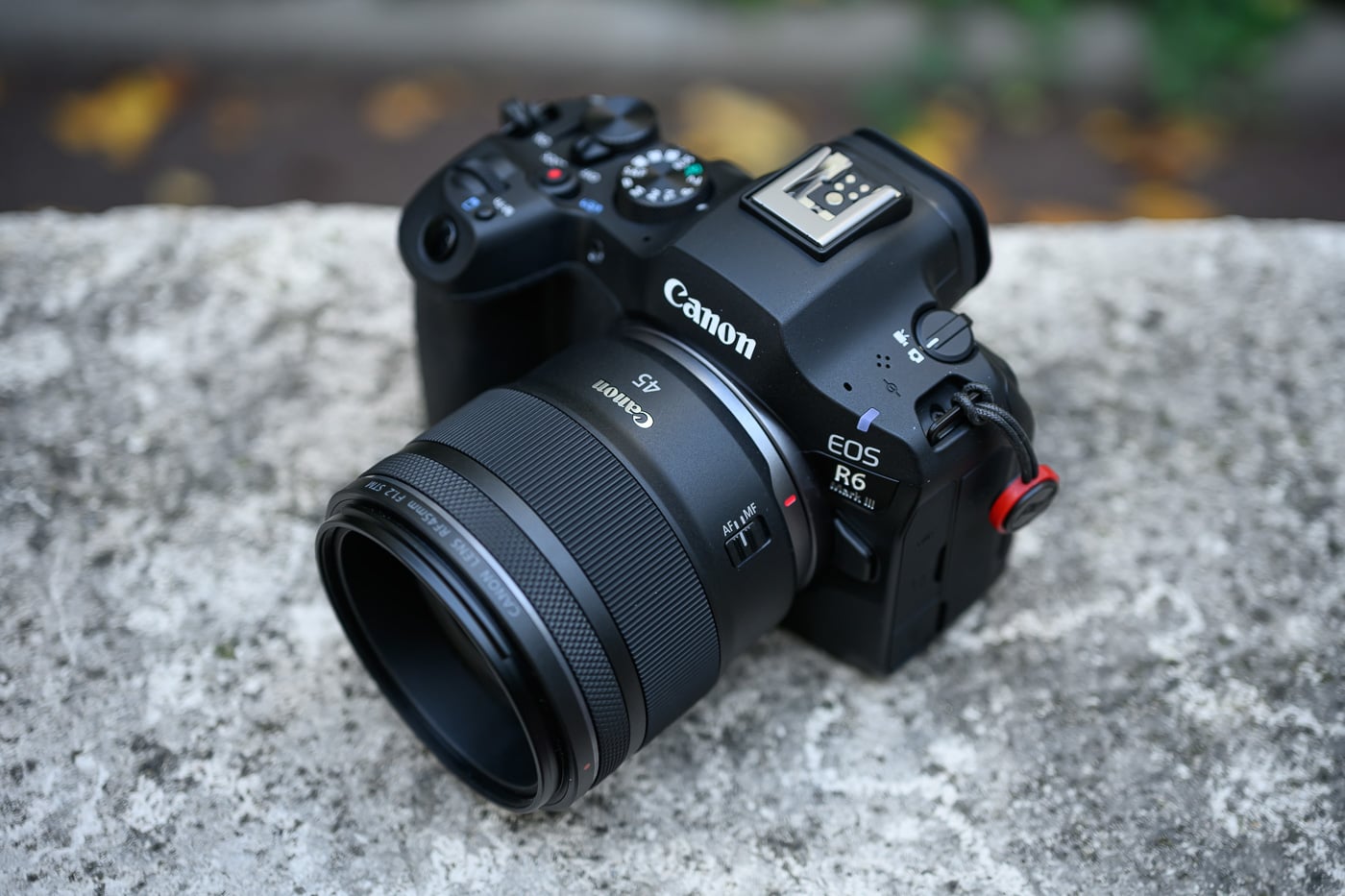
At first glance, the Canon RF 45 mm f/1.2 STM is (genuinely) surprising in its compactness and lightness. It measures just 7.5 cm in length with a maximum diameter of 7.8 cm, for a weight of… just 346 g. Compare that with the 950 g of the RF 50 mm f/1.2 USM! Mounted on a Canon EOS R6 Mark III, the combo weighs only 1,015 g. An unprecedented level of lightness (in RF mount) for such a fast lens on a full-frame body.
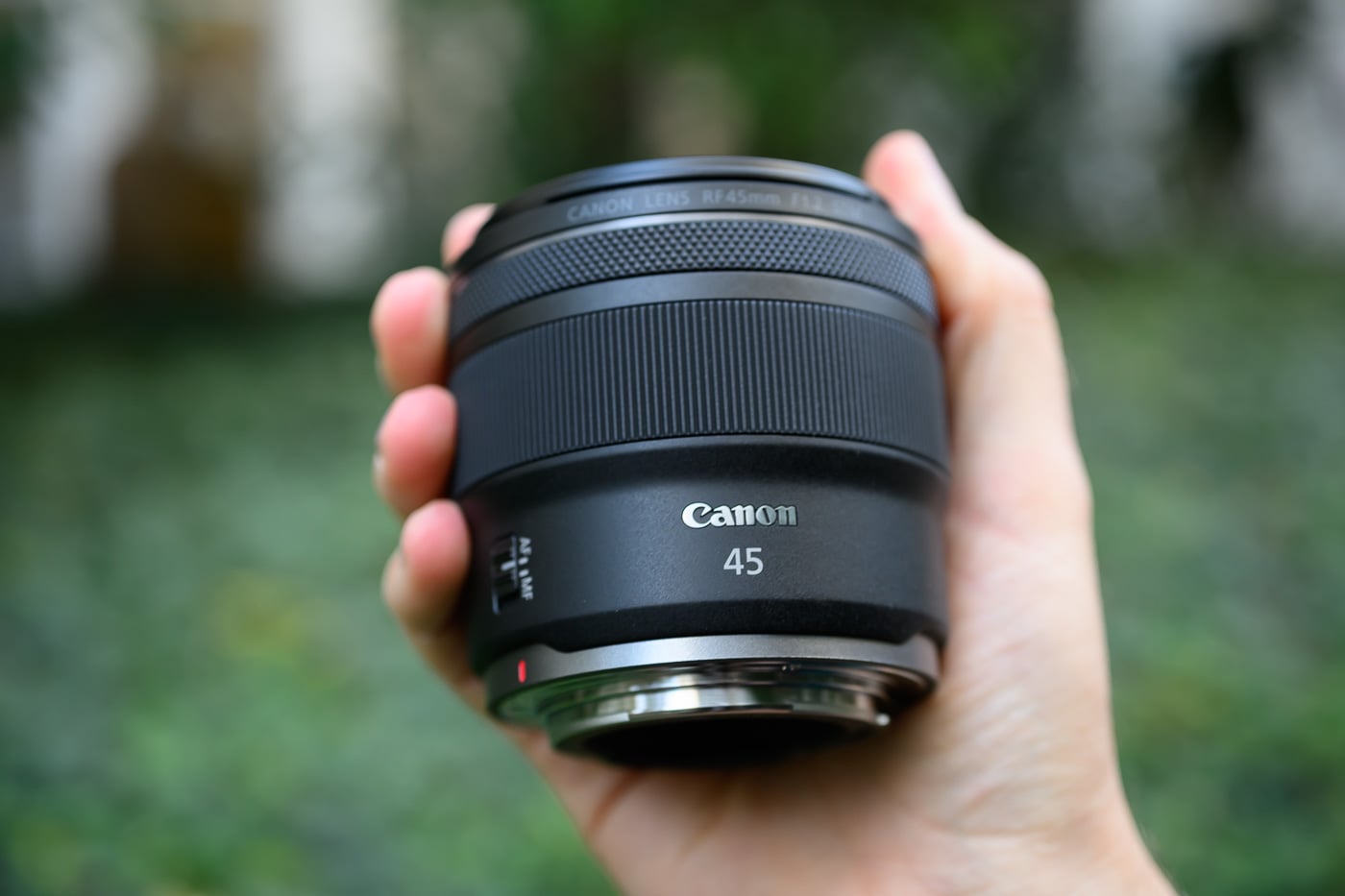
To achieve such lightness, Canon made extensive use of plastic (or rather, polycarbonate) for this lens. Fortunately, the lens feels well built and well finished. The front and rear elements are fairly large (approximately 4 cm).

However, the lens is not weather-sealed: exercise caution if you plan to use it in humid or dusty environments. It is also worth noting that focusing is not internal: the closer the focusing distance, the further the front element extends from the barrel. This creates a risk of dust intrusion into the lens.

In terms of manual controls, the lens is minimalist. Besides an AF/MF switch on the side, there is a wide focus ring. It drives an internal motor and has no hard stop. The (virtual) throw is fairly long: convenient for manual focus. You will also find the usual control ring (clicked), which can be configured from the camera’s menus.

Since the lens is not part of the L series, it ships only with its front and rear caps. The lens hood is not included in the box. It will cost you €39 to purchase separately.
Canon thus delivers a remarkably light and compact lens that is a genuine pleasure to use, whether on a small body like the EOS R8 or on a larger mirrorless camera like an EOS R5 Mark II. It can remain permanently attached to your camera, ready to accompany you on all your adventures.
Image quality of the Canon RF 45 mm f/1.2 STM
We tested this ultra-fast Canon prime on a Canon EOS R6 Mark III (32.5 MP) and on a Canon EOS R5 Mark II (45 MP).
Feel free to click on each image to view it larger.



Sharpness
In terms of image quality, Canon had to make some compromises in order to keep the lens affordable enough. Unsurprisingly, sharpness and uniformity cannot match those of the prestigious L series lenses… but this Canon RF 45 mm f/1.2 STM has some serious strengths to offer.
At wide open (f/1.2), centre sharpness is acceptable… but not particularly dazzling. The edges show a real lag, with blurred details.

Fortunately, things improve very quickly. Centre detail becomes good from f/1.4 onwards. At f/2.0, the overall rendering becomes refined, both at the centre and the edges of the frame – only the corners still lag behind.

However, you need to wait until f/5.6 for the lens to deliver its best performance, with respectable sharpness and uniformity. Our concerns about diffraction were unfounded: performance holds up at f/11, and it is only at f/16 that the decrease in sharpness becomes noticeable.

Overall, the Canon RF 45 mm f/1.2 STM’s performance proves very consistent given its (very) wide aperture, its optical design… and its price point.
Distortion and aberrations
With Canon, distortion and vignetting are corrected automatically by the camera body (on JPEGs) and by our software in post-processing (on RAW files).
With the correction profile offered by Lightroom Classic, chromatic aberrations are not perfectly corrected. On certain “complex” patterns, you will find quite prominent green and purple fringing, which is fairly difficult to correct manually.


Likewise, there is very noticeable barrel distortion and extremely pronounced vignetting… which fades by f/4.


Canon therefore relies on software correction for aberrations and distortion. A solution that is far less expensive and complex to implement than optical correction. This is hardly surprising given the lens’s price tag… and is becoming increasingly common across the industry.
Canon’s design choices are also reflected in the lens coatings. While the loss of contrast in backlit conditions is relatively well controlled, flare can be very pronounced, with orange and green artefacts clearly visible in the frame. Fortunately, ghosting is absent.

Last but not least, focus breathing is particularly pronounced. If you intend to shoot a lot of video with this lens, consider yourself warned…
The ultimate weapon for bokeh lovers
Bokeh is undoubtedly the main selling point of this Canon RF 45 mm f/1.2 STM. With its ultra-fast aperture, it makes it incredibly easy to play with depth of field, producing images that truly stand out from the ordinary – especially if you are not accustomed to such wide aperture values.

And in real-world use, the rendering delivered by this lens is quite extraordinary. The background blur is extremely diffuse, creating a beautifully dreamy effect. The transitions between the subject and the fore/background are remarkably smooth. The lens is an excellent ally for portrait photography, with good sharpness on the subject and a gorgeous background blur.

The slightest reflection, the slightest light source in the fore/background transforms into a highly aesthetic bubble, with a swirling effect. In short: bokeh lovers should be thrilled! Unsurprisingly, at f/1.2, the zone of sharpness is extremely narrow: you will need to be meticulous about focus point placement. Fortunately, the autofocus proves sufficiently accurate (more on that below).

On closer inspection, however, we find a few (minor) flaws. The cat’s eye effect is quite noticeable, with bokeh balls being “clipped” towards the edges of the frame. A slight onion ring effect is present, with the outline of the bokeh balls sometimes appearing a bit too defined – along with some chromatic aberrations.

Similarly, in documentary work, the lens shows its limitations: if the distance between the subject and the background is not great enough, the background blur is not particularly attractive – and the chromatic aberrations are quite visible. A pity.
Finally, a word about the minimum focusing distance. It stands at 45 cm. This value was entirely expected given the lens’s focal length.

Still, we cannot help but wish it had been even shorter, to get even closer to the subject. But there is no denying that in practice, the f/1.2 aperture makes it effortless to make virtually any subject shine, in any situation. And that is truly where the strength of this Canon RF 45 mm f/1.2 STM lies.

Autofocus of the Canon RF 45 mm f/1.2 STM
The Canon RF 45 mm f/1.2 STM uses a “standard” stepping STM motor. With few exceptions, USM motors remain the preserve of L series lenses. That said, the lens is fully compatible with Canon bodies’ subject detection and tracking modes.
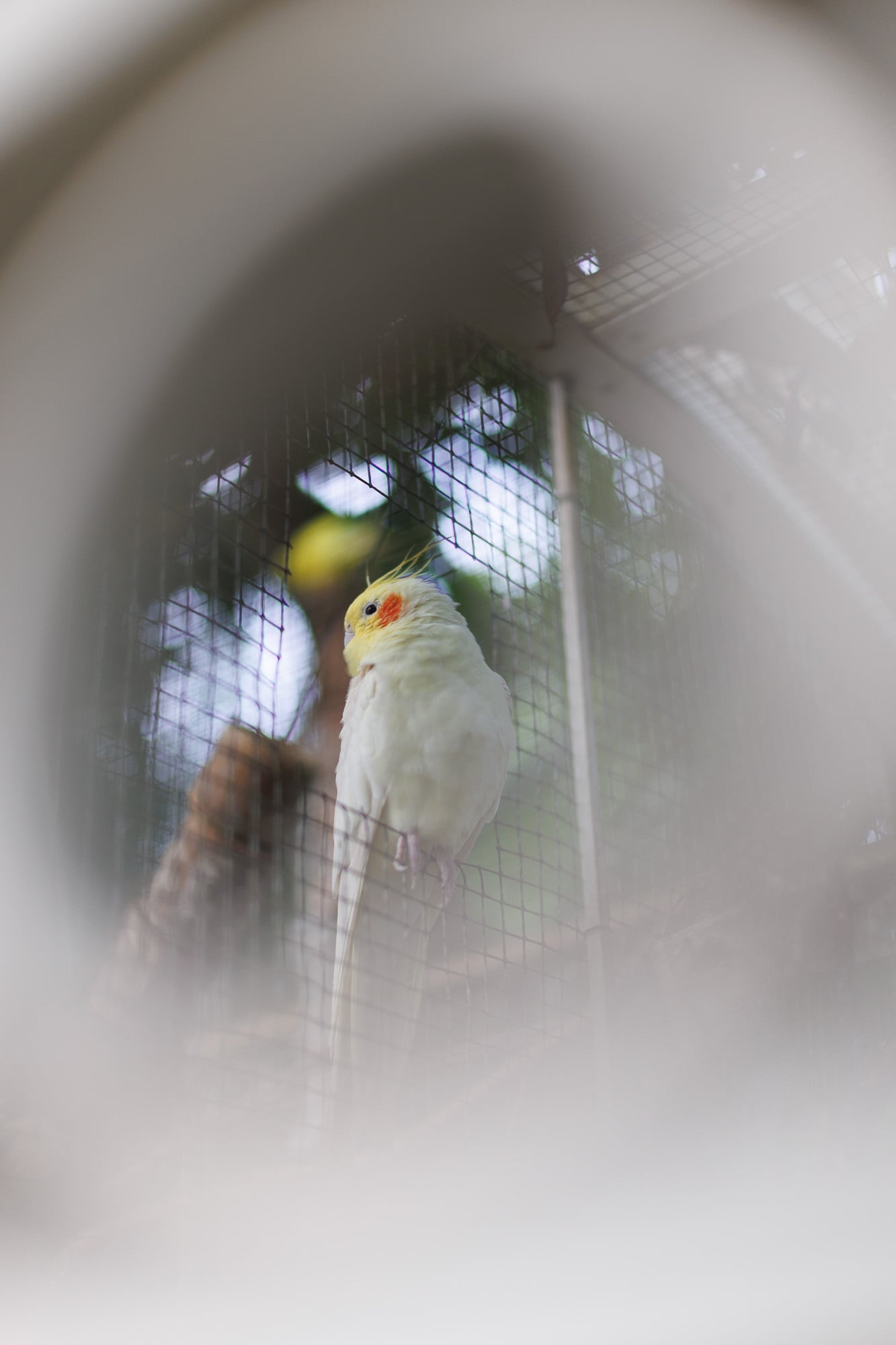
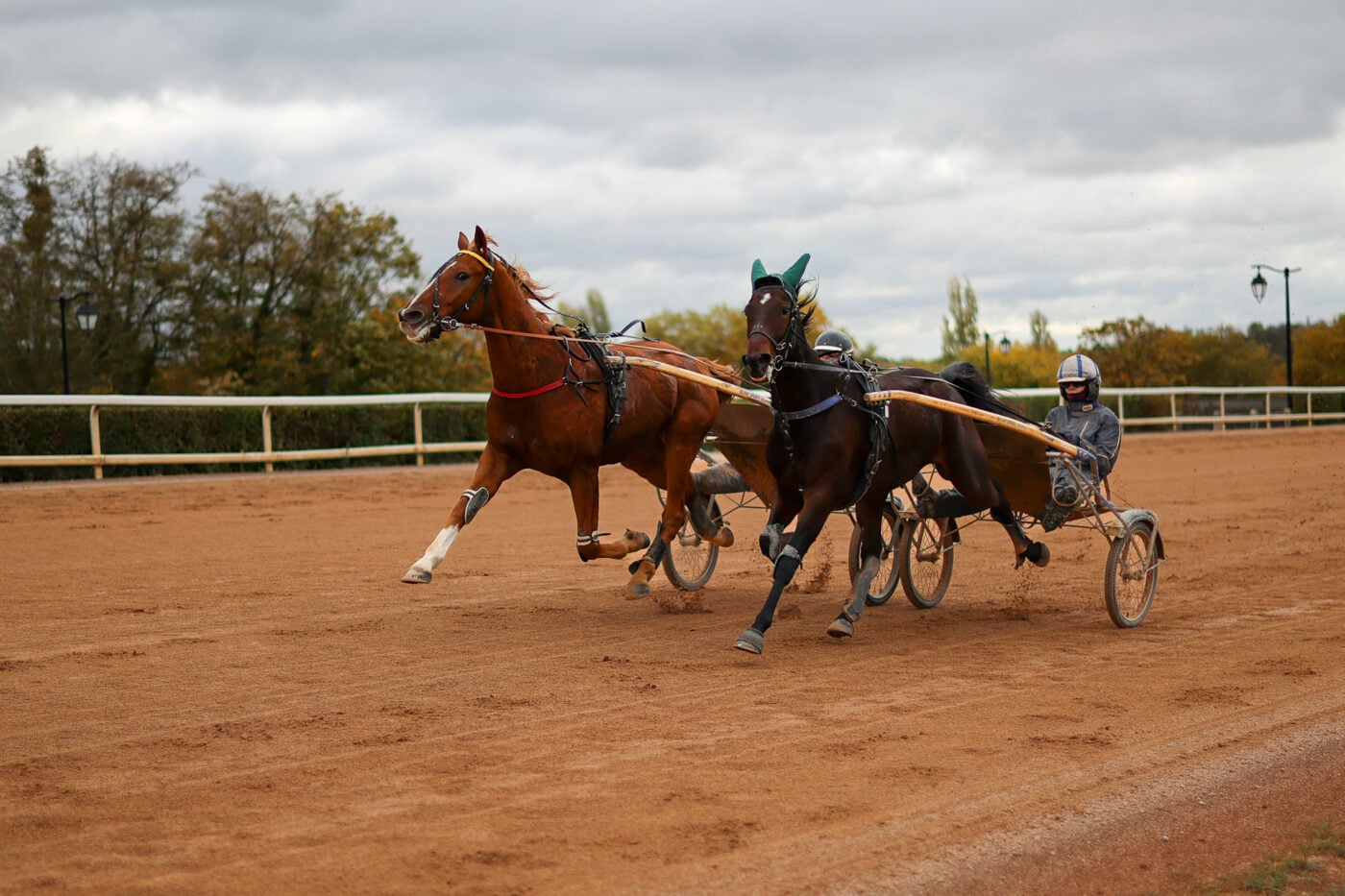
In the field, the lens offers fast and delay-free focusing. In portrait photography, the AF locks precisely onto the subject’s eye, even when the subject is moving. Similarly, in this regard, the lens is a good companion for documentary and street photography shooters, thanks to its responsive autofocus. Action scenes and very high burst rates (40 fps with the EOS R6 Mark II or Mark III) do not faze it.

The lens also delivers good low-light performance when the subject is static or moving slowly and predictably. However, some occasional hesitation may occur when the subject’s movements are sudden and/or erratic. We also encountered some difficulties with our EOS R5 Mark II running firmware version 1.0: do not forget to update your camera body…

Finally, the lens lacks optical stabilisation. It therefore relies on the camera body’s IBIS (except for the EOS R8 and RP, which unfortunately lack stabilisation). However, we managed to go down to 1 s handheld without difficulty.

Below is a selection of photos captured with the Canon RF 45 mm f/1.2 STM:














Against the competition
It is a well-known fact among Canon users: the red-and-black brand continues to maintain complete control over its imaging chain. And while third-party brands are welcome in RF mount, this only applies to APS-C. As a result, the competition faced by the 45 mm f/1.2 STM comes solely from Canon’s own catalogue.
In terms of range, the most obvious alternative comes from the Canon RF 50 mm f/1.8 STM. Launched in late 2020, it is none other than the most affordable lens in the RF mount lineup. In the field, it delivers fairly good image quality – although you need to stop down a few clicks to obtain good centre sharpness. It is available at a very gentle price of $239.
With its ultra-fast f/1.2 aperture, the Canon RF 50 mm f/1.2 L USM is an obvious competitor to our RF 45 mm f/1.2 STM. But it plays in a very different league, serving as the flagship of the RF mount at its launch. Offering a subtle blend of exceptional sharpness and very smooth bokeh, it does however come with a rather exclusive price tag of $2,599 and a weight approaching a kilogramme…
Finally, we should mention the Canon RF 50 mm f/1.4 L USM. With its f/1.4 aperture, it fills the gap between the two lenses mentioned above. It stands out thanks to its dual nano USM and VCM motor, which delivers AF that is both smooth and precise, ideal for both stills and video. Add to that excellent image quality and a very attractive bokeh, and you get one of the most accomplished lenses in the RF mount. But here again, its price of $1,549 places it in a different category from the RF 45 mm f/1.2 STM…
Conclusion
With this lens, Canon set itself a bold challenge: to make accessible an f/1.2 aperture that was previously reserved for far more premium lenses. And in the field, the brand delivers a particularly appealing lens.
The Canon RF 45 mm f/1.2 STM successfully combines a versatile focal length, an ultra-fast aperture, effective autofocus, a compact form factor and a very, very competitive price.
Admittedly, optical performance cannot match that of the L series benchmarks. While centre sharpness is respectable from f/2.0 onwards, the corners lag behind until f/5.6. Likewise, chromatic aberrations are very pronounced.
But these few criticisms fade in the face of the beautiful background blur. A true bokeh machine, it makes it effortless to enhance any subject. In short: the Canon RF 45 mm f/1.2 STM is not a “mere” addition to the brand’s catalogue: it is nothing less than the first “character lens” in RF mount.
Portrait and documentary photographers will find a highly relevant ally here. Street photo enthusiasts will appreciate its responsiveness. This lens is a genuine invitation to be creative, spontaneous, to experiment, to play with bokeh, to rediscover your surroundings. That is what makes this prime lens unique – and why we recommend it without the slightest hesitation.
The Canon RF 45 mm f/1.2 STM is available at a price of $469. You will find it at B&H.